Skip to content

Canada's Business and Tech Newsroom

  • Professional Subscription
  • Partnerships & Advertising
  • Licensing & Syndication
Log In Subscribe
Welcome,
  • My Account
  • Log Out
  • Business
  • Tech
  • National
  • The Big Read
  • Briefings
  • Commentary
Search
Log In Subscribe
Welcome,
  • My Account
  • Log Out
News

Nearly a quarter of Canadians say they’ve lost most or all of their income during the COVID-19 pandemic

This article is a preview of The Logic’s exclusive journalism.

Get complimentary access to award-winning reporting to navigate these unprecedented times. Sign up now.

Twenty-three per cent of Canadians reported losing most or all of their income due to the COVID-19 pandemic, according to a poll conducted by Toronto-based predictive analytics firm Riwi. 

That’s more than the 20 per cent in the U.S. who said they’d lost most or all of their income, and the 13 per cent in the U.K. Fifteen per cent of Canadians reported losing about half their income, and 13 per cent lost about a quarter.

Riwi runs surveys on dormant or vacant URLs, reaching a broad segment of internet users including groups like young people and immigrants, who are often missed in traditional polling methods. The firm, which collected data on a wide range of ways COVID-19 is affecting both Canada and the world, shared key findings on data from April 20 to May 18 with The Logic.

News

Nearly a quarter of Canadians say they’ve lost most or all of their income during the COVID-19 pandemic

By Zane Schwartz
Empty Yonge Street in Toronto during the pandemic. Photo: Chris Donaldson/Shutterstock
May 20, 2020
A A
A Small A Medium A Large
Share

Share

This article is a preview of The Logic’s exclusive journalism.

Get complimentary access to award-winning reporting to navigate these unprecedented times. Sign up now.

Twenty-three per cent of Canadians reported losing most or all of their income due to the COVID-19 pandemic, according to a poll conducted by Toronto-based predictive analytics firm Riwi. 

That’s more than the 20 per cent in the U.S. who said they’d lost most or all of their income, and the 13 per cent in the U.K. Fifteen per cent of Canadians reported losing about half their income, and 13 per cent lost about a quarter.

Riwi runs surveys on dormant or vacant URLs, reaching a broad segment of internet users including groups like young people and immigrants, who are often missed in traditional polling methods. The firm, which collected data on a wide range of ways COVID-19 is affecting both Canada and the world, shared key findings on data from April 20 to May 18 with The Logic.

Talking Point

More Canadians said they’ve experienced severe income loss than people in the U.S. or U.K. Canada is also ahead when it comes to the percentage of people working and/or studying from home during the pandemic. And Canadians were more likely to approve of their reopening pace than people in the U.S. or U.K., 44 and 42 per cent of whom, respectively, said their country was reopening either somewhat or much too fast. Thirty-three per cent of Canadians said the pace was too fast.

“Because of the unique way we gather data and our approach to question design, our results sometimes differ from other data out there, and the differences can at times matter a lot,” said Danielle Goldfarb, head of global research at Riwi. Goldfarb said over half of Riwi’s survey takers in Canada have not taken a survey of any other kind in the past month. She also said its unweighted survey results nearly match Canadian census data in terms of age, gender and geographic distribution, although they “tend to skew a bit younger, more educated, and more urban.”

Income loss

Young Canadians were the most impacted: 34 per cent of people between the ages of 14 to 24 reported losing most or all of their income, followed by 29 per cent of those between the ages of 25 to 34.

Losing jobs or paying bills biggest concern

Twenty-seven per cent of Canadians said paying bills or losing their job was the biggest stressor affecting most of their family and friends, more than those in the U.K. or China, but behind the U.S.’s 30 per cent. Only seven per cent of Canadians listed having “enough food” as the biggest stressor.

Lockdown fatigue

Fifty-three per cent of Canadians said they were always avoiding public places, gatherings and physical contact with others for the week ended May 17. However, that number has dropped for the past four weeks from its peak of 66 per cent the week ended April 19. At the same time, the number of Canadians saying “there is no need” to avoid the spaces was up from nine per cent in mid-April to 13 per cent for the week ended May 17. 

About 10 per cent of Canadians reported they were not avoiding public spaces because they had “no choice,” with another approximately 10 per cent saying “there is no need” every week from mid-March to mid-May. The number of people who said they avoided public spaces at least some of the time has hovered at around 80 per cent throughout.

Activities resuming too quickly 

One-third of Canadians said the government was allowing citizens to resume regular activities too quickly. Twenty-three per cent, however, said the pace was too slow and 44 per cent said it was just right. Canadians were more likely to approve of their reopening pace than people in the U.S. or U.K., 44 and 42 per cent of whom, respectively, said their country was reopening either somewhat or much too fast.

One-third of Canadians are working from home 

At 37 per cent, Canadians were more likely than people in the U.K. or U.S. to be working and/or studying from home during the pandemic. People in China were well above other countries, though, at 65 per cent. Canadian women were more likely than men to report not being allowed by their employers to work and/or study from home, at 20 per cent compared with 17 per cent. People between the ages of 35 to 44 were most likely to report not being allowed to work from home at 24 per cent, with those 65 and over the least likely, at eight per cent.

Education staff most likely to be working from home

Eighty-three per cent of people in the education sector reported they were working and/or studying from home, ahead of technology and engineering, at 77 per cent. About one-quarter of people in both the government and financial-services sectors said they weren’t allowed to work from home, behind only the health-care sector at 37 per cent.

Numbers in the working from home chart by sector have been updated with more recent data. Numbers in the income source chart and the most common anxieties chart have been corrected.

***

Our reporting team is working tirelessly around the clock to deliver the very latest information on the COVID-19 crisis. If you like our journalism, please consider subscribing. You can get a subscription today for more than $100 off your first year.

#COVID-19 #Riwi

Sponsored Content

How to shift your workforce from AI experimentation to adoption

By Jessica Aftimus Rosa

The real-world economic offshoots of sovereign AI

By Deborah Aarts
Illustration of a plane flying above a mailbox

Increasing healthcare access across Canada

By Deborah Aarts
Paid promotional content

Loading...

Thanks for sharing!

You have shared 5 articles this month and reached the maximum amount of shares available.

Close
This account has reached its share limit.

If you would like to purchase a sharing license please contact The Logic support at [email protected].

Close
Want to share this article?

Upgrade to all-access now

Close
Gift the full article!

You have gifted 0 article(s) this month and have 5 remaining.

Copy link and gift
Copy Link
Email to a friend
Send Email
Gift on Social Media

Recipients will be able to read the full text of the article after submitting their email address. They will not have access to other articles or subscriber benefits.

Photo: Chris Donaldson/Shutterstock

Most Popular This Week

Special Report

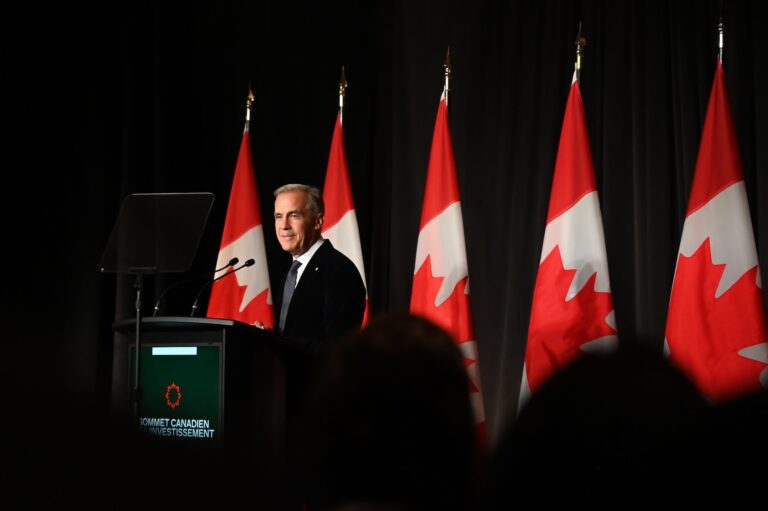
Canada pitched itself to the world’s biggest investors. Now comes the hard part

By David Reevely, Anita Balakrishnan, Murad Hemmadi, Chaimae Chouiekh, Claire Brownell and Kevin Carmichael
News

The Canada Investment Summit’s US$430B deal book, in charts

By Chaimae Chouiekh
Donald Trump holding up a board bearing the names of countries and tariff rates. He's standing behind a lectern bearing the U.S. presidential seal.
Analysis

The ‘red line’ in U.S. trade talks that sets Canada apart from other countries

By Joanna Smith
News

What Canada will pitch to the world’s investors at next week’s high-stakes summit

By Anita Balakrishnan, Chaimae Chouiekh, Murad Hemmadi and David Reevely

In-depth, agenda-setting reporting

Great journalism delivered straight to your inbox.

A nighttime shot of Donald Trump holding his hand while speaking. He's wearing a red hat with "USA" emblazoned on the front.
News

Trump steps up effort to block Canadian goods from U.S. procurement—but his order leaves a lot untouched

By Joanna Smith

Briefing

Mila and Mozilla launch project to make it easier to use open source AI

By Murad Hemmadi   |   Sep 17, 2026 | 3:59 PM ET

Alberta will revise its oil royalty regime to encourage new production

By Meghan Potkins   |   Sep 17, 2026 | 3:31 PM ET

Toronto-based AI health firm Altis Labs raises US$25M

By Catherine McIntyre   |   Sep 17, 2026 | 3:12 PM ET

Best business newsletter in Canada

Get up to speed in minutes with insights and analysis on the most important stories of the day, every weekday.

Exclusive events

See the bigger picture with reporters and industry experts in subscriber-exclusive events.

Membership in The Logic Council

Membership provides access to our popular Slack channel, participation in subscriber surveys and invitations to exclusive events with our journalists and special guests.

Recent Popular Stories

Analysis

The ‘red line’ in U.S. trade talks that sets Canada apart from other countries

By Joanna Smith   |   Sep 14, 2026
Donald Trump holding up a board bearing the names of countries and tariff rates. He's standing behind a lectern bearing the U.S. presidential seal.
News

Arlene Dickinson launches $500M fund to back Canadian agriculture firms in Southeast Asia

By Catherine McIntyre   |   Sep 14, 2026
An aerial photo of a combine harvester swathing its way through a field of barley.
News

What Canada will pitch to the world’s investors at next week’s high-stakes summit

By Anita Balakrishnan, Chaimae Chouiekh, Murad Hemmadi and David Reevely   |   Sep 9, 2026
News

Major partnership between Canada and EU on track for October reveal, says envoy

By Joanna Smith   |   Sep 9, 2026
A shot of Mark Carney and Ursula von der Leyen in front of an abstract painting with Canadian and EU flags on either side of it. Von der Leyen is speaking, and Carney appears to be shrugging at the camera with a sly smile on his face.
News

The Canada Investment Summit’s US$430B deal book, in charts

By Chaimae Chouiekh   |   Sep 15, 2026
News

Canada’s investment problem isn’t a lack of money, investors say at Milken Institute event

By Chaimae Chouiekh, Anita Balakrishnan and Murad Hemmadi   |   Sep 14, 2026

Canada's most influential executives and policymakers are reading The Logic

  • CPP Investments
  • Sun Life Financial
  • C100
  • Amazon
  • Telus
  • Mastercard
  • bdc
  • Shopify
  • Rogers
  • RBC
  • General Motors
  • MaRS
  • Government of Canada
  • Uber
  • Loblaw Companies Limited
logic-logo

Canada's Business and Tech Newsroom

100% human-crafted journalism

Newsroom

  • News Tips
  • AI Policy
  • Editorial Disclosures
  • Story Pitches

Company

  • About Us
  • Terms of Service
  • Privacy Statement
  • Corporate Information

Contact

  • Contact Us
  • Advertise
  • FAQs
  • Work at The Logic

© 2026 The Logic Inc. All Rights Reserved.

Trusted by leaders

Error

Account creation failed.

Please email us at [email protected].

Create Account

[wppb-register form_name=”cozmo-registration-form-for-modal”]

I do have an account
Login
or

[wppb-login]

I don’t have an account