TORONTO — U.S. and European leaders presented different visions for the future of artificial intelligence at the AI Action Summit in Paris Tuesday, turning an event that sought to balance innovation imperatives and safety concerns into a contest of major powers. Canada, meanwhile, has emphasized the need for co-operation.
Skip to content

News
U.S. claims AI for its own as Canada makes push for global co-operation
Vance takes aim at European regulation in Paris speech, while von der Leyen promotes safety-first approach and Trudeau calls for collaboration
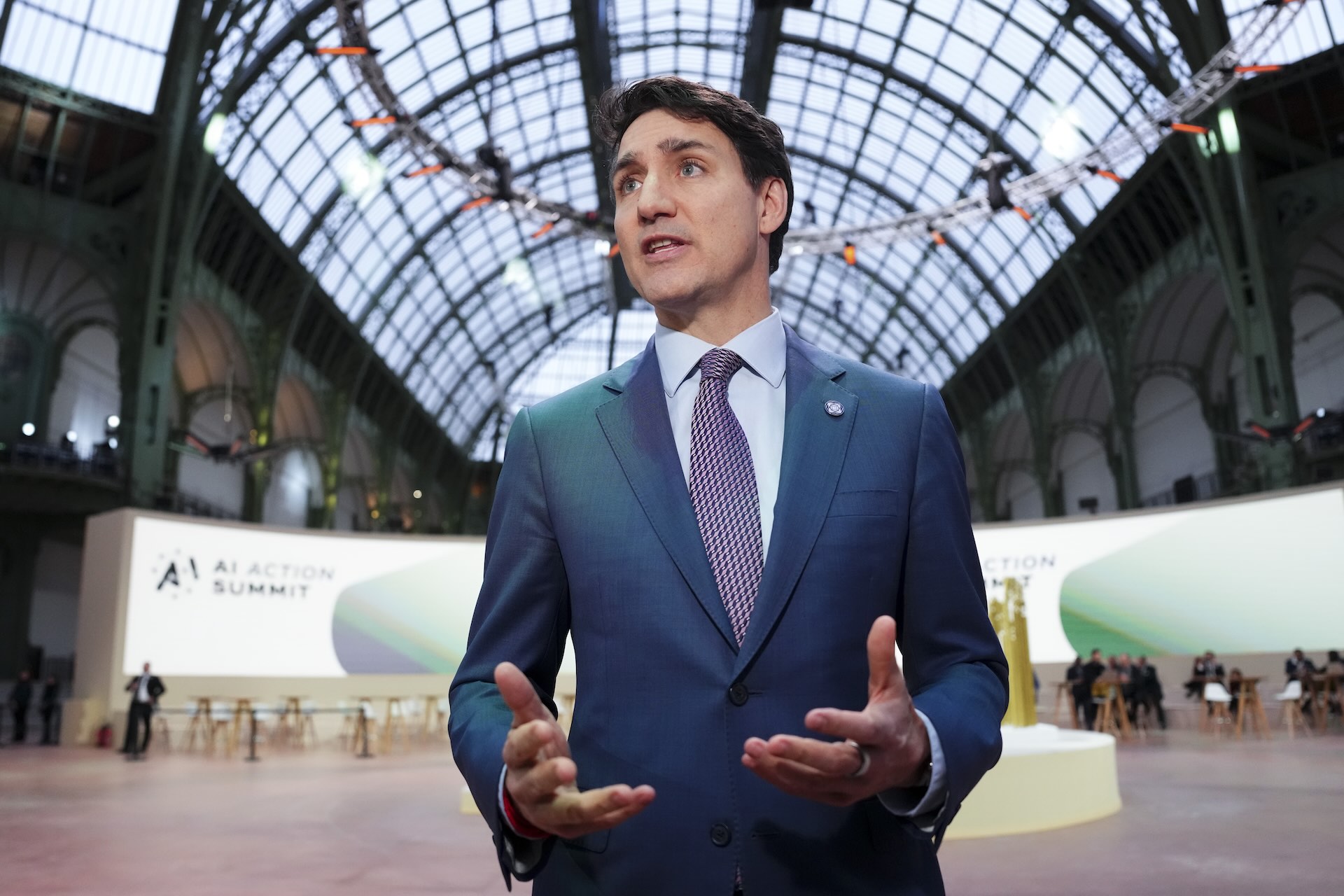
In what may be his last European trip as prime minister, Justin Trudeau went to Paris to make the case for Canada—and for co-operation. Photo: The Canadian Press/Sean Kilpatrick
TORONTO — U.S. and European leaders presented different visions for the future of artificial intelligence at the AI Action Summit in Paris Tuesday, turning an event that sought to balance innovation imperatives and safety concerns into a contest of major powers. Canada, meanwhile, has emphasized the need for co-operation.
Here’s what you need to know.
American AI: The U.S. intends to lead the way on AI, and will push internationally for “pro-growth” policies that allow the technology to spread, Vice-President J.D. Vance told world leaders including Prime Minister Justin Trudeau. “The Trump administration will ensure that the most powerful AI systems are built in the U.S. with American designed and manufactured chips,” he said.
Washington is keen to co-operate with other countries, but only if new international rules encourage the technology rather than limit it, Vance said. “We believe that excessive regulation of the AI sector could kill a transformative industry just as it’s taking off.”
Vance also warned other governments not to impose new requirements on U.S. tech giants. “America cannot and will not accept that.” He singled out the European Union throughout the speech, criticizing its data protection rules and the Digital Services Act, which governs how tech platforms deal with illegal content.
Related Articles


Domestically, President Donald Trump has repealed Joe Biden’s executive order that required AI developers to provide safety testing results and other information to policymakers. Trump has also backed efforts to build new U.S. computing capacity. In Paris, Vance repeatedly emphasized AI’s potential, citing improvements it could bring to manufacturing, health care and energy-generation. And he insisted AI will make workers more productive, not automate away their jobs.
The U.S. and U.K. did not sign the summit’s closing communique, a high-level list of objectives that included trying to reduce digital divides; ensuring AI is “inclusive, transparent, ethical, safe, secure and trustworthy”; and developing it sustainably. Participating governments also committed to co-operate on governance of the technology. Countries that did sign included other aspiring AI powers including Canada, China, Japan, Italy, and the United Arab Emirates.
Safety-first Europe: European Commission President Ursula von der Leyen struck an equally strong but opposite tone to Vance.
“We want Europe to be one of the leading AI continents,” she said according to the prepared text of her speech, disputing the idea that the U.S. and China have already raced ahead with the technology.
Von der Leyen said Europe’s version of AI focuses on complex industrial and manufacturing applications, on open-source models and on bringing together developers across different member countries. The bloc’s €10 billion ($15 billion) plan for shared public supercomputers will help support innovation, she said. “Our goal is that every company, not only the big players, can access the computing power it needs.”
But von der Leyen also emphasized the need for guardrails. “AI needs the confidence of people and has to be safe,” she said, touting the EU’s AI Act as a single set of rules across dozens of member states.
The bloc’s focus on safety extended to nomenclature—von der Leyen referred to the Paris event “the third summit on AI safety,” although its title doesn’t use the word. Nor did the conference in Seoul last April, although both are part of a series that began with the U.K.’s landmark AI Safety Summit in November 2023.
French President Emmanuel Macron used the stage to pitch his country as a site for AI data centres, noting that it has nuclear energy to spare. He’s already secured €109 billion ($161 billion) in commitments, including €20 billion ($30 billion) from Toronto’s Brookfield Asset Management.
Canada in the mix: In what may be his last European trip as prime minister, Trudeau went to Paris to make the case for Canada—and for co-operation.
Governments, industry and civil society must “think responsibly about how AI is shaping the world,” he said, citing the potential for machine-made disinformation and job losses. But he also acknowledged the need to “avoid the kind of heavy-handed regulation that stifles innovation.”
Like Macron, Trudeau touted Canada as a location for data centres. The Liberal government has proposed $15 billion in financing to attract investors to build new facilities in the country, and is currently rolling out a $2 billion program designed to increase compute capacity.
Also in France this week, Canada signed the first international treaty on AI, joining 12 other governments including the U.S. and EU. The Logic first reported in October that Ottawa was considering joining the Council of Europe’s framework convention on AI and human rights, democracy and the rule of law. The treaty commits signatories to ensuring AI systems are reliable, don’t discriminate and respect privacy.
AI is set to be a big focus of this year’s G7 Leaders’ Summit, which Canada is hosting in Alberta in June. In Paris, Trudeau outlined an agenda that includes generating more clean power to run the technology, as well as ensuring small firms and developing countries can adopt it. That will require Canada to get the U.S., France and other countries with differing interests on the same page; Trump notably rejected the communique when Canada last led the G7 in 2018.
“The path forward must be working together with like-minded partners as we maintain the competition that is healthy for innovation, but keeping in mind the requirements to keep people safe,” Trudeau said.



Loading...
Thanks for sharing!
You have shared 5 articles this month and reached the maximum amount of shares available.
CloseThis account has reached its share limit.
If you would like to purchase a sharing license please contact The Logic support at [email protected].
CloseGift the full article!
You have gifted 0 article(s) this month and have 5 remaining.
Recipients will be able to read the full text of the article after submitting their email address. They will not have access to other articles or subscriber benefits.
Photo: The Canadian Press/Sean Kilpatrick
Most Popular This Week




In-depth, agenda-setting reporting
Great journalism delivered straight to your inbox.
News
Anthropic revealed as client for EverWind’s $10B Nova Scotia data centre
Briefing
EverWind plans $10B data centre and wind development in Nova Scotia
Canada ready to force Stelco to sell its Canadian operations, Joly says
Feds plan a 60 MW defence-oriented data centre for Ottawa
Best business newsletter in Canada
Get up to speed in minutes with insights and analysis on the most important stories of the day, every weekday.
Exclusive events
See the bigger picture with reporters and industry experts in subscriber-exclusive events.
Membership in The Logic Council
Membership provides access to our popular Slack channel, participation in subscriber surveys and invitations to exclusive events with our journalists and special guests.






