A small Canadian shawarma chain has attracted praise from influential crypto figures for something off-menu: its business strategy of putting its entire cash reserves in Bitcoin.
Tahini’s, a Mediterranean-fusion shawarma chain founded in 2012 by two brothers in London, Ont., has developed a roster of unconventional shawarma flavours, like butter chicken and blueberry. The chain also began taking an uncommon approach to its finances in 2020, when it moved all its cash reserves into crypto. It’s a move that few companies have made, especially startups, which tend to reinvest profits into their growing companies.
Talking Points
- Tahini’s put all its cash reserves in Bitcoin, inspired and endorsed by MicroStrategy’s Michael Saylor
- The shawarma chain has developed a cult following in the Bitcoin community and is planning to open locations globally where it’s captured fans
- Critics say the strategy is risky for a company that should be reinvesting in its operations
“We like to take big, bold risks, and that’s what we did,” co-founder Ali Hamam said in an interview. “And we went all in with our company treasury, and it’s been one of the best decisions so far.”
Hamam and his brother were concerned about the potential devaluation of the loonie during the pandemic, and decided to follow in the footsteps of MicroStrategy’s former CEO Michael Saylor—one of the first and most notable business leaders to put billions of company funds in Bitcoin. Saylor himself endorsed Tahini’s strategy on a podcast, saying he’s a “big fan” of the chain. He later posted a photoshopped image of himself wearing a hat with the Canadian company’s logo on X.
“I’m inspired by Tahini’s. And I think they’re inspirational for a lot of other businesses,” Saylor said in an interview with “Once Bitten!” podcast host Daniel Prince in November 2020.
The billionaire stepped down from his role as CEO of MicroStrategy in 2022, after the company posted an almost US$1-billion loss when the value of Bitcoin dropped that year. He remained president of the company, and since then, MicroStrategy has continued to acquire Bitcoin and holds around US$30 billion in the cryptocurrency.
Hamam declined to disclose Tahini’s financials or the amount of Bitcoin it holds, given it’s a private firm. He said Tahini’s puts money into Bitcoin without taking on debt—which is different from Saylor’s leveraged strategy. Hamam said that a non-leveraged approach will serve the company better and reduce potential risks as they start to expand.
“I think Michael Saylor is more aggressive in his strategy,” Hamam said. “He’s taken out debt to buy more Bitcoin. We’re trying to be on the more conservative side.”
Bitcoin proponents tout its scarcity—a guarantee that only 21 million will ever be created is baked into its code—and freedom from government control as reasons they believe its value will continue to go up. The price of Bitcoin has swung to a high of around $80,000 in 2021, and then down to the $20,000s in 2022. It hit an all-time high of around $138,000 as of Thursday, after Donald Trump’s election win pushed up the price.
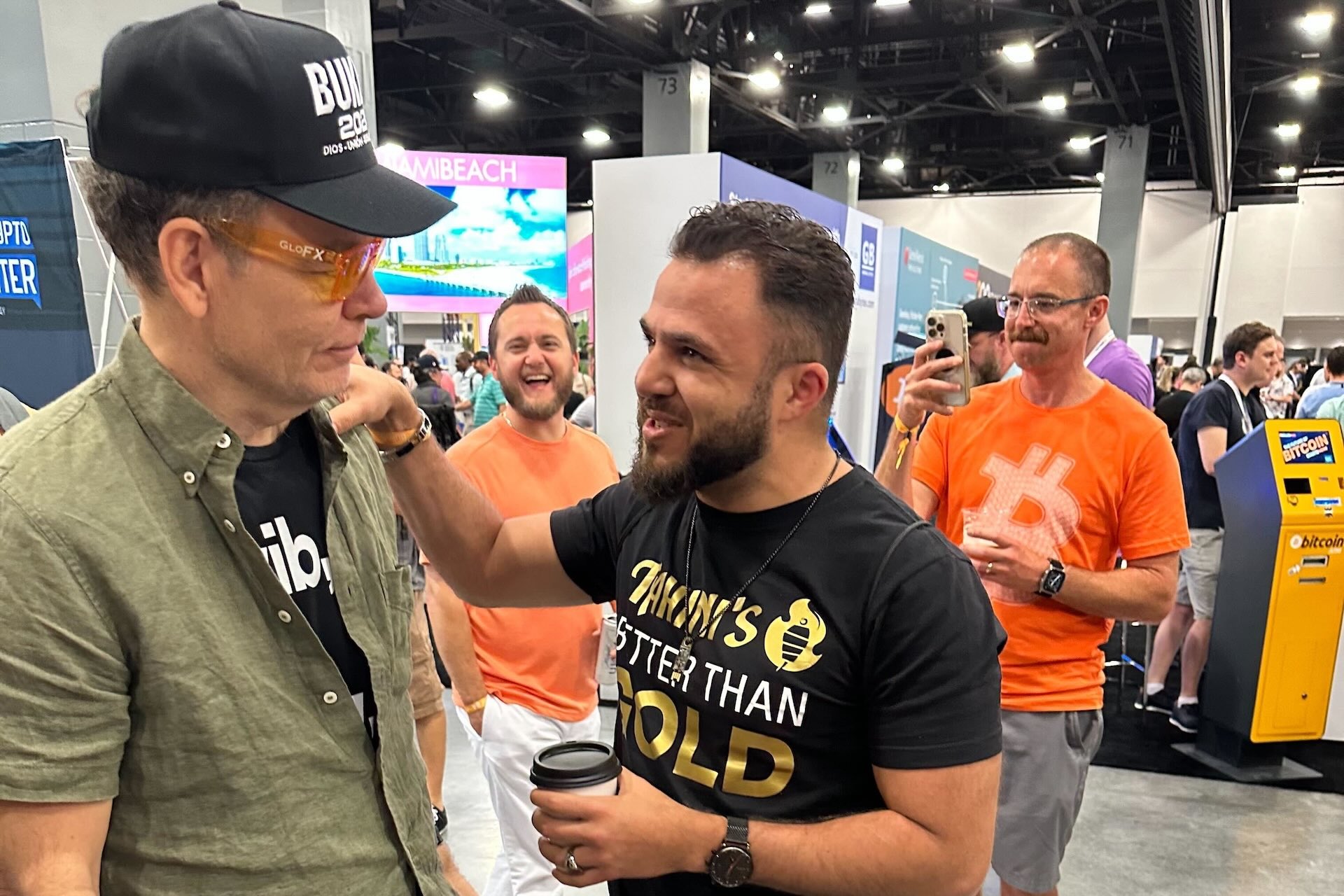
Tahini’s co-founder Ali Hamam speaks to former MicroStrategy CEO and crypto billionaire Michael Saylor at the Bitcoin conference in Miami. Photo: Handout
Crypto fans on social media have helped drive global interest in Tahini’s, the brothers said. A decade after opening their first restaurant, the franchise has millions of social media followers— with its YouTube account’s followers topping McDonald’s. The restaurant’s strategy has also seized the attention of another major crypto investor: American broadcaster Max Keiser.
Keiser, who calls himself the “high priest of Bitcoin,” publicly lauded the restaurant’s Bitcoin success, calling Tahini’s “charming” on a segment with state-controlled media RT (formerly Russia Today). Keiser is a major proponent of the cryptocurrency and worked with Nayib Bukele, the president of El Salvador, to adopt Bitcoin as the country’s legal tender.
Tahini’s founders were also friendly with Conservative Leader Pierre Poilievre, bringing him into one of their stores in 2022, where he purchased a shawarma using Bitcoin.
Previously, Poilievre had been outwardly in favour of cryptocurrencies and held a Bitcoin exchange-traded fund himself. Since the end of 2023, however, he’s quieted on the matter.
“We like to take big, bold risks, and that’s what we did.”
“We would do the same thing with somebody from the opposite party as well,” Hamam said. “We’re just trying to push the Bitcoin movement, and communicate that this is good for Canadians.”
Now with over 50 stores across the country, Tahini’s is plotting a global expansion, with plans to open locations across the U.S. in coming months. The chain’s foray into Bitcoin was what launched it into global crypto fame, and it’s mapped out its expansion based on where it’s seen interest from fans—the U.K., India, Pakistan, the Philippines and El Salvador.
“We just wanted to kind of test the waters, make sure that we’re doing everything properly,” the chain’s other co-founder and Ali’s brother, Omar Hamam, said. “We’re gonna hopefully expand all over the states.”
Tahini’s is not too concerned about price volatility of Bitcoin. It lets them buy the token when its price dips and will give them “a really good return” over the long term, Ali Hamam said.
With over 50 stores across the country, Tahini’s is now plotting a global expansion, with plans to open locations across the U.S. in coming months. Photo: Handout
But Tahini’s all-in approach may be risky. Traditionalists have rebuffed the idea of investing in cryptocurrency in general. Esteemed investor Warren Buffet has called it “rat poison squared,” and regulators have been proceeding with caution.
“No one can time the market perfectly,” said Wei Wang, finance professor and associate dean of the Smith School of Business at Queen’s University. It could indicate that they’ve got too much cash on hand, when it should be invested back into its operations, Wang said.
“It is always puzzling or even alarming if a company puts cash in a single investment such as crypto, because it tells you that maybe a company is keeping too much cash,” Wang said. “It’s hard to argue that they are making optimal decisions by putting money in crypto.”
Paul Calluzzo, another finance professor at Queen’s University, said companies will typically put their investments in assets that will give them a unique competitive edge—like a project or technology, he said. Or, like Warren Buffet, they have a track record of investing in undervalued stocks. But anyone can invest in a “speculative asset” like Bitcoin, he said.
“This feels like a situation where people are going to be left holding the bag and losing a lot of money,” he said.
But the Hamam brothers are confident in their strategy. “If you’re willing to invest in Bitcoin, you have to be OK with the volatility of it,” Omar Hamam said. “If you play the long game—it pays off.”