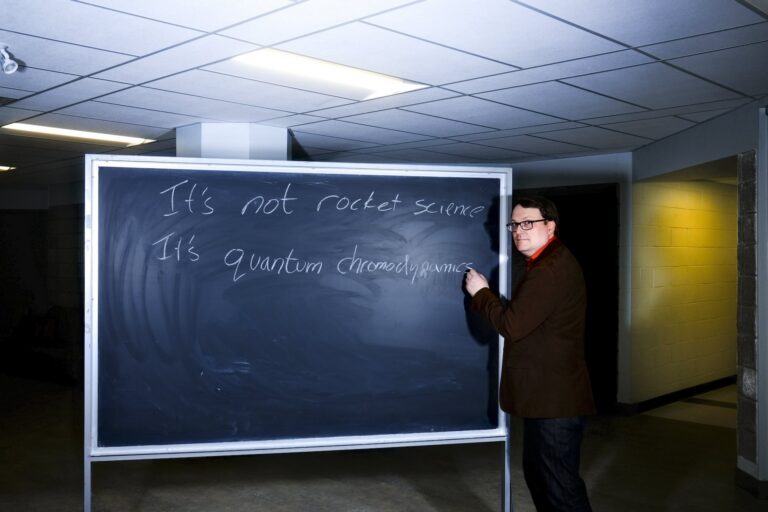
Marcela Carena has come to Waterloo, Ont. to lead what Canada will hope is the next physics revolution. As the new executive director of the Perimeter Institute, she has a complex task: to ask fundamental questions about fundamental science, without knowing what mysteries she might uncover.
Skip to content

The Interview
The Perimeter Institute’s new boss wants to wow you with physics
Marcela Carena takes over the research facility as fundamental scientific questions get harder to answer and governments push for more commercialization
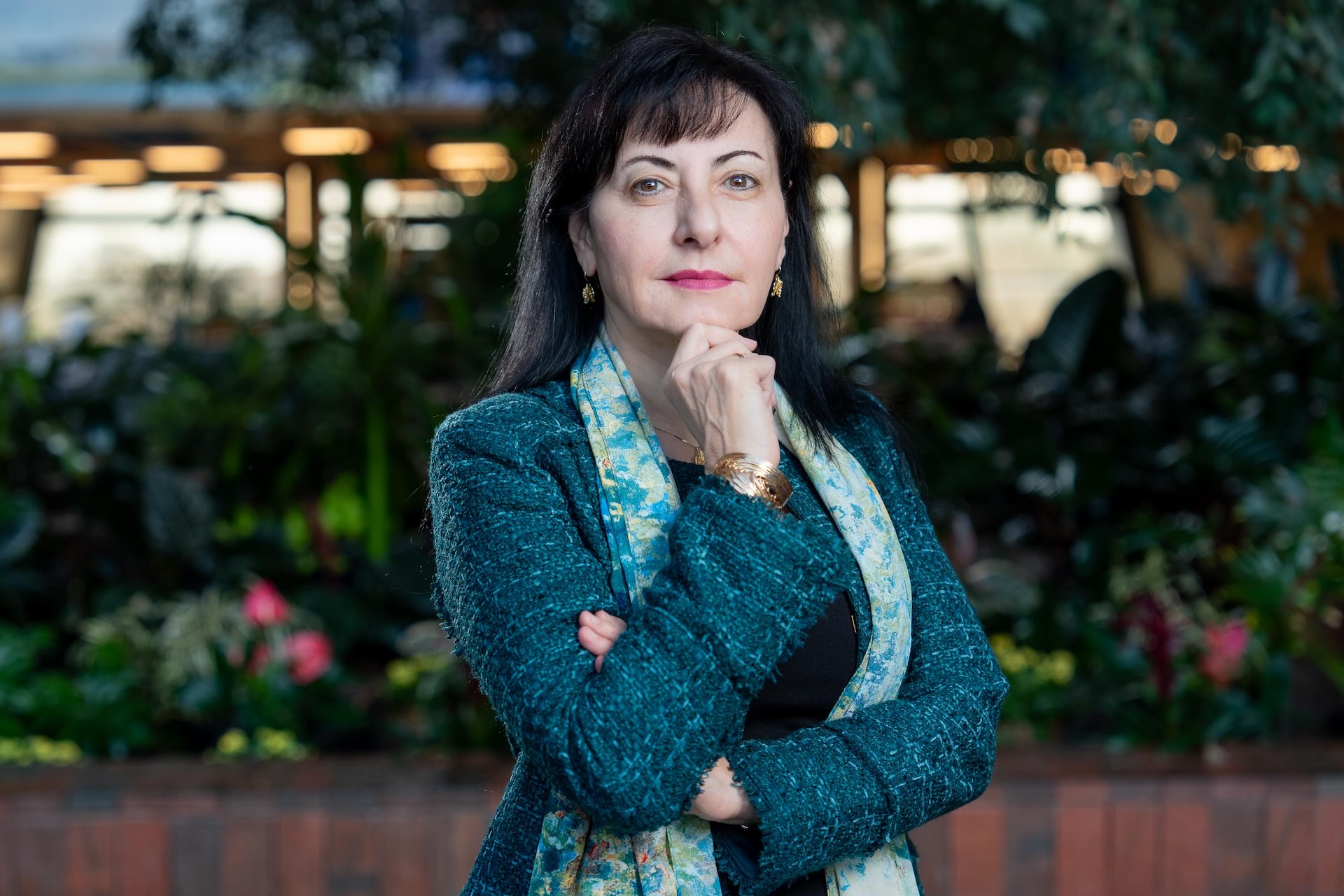
Marcela Carena joins the Perimeter Institute from the U.S. Department of Energy’s Fermi National Accelerator Laboratory. Photo: Dan Svoboda/Fermilab
Marcela Carena has come to Waterloo, Ont. to lead what Canada will hope is the next physics revolution. As the new executive director of the Perimeter Institute, she has a complex task: to ask fundamental questions about fundamental science, without knowing what mysteries she might uncover.
“We are doing exploration,” Carena says. “Not every time you go through a path, you find what you wanted.”
Talking Points
- Marcela Carena is the new executive director of the Perimeter Institute, a Waterloo, Ont. research centre where scientists are studying the properties of the universe and the matter that fills it
- Despite its theoretical nature, the partical physicist argues that fundamental science is a major contributor to new technologies, and she has a plan to keep the public on board
The Argentine particle physicist was previously head of the theory division at the U.S. Department of Energy’s Fermi National Accelerator Laboratory.
At Perimeter, scientists are studying the properties of the universe and the matter that fills it. Past work on quantum mechanics helped seed an ecosystem of research institutes and technology startups in the region around the University of Waterloo. These days, Perimeter’s remit includes quantum error correction, a process that could make super-fast computers reliable enough to use widely.
Carena is taking over at Perimeter as policymakers and funders push research institutes to commercialize more discoveries, and other fields previously dominated by academia like artificial intelligence escape the lab to find economic applications. Despite its theoretical nature, Carena argues that fundamental science is a major contributor to new technologies, and she has a plan to keep the public on board.
This interview has been edited for length and clarity.
Related Articles

Why did you take this job?
I hope I can create opportunities for theoretical physics that will be transformational for the way we understand our universe. The easy questions, we have answered most of them. Now we are left with the real tough questions. One way to say it is: Why we are here? The physics way to say it is: Why there is more matter than anti-matter in the universe?
There are many big questions we have. What was the origin of the accelerated expansion of the universe? We know that 85 per cent of all matter is what we call “dark matter,” because it interacts very feebly with us. But we have no clue what it is made of.
We have to go beyond our standard model of what we understand in physics. Perimeter allows this cross-cutting exploration, and has a very stable and strong funding profile, which allows for this unstructured approach.
What is it that Perimeter does differently?
A hundred years ago, all the questions in theoretical physics were asked from one perspective. As we evolve, we start being more specialized and dividing. I am an expert in particle physics. There are also people doing astroparticle physics, cosmology, quantum gravity, string theory. We are trying to ask very tough questions, so we need to get this cross-cutting among the different views of solving theoretical physics problems that then can be connected to the experimental excavations that we are doing.
Physics is inherently quantum, but we are looking at new approaches of quantum information science. Artificial intelligence and machine learning is in many ways a tool. We are maybe not doing groundbreaking new research, but we will use artificial intelligence in a way that will solve problems that are so difficult that we wouldn’t be able to solve it otherwise.
In Canada, at both the federal and the provincial level, we’ve seen a lot more focus on commercialization and applications of research. How does that fit with Perimeter’s goal of pure science research?
We are trying to answer complex questions. We try to tackle those questions using the laws of physics, and very sophisticated mathematical terms. It’s hard—we don’t have a clue where to go, so we have to explore a lot.
We get a team of strong scientists and theoretical physicists, trying to pose the most pungent questions. Then we go to our experimental friends, to see if our theories and ideas are correct. Because the questions are difficult, we need to develop new technologies that are not in the market to build the apparatus that will allow us to answer, or at least poke, the questions.
Think about the Large Hadron Collider. The technology [for] dealing with large data, micro-electronics, quantum sensing—everything is very advanced. To develop and produce it, we need to go to industry. At the end of this chain, the industries who have developed these technological advances think about other ways of using those for health-care, for security, for agriculture.
Of course, our goal is to answer these difficult questions, but it is very strongly linked to things that are super good for society. We need to explain this in a good way to those that are supporting us—private or public funding.
Do you need to keep announcing some huge physics breakthrough every few years to keep people interested in this world?
I think that would be underestimating the public’s capacity to be amazed.
I always tell this little story: When I was six years old, I would spend my summers in the countryside in Buenos Aires in Argentina. I remember with my cousins sitting in the nights, just looking up in the sky and seeing the Milky Way. We had no clue about the physics related to those stars or anything, okay? But it was breathtaking. The world we live in is breathtaking.
Dark matter is fascinating—it is what holds the universe together. We discovered the Higgs boson 12 years ago, in 2012. That is the reason that the electron—most people know it is the tiniest particle—has mass rather than not. The radius of an atom is inversely proportional to the mass of the electron, so if the electron would be massless, atoms would be infinite, and the universe we know would not exist.
There are so many mysteries; it only depends how we tell them to people. The Higgs discovery was big. From the time that Mr. Higgs first thought about it till the time it got discovered, it was almost half a century. It took 6,000 experimentalists building a machine for more than 20 years to be able to prove this idea.
My experience is when I [talk about] this to young kids in school, to high school kids, to business people, to people on the streets, they get excited.
Do you see breakthroughs coming in the next little while on the theoretical side of quantum error correction that could translate on the practical side?
If I could know that, I would be betting on it already.
We are trying to build what we call “quantum advantage,” so that quantum computers will solve problems that we cannot solve with the computers we have today. Certainly we are going to do big advances; we are doing advances constantly. But the way science is done is with little baby steps.
Do I expect important things to come from Perimeter? Certainly. Do I know what they are? No. But we are investing a lot. Canada is very well-positioned in quantum initiatives. One of the things I would like to explore, together with universities across Canada, is to unite our forces and brightest minds to see where the next new, breathtaking advancement in quantum will come.



Loading...
Thanks for sharing!
You have shared 5 articles this month and reached the maximum amount of shares available.
CloseThis account has reached its share limit.
If you would like to purchase a sharing license please contact The Logic support at [email protected].
CloseGift the full article!
You have gifted 0 article(s) this month and have 5 remaining.
Recipients will be able to read the full text of the article after submitting their email address. They will not have access to other articles or subscriber benefits.
Photo: Dan Svoboda/Fermilab
Most Popular This Week

In-depth, agenda-setting reporting
Great journalism delivered straight to your inbox.
Commentary
Carmichael: What Finland can teach Canada about sleeping next to an elephant
Briefing
Financing instability is slowing down Ottawa’s housing agency, CEO says
Cleveland-Cliffs CEO says federal lawsuit would be a bad business decision for Canada
BoC shows off its new forecasting model, Prima
Best business newsletter in Canada
Get up to speed in minutes with insights and analysis on the most important stories of the day, every weekday.
Exclusive events
See the bigger picture with reporters and industry experts in subscriber-exclusive events.
Membership in The Logic Council
Membership provides access to our popular Slack channel, participation in subscriber surveys and invitations to exclusive events with our journalists and special guests.