MILTON KEYNES, England — More than two-dozen governments, including rival powers the U.S. and China, committed on Wednesday to greater cooperation on ensuring artificial intelligence is made and used responsibly and safely.
Skip to content

News
Countries pledge more AI governance cooperation, new scientific network at U.K. Safety Summit
Canada, U.S. and China among nearly 30 governments to sign on
U.K. Secretary for Science Michelle Donelan and U.S. Commerce Secretary Gina Raimondo watch China’s science minister Wu Zhaohui speak on Nov. 1 at the U.K. AI Safety Summit. Photo: Getty Images/Leon Neal
MILTON KEYNES, England — More than two-dozen governments, including rival powers the U.S. and China, committed on Wednesday to greater cooperation on ensuring artificial intelligence is made and used responsibly and safely.
Canada was among the group of nations that also agreed to set up a scientific network to monitor AI advancements, the details of which have yet to be set down.
Talking Points
- At the U.K. AI Safety Summit at Bletchley Park, countries including the U.S., China and Canada called for greater collaboration to the risks of the technology and safety measures to address them
- Nearly 30 governments also agreed to establish a new scientific network to monitor advancements in the field
As the now-inaugural AI Safety Summit commenced at Bletchley Park, ministers talked up the technology’s potential—and its perils. Benefits could include curing cancer; harms the breakdown of societal trust, said U.K. Technology Secretary Michelle Donelan. There’s no consensus on how, when or even whether those risks will play out, she acknowledged.
Still, she told political peers, tech CEOs and civil-society representatives in attendance, “we have the resources and the mandate to uphold humanity’s safety and security.”
The summit, and the recent bout of concern about our species as a whole, trace back to November 2022, when much of the public had its first knowing encounter with advanced AI thanks to ChatGPT. Seeing the foundational models that power tools like that, luminaries in the field like the University of Toronto’s Geoffrey Hinton and Université de Montréal’s Yoshua Bengio shortened their timelines for AI to achieve human-beating, or at least human-competing, intelligence. And that heightened their level of concern.
At Bletchley Park, the program focuses on so-called frontier AI, shorthand for the largest models that can do the most things. “It’s a good first step for everybody to focus on the big companies,” said Mustafa Suleyman, CEO of Palo Alto, Calif.-based Inflection AI and a co-founder of DeepMind. But he acknowledged that “there are also a lot of near-term risks, which probably aren’t getting as much immediate attention.”
Related Articles
Some AI scholars have called the utopian and apocalyptic views of humanity’s AI future a distraction from the current need for regulation that would require transparency on generated media and prevent labor exploitation. Others say big tech firms are fear-mongering only so governments will implement regulations that stall smaller and open-source competitors. If they succeed, “a small number of companies from the West Coast of the U.S. and China will control [the] AI platform,” Yann LeCunn, Meta’s chief AI scientist, has predicted.
“We will compete as nations,” U.S. Commerce Secretary Gina Raimondo promised on stage at the summit. But she classed AI safety as a global problem in need of a collective solution, citing the precedent of nuclear weapons. “It requires us to do everything we can to make sure that this technology does not get into the wrong hands and is not misused.” The executive order President Joe Biden issued on Monday requires firms working on security-impacting AI systems to disclose safety data to the government. On Wednesday, Raimondo promised more international information sharing and research collaboration in pursuit of “policy alignment across the globe.”
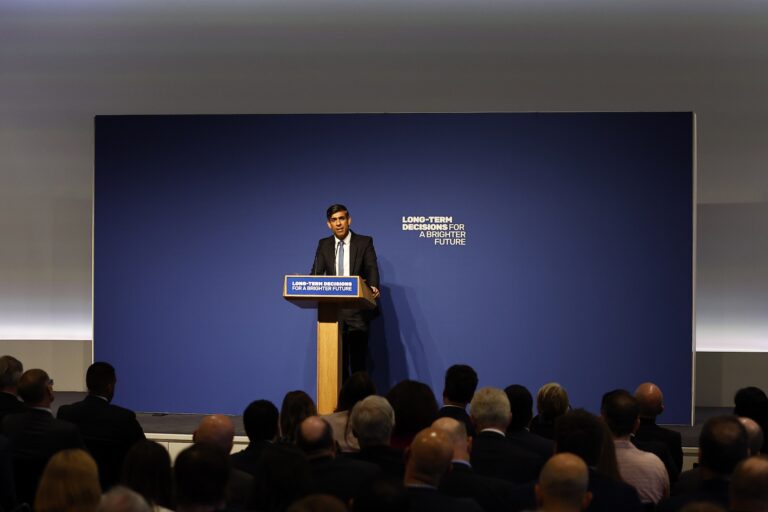
For now, the countries that signed the summit communique have agreed that AI should be made and used “in a manner that is safe,” and that they will roll out risk-based policies that include transparency and testing. And they’ll set up the new scientific network. While details of the initiative were not part of the announcement, British Prime Minister Rishi Sunak teased the concept last week when he called for a global expert panel to write a state of the science report. The U.K., U.S., EU and China, which have pursued differing approaches to AI and industrial policy, all signed.
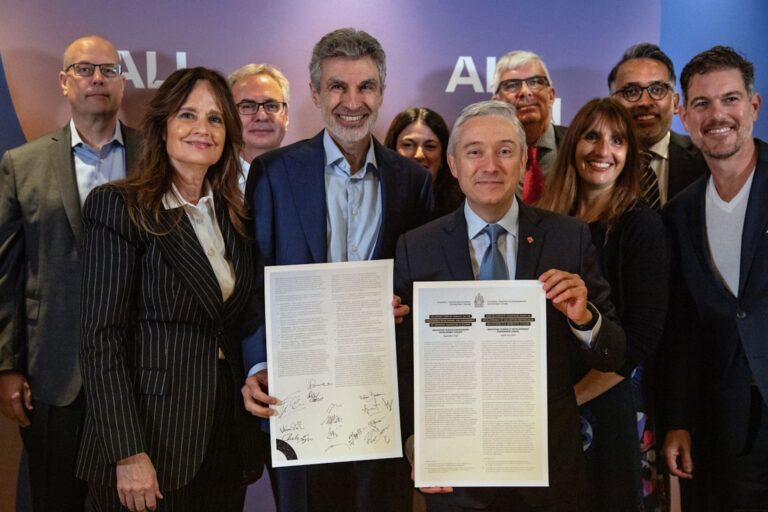
“There’s a broad consensus that we need to take action, both domestically and internationally,” said Innovation Minister François-Philippe Champagne, who chaired a roundtable on global safety risks. Domestic laws and codes of conduct are necessary—Champagne has proposed one of each in Canada. But “we need to converge,” he said.
Nations are also competing to lead the AI regulation conversation. The summit was a showcase for the U.K. bid, alongside a new safety institute. On Wednesday, the U.S. launched its own safety institute, housed in Raimondo’s department. With the summit underway in Milton Keynes, Vice-President Kamala Harris made a big AI speech, down the road in London. (Canada already hosts a responsibility-focused AI center, CEIMIA, one of two under the Global Partnership on Artificial Intelligence.)
At the AI Fringe, a festival of sorts staged around the main event at Bletchley, skepticism and realism about the summit mingled. Many there dismiss worries about existential risk as a misdirect, yet accept it’s what’s driving the conversation and brought everyone here, so they seem inclined to make the most of the moment.
This week’s AI summit is invite-only, with only 100 or so officials, executives and academics receiving gilt-edged emails. The limited guest list left plenty of boldfaced names to fill the fringe stages. (Some, like the Canadian-connected Sara Hooker of Cohere for AI and Yoshua Bengio of Mila, are doing both).
Up at the summit, politicians and tech executives filled closed-door sessions on the societal and safety risks of frontier AI, as well as who can do what to address them. They also networked. “People were mingling and making new relationships,” said Suleyman. “That’s how trust is built.”
Attendees also committed to keep the conversations going. South Korea will host an online summit in the next six months, and France an in-real-life one in a year. Of course, there’s another day of the summit itself still to come.
Whatever the outcome, the symbolism of Bletchley Park was hard to miss. The country house once held Britain’s wartime codebreakers. Alan Turing, the most famous, is perhaps most famous for designing a test for machine sentience. Reading the responses of a human and of a computer, can you tell which is which? More than 70 years later, that question—and the consequences that follow if the answer is “no”—hung over his old haunt.



Loading...
Thanks for sharing!
You have shared 5 articles this month and reached the maximum amount of shares available.
CloseThis account has reached its share limit.
If you would like to purchase a sharing license please contact The Logic support at [email protected].
CloseGift the full article!
You have gifted 0 article(s) this month and have 5 remaining.
Recipients will be able to read the full text of the article after submitting their email address. They will not have access to other articles or subscriber benefits.
Photo: Getty Images/Leon Neal
Most Popular This Week




In-depth, agenda-setting reporting
Great journalism delivered straight to your inbox.
Commentary
Carmichael: Being boxed in will help Canada focus on what matters
Briefing
Rio Tinto gets nearly $165M in additional federal funds for Quebec aluminum
U.S. to lift tariffs on some Canadian products crucial to Maine: Collins
Carney warns of tech dependence after Starlink disruptions in Ukraine
Best business newsletter in Canada
Get up to speed in minutes with insights and analysis on the most important stories of the day, every weekday.
Exclusive events
See the bigger picture with reporters and industry experts in subscriber-exclusive events.
Membership in The Logic Council
Membership provides access to our popular Slack channel, participation in subscriber surveys and invitations to exclusive events with our journalists and special guests.






