DETROIT — Hello from gate D5 at Detroit Metro Airport, where I’m waiting for my flight home after covering the North American International Auto Show.
A Ford factory just north of here in Wayne, Mich., is one of three locations the United Auto Workers targeted in what it calls a “stand-up” strike against Ford, General Motors and Stellantis, with nearly 13,000 workers walking off the job overnight as automakers failed to close a deal with the union and its about 150,000 members before their midnight deadline.
The prospect of labour unrest loomed over the industry’s signature North American event this week. It comes as workers’ cost of living skyrockets, while companies are plunging billions in profits into new technologies like electric vehicles and automation.
Why this time’s different: Unlike past strikes that have led to all-work stoppages at one “strike target” company, the stand-up strike starts with a few local branches at a time: as well as the Ford factory in Wayne, it’s hitting a GM plant in Missouri and a Stellantis plant in Toledo, Ohio.
The UAW has said an all-work stoppage is still on the table.
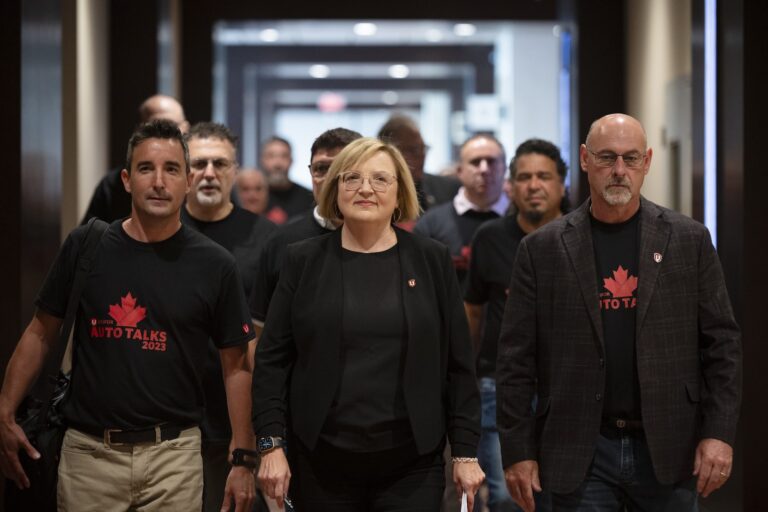
Meanwhile, in Canada: About 18,000 of Canada’s autoworkers under Unifor are bargaining with the Detroit Three in parallel with the UAW, which hasn’t happened since the 2008–2009 recession. Their deadline to reach a deal with Ford, the strike target, is Monday night.
Unifor National President Lana Payne told members yesterday Unifor is charting its “own course” amid “completely different” economic factors than those facing its U.S. counterpart.
In an interview with The Logic Friday, Payne said Unifor will bargain with Ford through the weekend. Meanwhile, she is watching the situation in the U.S. “hourly,” and checking whether the impact will spread to workers at Canada’s auto-parts plants that aren’t currently at the bargaining table.
Electricity in the air: Automakers’ push to quickly retool their plants to make EVs loom over the labour talks on both sides of the border.
EVs have fewer little parts than traditional autos, and thus may need up to 30 per cent fewer workers to make them, according to DBRS Morningstar analysts. The jury’s still out on whether that will prove true.
Union leaders are eyeing the wave of new EV battery plants—often joint ventures with tech giants like LG or Samsung—and want workers there to be paid competitive wages as well. Plus, Unifor wants members to get “transition support” if plants are closed for renovations as they switch to EVs.
Meanwhile, companies like Tesla, Prius-maker Toyota and Leaf-maker Nissan, plus major Chinese brands like BYD, don’t face the same pressure from unions.
The economic impact: Analysts at CIBC, citing consulting firm Anderson Economic Group, estimate that if all UAW workers were to go on strike, it would mean a total economic loss of more than US$5 billion, spilling over to dealers, parts makers and places where autoworkers shop.
The 2019 GM strike—the longest autoworkers’ strike since 1970—may offer a hint of what’s at stake. That strike cost workers an estimated US$1 billion in wages and cost GM nearly US$2 billion.
The impact was wide: Magna, which saw sales decline 3 per cent in 2019, cited the strike 16 times in that year’s annual results, while fellow Canadian auto-parts maker Martinrea estimated that the 2019 strike led to about $65 million in lost production sales during that year’s fourth quarter.