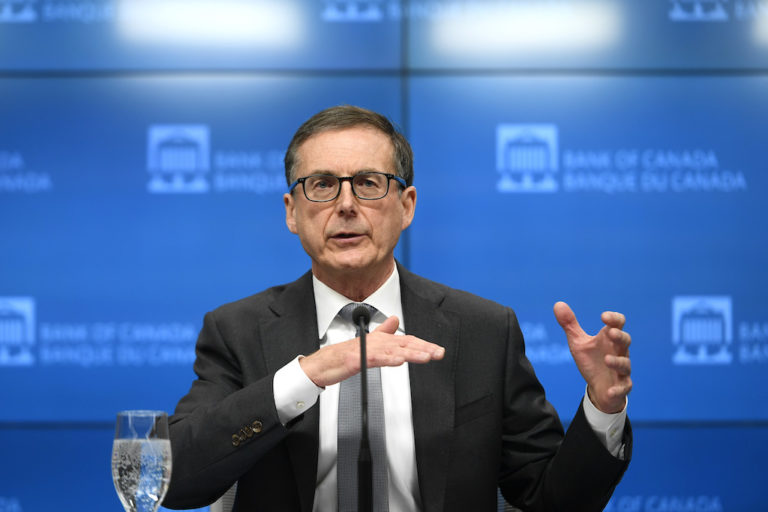
OTTAWA — The Bank of Canada raised its key interest rate another half-point Wednesday, to 3.75 per cent. That’s a smaller increase than the last two it’s imposed as it tries to suppress inflation, but still substantial, and the central bank said to expect further increases. It also updated its outlook on the Canadian and global economies.
Here’s what you need to know:
The economy is slowing faster: Higher interest rates are supposed to reduce borrowing and the needless part of the spending that borrowed money can cause. The trick is to do that without smothering the spending that leads to increases in genuinely valuable economic activity.
Since its last broad report on the economy in July, the bank has cut its forecast of Canadian economic growth over the next few years, from 2.6 per cent this year and 1.8 and 2.7 per cent in the next two years, to 2.1, 1 and 2.3 per cent.
“Growth is projected to essentially stall later this year and through the first half of 2023,” the latest take says, as businesses, homebuyers and consumers all pull back. The economy could even shrink, bank governor Tiff Macklem said in a news conference.
“Two or three quarters of slightly negative growth is just as likely as two or three quarters of slightly positive growth,” he said. “That’s not a severe contraction, but it is a significant slowing of the economy.”
Why: Much of the cause is global, according to the bank—the U.S. is tightening its money supply, energy prices are high in Europe and China’s COVID-19 lockdowns are squeezing the world economy.
Also, the costs of supply-chain disruptions and labour shortages “are now assumed to be permanent,” at least as far as the bank looks ahead. More expensive supply chains and difficult hunts for talent are a new normal.
But some is deliberate, the result of the bank’s policy choices, Macklem said.
“We need the economy to slow to rebalance demand and supply and relieve price pressures,” he said. “But once we get through this slowdown, growth will pick up, our economy will grow solidly, and the benefits of low and predictable inflation will be restored.”
What it means for inflation right now: Not as much as the bank would like.
“The Bank of Canada’s job is to ensure inflation is low, stable and predictable. We are still far from that goal,” Macklem said.
We’re still in “excess demand,” the state that leads to price increases for no increase in national wealth, and “the bank’s preferred measures of core inflation are not yet showing meaningful evidence that underlying price pressures are easing.”
What it means for inflation over time: Big-picture, the bank’s prediction is the same as it was three months ago—it expects the inflation rate to fall to three per cent or below by the end of 2023 and to the target of two per cent by the end of 2024.
What’s next: Continued “quantitative tightening” as the bank extinguishes government bonds it bought to prop the credit markets up at the beginning of the pandemic. And likely another interest-rate increase at the next update Dec. 7, the bank said, because its governing council is “resolute in our commitment to restore price stability.” Its margin for error to achieve that without causing real economic harm is getting smaller.