Two-thirds of respondents to The Logic’s latest subscriber survey say they would support an affordable housing plan even if it decreased their own property’s value, but they aren’t quite sold on the federal government’s supply-side solution to the housing crisis.
Skip to content




Subscriber Survey
Most of you would be willing to trade home equity for affordability
Respondents to The Logic’s latest subscriber survey aren’t totally sold on Carney’s plan to solve the housing crisis—but would be willing to take a hit on their property value to get it done
A rental apartment complex under construction, bottom, and houses are seen in an aerial view at a new housing development in Langford, B.C., Thursday, May 30, 2024. Photo: The Canadian Press/Darryl Dyck
Two-thirds of respondents to The Logic’s latest subscriber survey say they would support an affordable housing plan even if it decreased their own property’s value, but they aren’t quite sold on the federal government’s supply-side solution to the housing crisis.
Last month, Ottawa announced the first details on Build Canada Homes, the federal agency tasked with ramping up homebuilding. With an initial budget of $13 billion, the new organization is part of the government’s promise to double housing construction to 500,000 homes per year by 2035—a lofty goal meant to make housing more affordable.
Related Articles


Readers aren’t totally convinced: 40 per cent said Prime Minister Mark Carney’s plan will be partially effective, while about a quarter don’t think it will work at all. Several readers said it’s “nice to see action” of some kind, while others expressed skepticism about the strategy’s ability to address the “spiderweb of regulations” slowing construction, as well as securing provincial and municipal government buy-in, and funding enough non-profit housing.
“I am unconvinced that greater supply will have an impact on house prices in or near urban centres where young people increasingly want to live,” one respondent said. “Density is a necessity, but even then I remain unconvinced that the 65-plus crowd will be willing to realize non-multimillion-dollar gains on homes they purchased two generations ago.”
Housing minister and former Vancouver mayor Gregor Robertson has said that solving the housing crisis doesn’t require lowering prices, arguing that more supply and construction innovation will be enough.
Still, 66 per cent of respondents said they’d be willing to see their property value decrease in a plan to make housing more affordable.
“Housing is a basic human right. I don’t see my home as an investment,” one subscriber said. “I’ve already been incredibly fortunate to see the value of my home rise, but it’s purely down to luck and timing. I don’t want current and future generations to be left out of the housing market for the same reason.”
Several readers said they’d be on board with a price decrease for affordability if it were “within reason.” Others said they don’t own property, so it was easier to agree with such a hypothetical. One respondent said they wouldn’t want to see the cost of their house go down, as its value is tied up in their retirement—and price drops in their neighbourhood had already been “devastating to [their] plans.”
But several subscribers said such goals need not be mutually exclusive, and that housing affordability can be achieved with the right kind of supply. The federal government is making a similar bet by allocating $26 million in financing for modular and prefabricated housebuilders; types of housing the Liberals say can reduce construction times and costs by up to 50 per cent and 20 per cent, respectively.
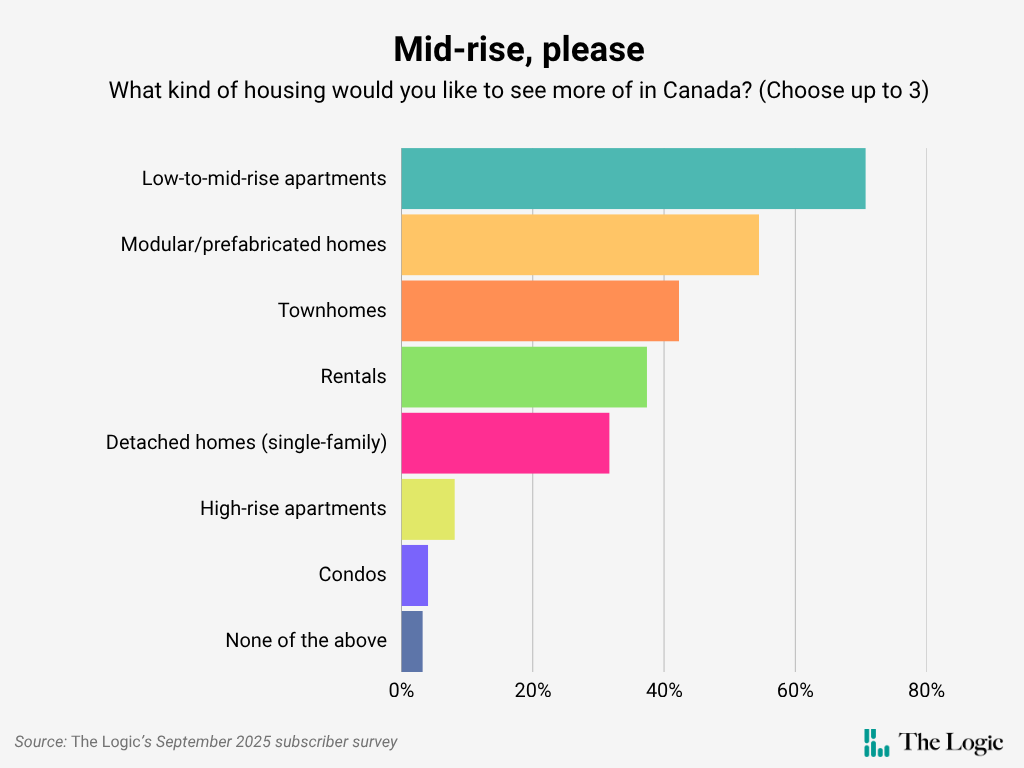
Asked what kind of homes The Logic’s readers want to see more of, 71 per cent of respondents said low-to-mid-rise apartments. Modular units were runner-up, with support from 54 per cent of respondents.
More than three-quarters of respondents said both public- and private-sector developers should build homes in Canada, but they were more split on outlook—32 per cent were optimistic and over 45 per cent were pessimistic that Canada can solve its housing crisis.
Some expressed doubt that different levels of government have the “political courage” and construction expertise to work together on housing, but a few were cautiously hopeful, citing the post-Second World War housing boom as evidence. “I am the least pessimistic I have been in a long time,” one said.
“There is a lot of inertia… but I have to believe we will have to shift to systems and strategies that make sense,” said another reader, “It will take 20 to 30 years, though. Two generations of neglect can’t be solved quickly.”



Loading...
Thanks for sharing!
You have shared 5 articles this month and reached the maximum amount of shares available.
CloseThis account has reached its share limit.
If you would like to purchase a sharing license please contact The Logic support at [email protected].
CloseGift the full article!
You have gifted 0 article(s) this month and have 5 remaining.
Recipients will be able to read the full text of the article after submitting their email address. They will not have access to other articles or subscriber benefits.
Photo: The Canadian Press/Darryl Dyck
Most Popular This Week




In-depth, agenda-setting reporting
Great journalism delivered straight to your inbox.
News
Dominic Barton’s next big job for Canada? Bringing home the money
Briefing
BMO, CIBC join cross-border blockchain experiment Project Agorá
Trade remains greatest ‘downside risk’ to Canada’s economic growth: Deloitte
AMD to acquire Radical Ventures-backed World Labs in US$8.2B deal
Best business newsletter in Canada
Get up to speed in minutes with insights and analysis on the most important stories of the day, every weekday.
Exclusive events
See the bigger picture with reporters and industry experts in subscriber-exclusive events.
Membership in The Logic Council
Membership provides access to our popular Slack channel, participation in subscriber surveys and invitations to exclusive events with our journalists and special guests.