CALGARY — When Jeff Allison launched Delta CleanTech in 2005, the carbon capture and storage industry was a sparse landscape. Heavy emitters were hesitant to pour big investment dollars into the emerging technology, and the Calgary-based engineering startup had to sustain itself on small demonstration projects for more than 10 years to keep the lights on.
Skip to content


News
How Calgary’s Delta CleanTech is eyeing a boom in carbon-capture deals
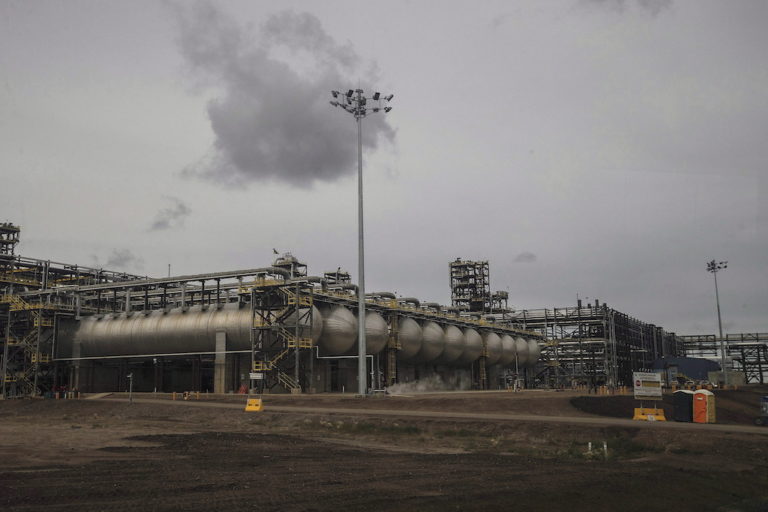
Delta CleanTech's modular carbon-capture unit installed at Enmax’s Shepard Energy Centre in southern Calgary. Photo: Handout/Delta CleanTech
CALGARY — When Jeff Allison launched Delta CleanTech in 2005, the carbon capture and storage industry was a sparse landscape. Heavy emitters were hesitant to pour big investment dollars into the emerging technology, and the Calgary-based engineering startup had to sustain itself on small demonstration projects for more than 10 years to keep the lights on.
Talking Point
Early developers of carbon capture and storage have had to wait a long time for their technologies to become relevant. But increasingly stringent emissions-reductions targets and a flood of subsidies for carbon-sequestration developments could finally spur rapid growth in the sector.
But Allison’s fortunes appear to be turning. The Canadian government has said it will introduce a new tax credit to incentivize major carbon capture, storage and utilization (CCUS) projects, kicking off a wave of proposed developments. Analysts at BMO estimate that oil-sands companies alone will have to spend $90 billion on new projects and infrastructure by 2050 to reach their net-zero targets, most of which will come through CCUS. Delta is currently reviewing about 50 inquiries from potential CCUS developers, Allison said, more than it received in the last decade combined.
“I like to say that we’ve been in the business for 17 years, and we’re an overnight success,” Allison said.
Delta, which has developed its own solvent-based carbon separation technology, is one of the carbon-capture technology pioneers that could be poised to reap the benefits of a potential boom.
Others include Calgary’s Entropy, a subsidiary of oil and gas producer Advantage Energy that designs modular carbon-capture facilities, and Burnaby-based Svante (formerly Inventys), which was established in 2007 and has partnered with companies including Cenovus Energy. The oil-sands giant used Svante’s technology at its Pike Peak South carbon-capture demonstration project near Lloydminster, Sask. Svante did not respond to The Logic’s interview request.
Delta’s technology takes CO2 from a facility’s exhaust and redirects it through a series of cylindrical tanks. The CO2 is first mixed with liquid solvents (similar to how carbonated drinks are made), then isolated from the mixture through a heating process. The separated CO2 is stored while the solvents are recycled.
The company’s carbon-capture technology designs have been installed in upward of 20 commercial projects spanning the U.S., China, Norway, Italy and elsewhere, Allison said. Its technology has been used at the giant coal-fired Ferrybridge Power Station in the U.K. and at Enmax’s Shepard Energy Centre in southern Calgary. It has also built a number of smaller pilot plants over more than a decade.
“We kind of survived over the last 10 years by doing small commercial projects, demonstration plants, a lot of things that paid the bills but we weren’t necessarily as successful as we wanted to be,” he said. “We think that that’s changed substantially now, and there seems to be a serious motivation to move ahead.”
Allison said the recent CCUS momentum has been driven primarily by rising pressure on the financial community to invest in assets with an eye to environmental, social and governmental considerations.
At the same time, governments in Canada, the U.S. and elsewhere have introduced tax credits and other subsidies in an effort to spur carbon-capture development.
The Alberta government has fielded bids from a number of would-be CCUS developers, and in April it selected its first six projects near Edmonton that are permitted to advance under the province’s regulatory review process.
Oil-sands companies including Cenovus, Suncor Energy, Canadian Natural Resources and others have submitted a proposal under a separate bidding process and plan to build a massive $13-billion sequestration hub in northern Alberta. It remains to be seen how many of the proposed projects actually move ahead, as industry representatives have said they are still contending with high construction costs and an uncertain regulatory environment.
In 2021, there were 27 CCUS projects in operation across the globe. According to Rystad Energy, a Norwegian research firm, that number could leap to 193 projects by 2030, capturing 270 million tonnes per annum of carbon emissions, up from 53 million today. The group expects that the Canadian energy sector, for its part, will invest $6.4 billion in CCUS projects between now and 2025.
Allison said Delta has already inked agreements on five commercial CCUS projects in North America this year, but declined to specify those developments, saying they are commercially sensitive.
That’s not to say investor enthusiasm has followed: Delta’s stock has plummeted on the Canadian Securities Exchange from its August 2021 debut price of 60 cents per share, and was trading at five cents as of Friday’s close.
The latest surge in carbon capture activity more broadly was a long time coming, Allison said. A few years before Allison launched Delta, then-U.S. president George W. Bush pulled out of the Kyoto Protocol, marking a major setback for international cooperation on emissions reduction.
But by 2006 the momentum had begun to swing in the other direction. Early that year, ExxonMobil CEO and later U.S. Secretary of State Rex Tillerson acknowledged the severity of the climate change problem in an interview with The New York Times, and former U.S. Vice-President Al Gore released the documentary An Inconvenient Truth, which detailed the damages caused by climate change.
Allison said that even with that momentum, it took well over a decade before governments decided to take major action. That in turn slowed the adoption of low-emissions technology like carbon capture and storage.
“At the end of the day, the governments didn’t follow through. They didn’t make it hard enough on the emitters,” he said.
While he believes oil and gas producers have made enormous strides in recent years to incorporate ESG protocols and commit to net-zero emissions targets, he says adoption of carbon-capture technology has generally come later than it could have. The federal government now expects its tax credit program will cost taxpayers $7.1 billion between now and 2030 as they look to spur new CCUS developments.
“The oil patch in the past has put their head in the sand somewhat and said this is too costly, and now they’re paying the price.”



Loading...
Thanks for sharing!
You have shared 5 articles this month and reached the maximum amount of shares available.
CloseThis account has reached its share limit.
If you would like to purchase a sharing license please contact The Logic support at [email protected].
CloseGift the full article!
You have gifted 0 article(s) this month and have 5 remaining.
Recipients will be able to read the full text of the article after submitting their email address. They will not have access to other articles or subscriber benefits.
Photo: Handout/Delta CleanTech
Most Popular This Week


In-depth, agenda-setting reporting
Great journalism delivered straight to your inbox.
News
Takeovers are shifting control of Canadian firms abroad, survey shows
Briefing
OMERS posts 4.8% first-half return, plans to increase Canada exposure
Brookfield joins investors group backing Nvidia’s US$500B AI financing push
Polar raises US$215M for second Canadian risk-transfer fund
Best business newsletter in Canada
Get up to speed in minutes with insights and analysis on the most important stories of the day, every weekday.
Exclusive events
See the bigger picture with reporters and industry experts in subscriber-exclusive events.
Membership in The Logic Council
Membership provides access to our popular Slack channel, participation in subscriber surveys and invitations to exclusive events with our journalists and special guests.