OTTAWA — When the James Webb Space Telescope takes off from French Guiana in the nose of a European Space Agency rocket later this month, the countdown begins for Neil Rowlands.
Skip to content

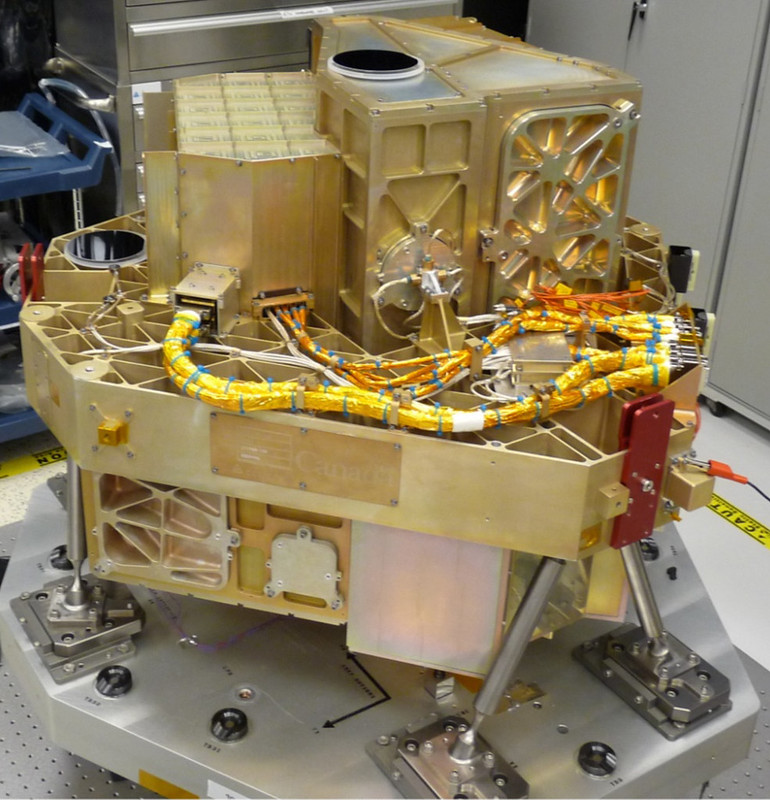 The flight model of the James Webb Space Telescope's Fine Guidance Sensor undergoing cryogenic testing in July 2011. Photo: COM DEV Canada/NASA
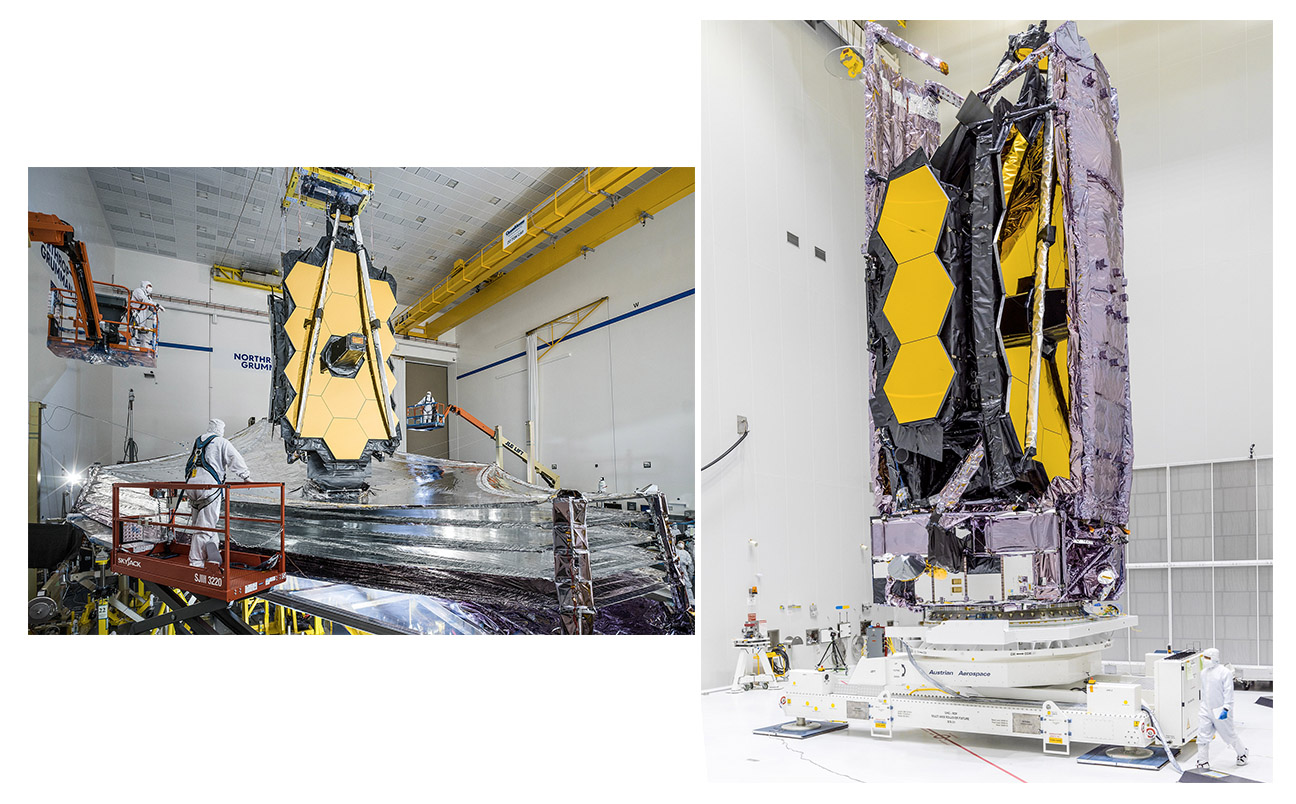 Left image: The Webb telescope in its final series of deployment and checkout tests before the observatory was packed for shipment to French Guiana for launch. Taken in December 2020. Right image: The telescope inside the clean room at its launch site at Guiana Space Center, in French Guiana. Taken in October 2021. Photo: NASA/Chris Gunn
The Big Read
Canada’s critical parts in ‘the most complex machine that was ever built,’ and what they get us
The flight mirrors for the James Webb Space Telescope undergo cryogenic testing at NASA Marshall. Taken in April 2011. Photo: Ball Aerospace/NASA
OTTAWA — When the James Webb Space Telescope takes off from French Guiana in the nose of a European Space Agency rocket later this month, the countdown begins for Neil Rowlands.
His team at Honeywell Canada made one of the four imaging devices on the orbital observatory that’s expected to take over from the Hubble Space Telescope as humanity’s premier eye on the universe. Honeywell also made a vital device called the Fine Guidance Sensor (or FGS, since these parts all get their own capital letters in the space-engineering business) that’s to aim the telescope’s instruments ultra-precisely and keep them pointed in the right direction.
Talking Point
The James Webb Space Telescope is 14 years late and $9.5 billion over budget, but it’s soon to launch aboard a European Space Agency rocket. Canada’s contributions of a critical aiming device and one of its four cameras guarantee our scientists time on the orbital observatory—if everything works right.
It’s been 24 years since the company put in its first proposal for the project, Rowlands said. But despite the long wait, he said he’s not very worried about the launch, scheduled for Dec. 22. The European Ariane 5 rocket taking the telescope up is very reliable.
“It’s the next few days that’ll be exciting, once they start deploying things—and then our panic comes about 33 days after launch, when they turn us on,” Rowlands said.
The FGS and the imager (the Near-Infrared Imager and Slitless Spectrograph, or NIRISS) are Canada’s contribution to the device, and they’re buying Canadian astronomy projects precious observation time on what Els Peeters said is “probably the most complex machine that was ever built.”
The astronomer at Western University in Ontario is a lead researcher in one of the telescope’s first assignments, aiming it at a region of space called the Orion Bar, where new stars are blasting their surroundings with radiation.
“How young, massive, newly born stars interact with their surrounding cloud is something that happens across the universe,” she said. “Whatever is found for our specific targets can be used for the interpretation for distant galaxies, or even other types of star-forming regions close by. And so it has very widespread impacts and implications.”
Aside from helping humanity understand how planets are born, the observations will be part of the James Webb telescope’s shakedown process, finding out just what it can do and what its limitations are. The results are to be released quickly so other scientists with proposals can see how well the telescope works.
The Canadian devices are made at Honeywell facilities in Ottawa and Cambridge, Ont., Rowlands said. Honeywell (or rather Com Dev, which Honeywell bought in 2016, most of the way through the Webb project) had supplied an aiming device for another space telescope, the Far Ultraviolet Spectroscopic Explorer (FUSE), that went up in 1999, which gave it a leg up in helping with the new telescope.
“The main telescope in that case was in the ultraviolet wavelengths,” said Rowlands, an engineering fellow at Honeywell’s Ottawa facility who has spent most of his career on the Webb components. “We could pick up a good chunk of the field of view in visible light and then just image the stars and make sure we could centre on them and measure their position. So that [history] was definitely a help.”
But for the Webb, he told The Logic, “we had to make use of infrared detectors for this purpose, which really hadn’t been done.”
The Hubble Space Telescope orbits Earth at an average altitude of 569 kilometres; the Webb telescope is headed for a spot orbiting the sun where the sun’s gravity, Earth’s gravity and centrifugal force will keep the device more or less stable relative to our planet.
That point and its exquisite balance of forces swing around the sun along a track that’s like Earth’s orbit but farther out—about 1.5 million kilometres away. That’s nearly four times as far from Earth as the moon.
Once it heads out, nobody’s expecting to be able to touch it again. Unlike Hubble, which astronauts have repaired and upgraded several times.
“I would say that this is a general drawback of space systems,” said Martin Bergeron, the Canadian Space Agency’s manager of planetary exploration and astronomy missions. The capacity to look at the universe without a layer of atmosphere and bright light in the way is invaluable. “But on the down side, because of the long development time, already when you launch your electronics are outdated. That’s the very nature of what we do in space.”
The Webb telescope is to go into space folded up like origami so it can fit into the Ariane 5 rocket’s cargo compartment, which is 5.4 metres across.
Once it’s up, the telescope is to unfold a solar panel for energy and an antenna, that multilayered solar shield, a flap to keep itself steady in the solar wind of particles flying away from the surface of the sun, its instruments, and finally multiple hexagonal segments of its mirror, which is to reflect and focus light onto the telescope’s sensors.
The bigger the mirror, the more light it can gather and the finer the images it can make. Hubble’s primary mirror is 2.4 metres across; the Webb’s is 6.5 metres. It’s to take at least two weeks from the rocket launch to unfolding the mirror, and another two weeks to calibrate it.
The other Canadian component, the near-infrared imager and spectrograph, began as a different device called a Tunable Filter Imager (TFI, inevitably), Rowlands said. It’s meant to look for the signs of “first light” from incredibly distant, newly formed astronomical objects. But during its development, scientists realized they’d been planning to look for the wrong wavelengths.
“The predictions coming from Hubble [observations] kept changing and kept moving away from the wavelength range that we had designed to filter for,” Rowlands said.
Bergeron’s take is a little more critical: the TFI didn’t work right. “They did give it a go, funded by the Canadian Space Agency for many years, and they tried to make the instrument function properly. But at some point, it became apparent that they could not succeed,” he said.
Either way, the specs changed. The NIRISS reused many elements of the TFI plan. “They proposed something that was easier to [build], yet provided the desired science but in some different ways,” Bergeron said. “Innovation doesn’t necessarily come in a linear path. Sometimes you have to take a step back, go at it again and do this. So they did not have as much time then, but they succeeded.”
The Webb telescope is to look at some of the oldest, most distant objects in the universe, and at nearer objects with vastly improved resolution.
“With an old camera, if you take a picture from a crowd, each face would be one pixel. While if you take the new cameras, each face will be a million pixels,” Peeters said. “Our region [to be studied] is very close by so we can have a very detailed image of the entire region and how things change as we go further away from the star.”
For Bergeron, the most exciting prospect is to examine the atmospheres of planets around distant stars for evidence of life.
“We didn’t know [exoplanets] existed just 20 years ago. Now we’ve found quite a few, in the numbers of the thousands. And the question now is, for those that are similar to Earth, what is there? Can we better understand what’s there and how different are they from our own planet?”
One commercial use for the technology Honeywell developed for the Webb is in new communication satellites, which can use infrared beams to transmit information at many times the bandwidth of radio-frequency communication, Rowlands said. The infrared aiming technology in the Fine Guidance Sensor could help two such satellites lock onto each other.
This has not been cheap. Originally budgeted at US$500 million, the telescope’s total estimated cost is now nearly US$10 billion. Canada’s contribution has reached $177.8 million for the components. Our space agency is expecting to spend $31.6 million supporting research based on the Webb’s observations.
After all these years of delays, the telescope is finally at the launch site in South America.
Bergeron is a relative newcomer to the Webb project, but as the overseer of the Canadian scientific plans for it he said he sees making sure the next generation of scientists get to work with one of the most amazing machines humanity has produced as a key part of his job.
“This is building the Pyramids—really, it’s the Pyramids of our days, and there’s about 1,100 people that have contributed from Canada, so I think we are all very fortunate for their involvement.”



Loading...
Thanks for sharing!
You have shared 5 articles this month and reached the maximum amount of shares available.
CloseThis account has reached its share limit.
If you would like to purchase a sharing license please contact The Logic support at [email protected].
CloseGift the full article!
You have gifted 0 article(s) this month and have 5 remaining.
Recipients will be able to read the full text of the article after submitting their email address. They will not have access to other articles or subscriber benefits.
Photo: Ball Aerospace/NASA
The flight model of the James Webb Space Telescope's Fine Guidance Sensor undergoing cryogenic testing in July 2011.
Left image: The Webb telescope in its final series of deployment and checkout tests before the observatory was packed for shipment to French Guiana for launch. Taken in December 2020. Right image: The telescope inside the clean room at its launch site at Guiana Space Center, in French Guiana. Taken in October 2021.
Most Popular This Week


In-depth, agenda-setting reporting
Great journalism delivered straight to your inbox.
Commentary
Carmichael: Canada’s biggest companies aren’t wired for growth. That’s a problem for us all
Briefing
Stellantis considering selling Ontario factory, union says
Intellectual property from failed New Brunswick nuclear developer sold to Ontario’s Nuclea Energy
Drone maker Volatus reports revenue dip as it struggles with its supply chains
Best business newsletter in Canada
Get up to speed in minutes with insights and analysis on the most important stories of the day, every weekday.
Exclusive events
See the bigger picture with reporters and industry experts in subscriber-exclusive events.
Membership in The Logic Council
Membership provides access to our popular Slack channel, participation in subscriber surveys and invitations to exclusive events with our journalists and special guests.