TORONTO — A federal advisory group has urged the government to commit nearly $2 billion to ensure Canada capitalizes on quantum technologies, The Logic has learned.
Skip to content

Exclusive
Advisory council urges Ottawa to spend $2B to prepare for quantum disruption
Group says Canada should mirror a key Washington quantum program or risk falling behind, according to a letter obtained by The Logic
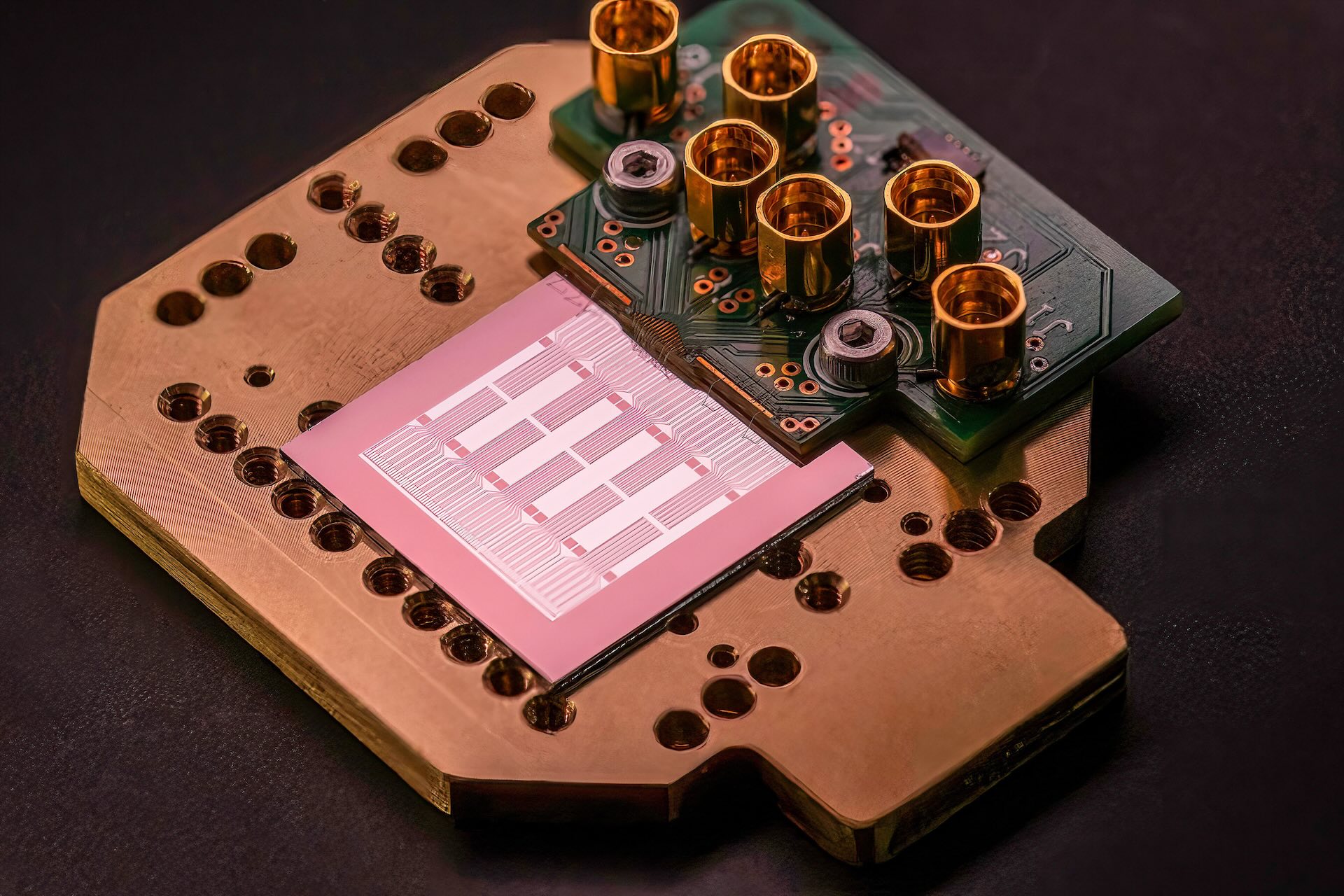
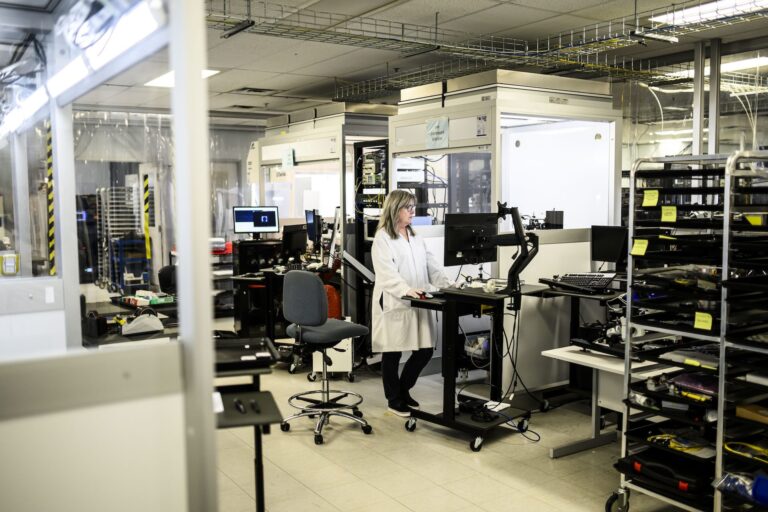
Photonic’s processors can be networked together using particles of light to form a quantum computer that could one day be capable of running complex applications. Photo: Photonics/Handout
TORONTO — A federal advisory group has urged the government to commit nearly $2 billion to ensure Canada capitalizes on quantum technologies, The Logic has learned.
In a letter to then-innovation minister François-Philippe Champagne on Nov. 1, 2024, the Quantum Advisory Council said that new programs are needed to ensure Canada builds up its quantum sector, secures government systems from devastating cyberattacks and to ensure that Canadian quantum firms don’t move to the United States. The Logic obtained the letter via an access to information request.
Talking Points
- The federal Quantum Advisory Council has recommended that the Liberal government launch a $1 billion program to match the U.S. Defense Advanced Research Projects Agency’s (DARPA) blockbuster Quantum Benchmarking Initiative
- Ottawa’s advisors say Washington’s program—which challenges firms to prove they can build a useful quantum computer—could crown the sector’s winner. The group is also calling for funding to boost quantum ecosystems in four provinces, and help prepare Canada for the security threats the technology poses
The letter cited the significant sums that the U.S., China and Germany, amongst others, are putting into the field. “The cost of inaction is tremendous,” the group wrote, citing Canada’s history of “inventing core technologies” but letting other countries “grow industries around our inventions.”
The centrepiece of the proposal is a $1-billion program that would mirror the U.S. Defense Advanced Research Projects Agency’s (DARPA) Quantum Benchmarking Initiative (QBI). The QBI requires participating firms to prove that their technology can produce a quantum computer capable of solving real-world industrial problems by 2033.
In April, DARPA announced it had picked 18 companies for the program’s first phase, including three Canadian ones in Sherbrooke, Que.-based Nord Quantique, Vancouver-based Photonic and Toronto-based Xanadu. Companies that make it through all three stages will receive up to US$316 million. “There’s a pot of gold at the end [that] is very enticing,” said Xanadu CEO Christian Weedbrook, citing the high cost of developing and building quantum computers.
Tech firms are pursuing several different approaches to quantum computing, so potential investors and customers can find it difficult to decide which to back or buy from. DARPA will provide that diligence by analyzing the developers’ scientific advances and R&D plans; firms that successfully make it through the program will effectively be crowned as the sector’s early winners. The QBI is “a kingmaker program that can’t be ignored,” said Stephanie Simmons, chief quantum officer at Photonic.
Related Articles

So far, DARPA hasn’t asked any of the three Canadian companies in the QBI to relocate to the U.S. or to give up ownership of their intellectual property, their founders say. But the federal advisory council’s letter and an accompanying memo briefing senior innovation department leaders warned that the QBI could pose some risks to Canada.
“Without a strong counter-weight, later-stage contract terms may force the winning organizations to ultimately move to the U.S.,” the letter claimed. It added that the QBI will give Washington deep technical and commercial information about the most promising quantum technologies and how to control them around the world.
That’s why Canada needs its own program, the advisory council argued. The letter proposed that the National Research Council of Canada use independent researchers around the country to assess firms’ technology and cut contenders that don’t advance quickly enough. This way, Canada can “conduct its own accelerated quantum race, doubling down on support for the most competitive approaches,” the advisory council said, predicting that “no more than three quantum companies, and likely fewer,” will make it through.
New AI Minister Evan Solomon reviews all the advisory council’s proposals, said innovation department spokesperson Andréa Daigle. While the government declined to comment on specific funding decisions, it “remains committed to maintaining Canada’s competitive position in quantum technology and supporting our world-class researchers and innovators,” she said.
In a speech at the Quantum Now conference in Montreal on Thursday, Solomon said the new Liberal cabinet is working on new programs and policies for the sector. “We cannot allow short-term funding opportunities to hollow out our domestic capabilities or transfer generations of Canadian innovation outside our borders,” he said.
Ottawa already has a $360 million national quantum strategy, first announced in April 2021. It includes $137.9 million in grants for scientific research, as well as $169 million for programs designed to help commercialize quantum discoveries.
The Quantum Advisory Council—which Simmons co-chairs and Weedbrook sits on—said its proposals build on that work and are based on consultations with industry and academia. Its letter calls for Ottawa to spend an extra $140 million over seven years on scientific research grants, plus $20 million for social scientists to study how to encourage the adoption of quantum technologies.
Another proposal suggests the federal government launch a quantum-focused version of its clusters program to encourage the growth of quantum ecosystems in Alberta, British Columbia, Ontario and Quebec. Under the plan, Ottawa would offer $15 million each for seven years to four organizations that bring together local universities, companies, investors and governments. The coalitions would jointly work on quantum research, testing, manufacturing, application development and skills training, as well as rules to ensure the technology is used ethically and securely.
Quantum computers also have security and defence implications. Cryptographers predict that the machines will one day be able to crack current encryption codes. The U.S. and Chinese governments have each claimed the other is harvesting huge amounts of currently secure data to decipher when the technology will be good enough to break encryption.
To avoid being compromised, governments and companies need to switch to new post-quantum cryptography, security agencies say. Canada needs to “pick a date” and go all in, Simmons said. If it doesn’t, the country risks “a completely disastrous cybersecurity event in the near future across all sectors,” the advisory council warned.
The letter called for Ottawa to spend $100 million on a new system that certifies that software is quantum-safe, and require government departments and firms in federally-regulated industries to only buy products that meet that standard from 2028. The group recommended spending another $190 million to develop other security systems.
The federal government will likely need to spend much more to make itself quantum-safe. In the U.S., officials project it would cost the federal government US$7.1 billion to switch to post-quantum cryptography by 2035.
By implementing the Quantum Advisory Council’s proposals, the group’s letter claimed, Canada can “unlock a massive opportunity” in an emerging field potentially worth hundreds of billions of dollars. To do that, it emphasized the need for Ottawa to move fast. DARPA is scheduled to launch the second phase of the QBI in August.
Beyond any direct economic benefits, the group said its proposals could help Canada meet its geopolitical goals. Nearly all the funding would count toward the country’s NATO commitment to spend two per cent of GDP on defence, the letter claimed, citing consultations with the defence department.
Prime Minister Mark Carney announced $9 billion in new funding this month to meet the NATO target this year, including $560 million for digital technology and cybersecurity. The Liberals have also proposed a new agency to get Canadian-made AI, quantum computers and other technologies into the Canadian Armed Forces and the Communications Security Establishment.



Loading...
Thanks for sharing!
You have shared 5 articles this month and reached the maximum amount of shares available.
CloseThis account has reached its share limit.
If you would like to purchase a sharing license please contact The Logic support at [email protected].
CloseGift the full article!
You have gifted 0 article(s) this month and have 5 remaining.
Recipients will be able to read the full text of the article after submitting their email address. They will not have access to other articles or subscriber benefits.
Photo: Photonics/Handout
Most Popular This Week




In-depth, agenda-setting reporting
Great journalism delivered straight to your inbox.
News
Transformer Lab has built an AI tool to automate scientific research
Briefing
Celestica completes US$3.45B share sale to meet demand for data-centre equipment
Sun Life pitches itself on Wall Street as an alternative to Blackstone, Apollo
MDA revenue jumps 34% in Q2, raises full-year outlook
Best business newsletter in Canada
Get up to speed in minutes with insights and analysis on the most important stories of the day, every weekday.
Exclusive events
See the bigger picture with reporters and industry experts in subscriber-exclusive events.
Membership in The Logic Council
Membership provides access to our popular Slack channel, participation in subscriber surveys and invitations to exclusive events with our journalists and special guests.