A group of Canadian immigration officers has created an electronic tool to process applications faster outside of the official case-management system. The tool was originally created without legal oversight, and Immigration, Refugees and Citizenship Canada has been using it to process applications for entry since March 2018 without disclosing to applicants its use or revealing the criteria programmed into the tool.
Skip to content

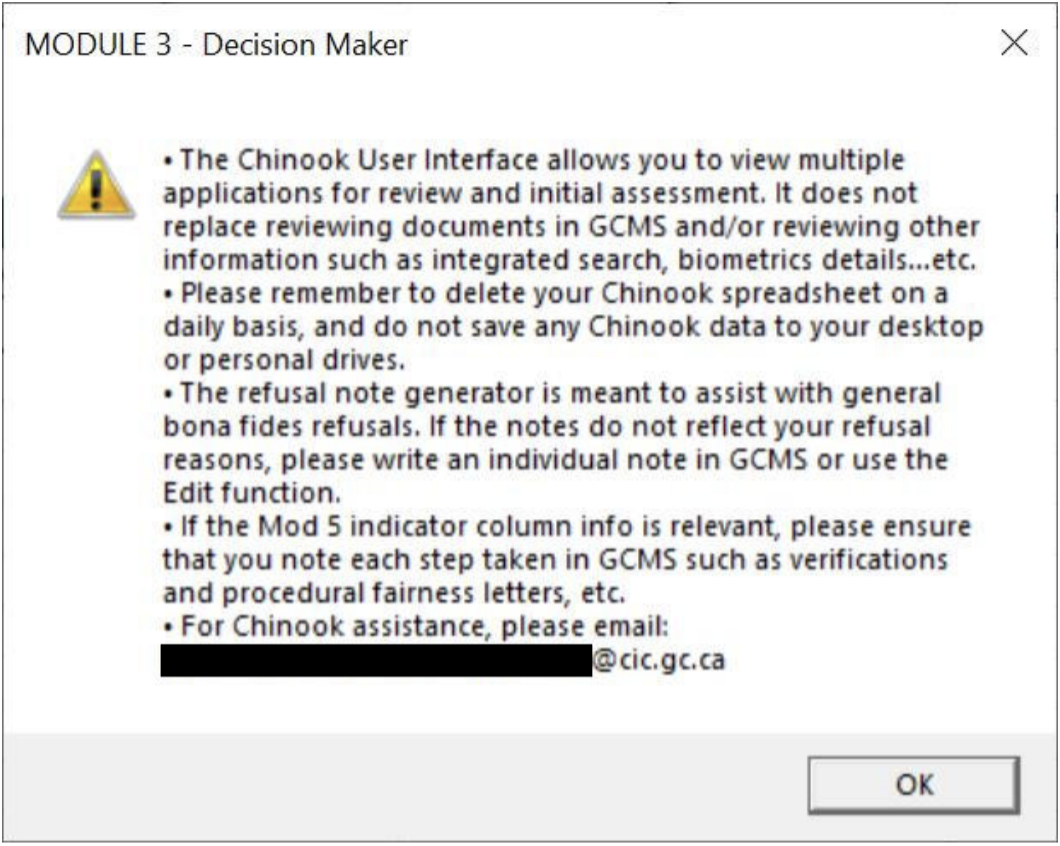 A “pop-up” window that is presented to decision-makers using Chinook. Photo: Court File No. IMM-6571-20

Exclusive
Internal IRCC tool to speed processing of immigration applications raises concerns among lawyers
A new Canadian holds a Canadian flag, their citizenship certificate and a letter signed by Prime Minister Justin Trudeau at a Canada Day citizenship ceremony in West Vancouver in July 2019. Photo: Darryl Dyck/The Canadian Press
A group of Canadian immigration officers has created an electronic tool to process applications faster outside of the official case-management system. The tool was originally created without legal oversight, and Immigration, Refugees and Citizenship Canada has been using it to process applications for entry since March 2018 without disclosing to applicants its use or revealing the criteria programmed into the tool.
The use of what one lawyer called a “black-box” tool, called Chinook, was publicly revealed in recent court proceedings. Immigration officers have used it to process applications for work permits, study permits and temporary-resident visas. No mention of it appeared on the website of Immigration, Refugees and Citizenship Canada, which documents these application processes, until earlier this year.
Talking Point
Court documents have revealed a tool called Chinook, created by IRCC officers to let them quickly process immigration applications, flag those they deem risky or low risk and that also suggested boilerplate text for rejection letters. An official said the tool was needed amid a surge of immigration applications that overloaded the existing system. Lawyers say IRCC should reveal more about how the tool works.
According to testimony in court, Chinook was created as a way around the “significant delays” IRCC officers around the world face when using the federal department’s official secure web portal, the Global Case Management System (GCMS), which involves long loading times in offices and limited network bandwidth.
The department told The Logic that Chinook is an “IRCC-sanctioned tool.” Immigration lawyers told The Logic its use raises questions about fairness and accountability in Canada’s immigration system. Some said they have seen an increase in the number of immigration applications being rejected with form letters that appear unrelated to their clients’ cases, especially clients from certain countries.
“We started to see the trend of people coming to see us with refusal letters that just didn’t look right,” said lawyer Will Tao.
“You just had [templated] language…. It sounded like the decision-maker wasn’t even looking at the documents in the case. But we couldn’t point to a reason why.”
He said the revelation of the existence of the digital shortcut shocked him, and changed his perspective of the immigration system.
“Chinook really connected the dots.”
In an affidavit filed in July as part of Abigail Ocran v. the Minister of Citizenship and Immigration, an ongoing immigration matter, Andie Daponte, IRCC’s director of international-network optimization and modernization, said he was part of a team of immigration officers with backgrounds in temporary-resident visa applications and in-house technical experts versed in “immigration processing or computer sciences” who created the first version of Chinook using Visual Basic for Applications in Microsoft Excel. In some IRCC offices, a web- or cloud-based version of the tool is now in use. According to Daponte’s subsequent testimony under cross-examination, it was initially developed without the oversight of legal experts.
Chinook collects immigration files en masse for “batch processes,” allows officers to “flag” what they consider high- or low-risk immigration applications, and helps draft rejection letters to hopeful immigrants and visitors.
One of those people was a resident of Ghana named Abigail Ocran. The letter from IRCC denying her application to come to Canada to study business administration at Calgary’s Bow Valley College offered, among others, two apparently contradictory reasons: one, that the third party she said would fund her studies was too remote of a connection to her—apparently not recognizing it was her Canadian maternal uncle, an arrangement allowed under immigration law—and two, because of her family ties to Canada, IRCC wasn’t convinced she’d leave the country when her permit expired. Challenging the decision in court, Ocran’s lawyer, Edos Omorotionmwan, said he found it “unintelligible,” and argued that the immigration officer should have recognized the problems with it, had they thoroughly reviewed her file.
After Ocran initiated her court challenge of the decision, the government disclosed it had used Chinook on her application.
Refusal rates on study permits have gone up since Chinook’s introduction, according to documents introduced in court. They were at 31 per cent in 2016, 33 per cent in 2017 and 34 per cent in 2018. Chinook was introduced in March 2018, and by 2019, the refusal rate had jumped to 40 per cent. In 2020, the refusal rate was 53 per cent, although there was a drop in application rates during the COVID-19 pandemic.
According to a court transcript, on the advice of Robert Gibson, counsel in the Department of Justice’s Public Safety, Defence & Immigration Law Group, Daponte did not answer a cross-examination question about whether this spike in refusals was due to the use of Chinook.
“OK,” Omorotionmwan then said. “The document tells us that since the introduction of Chinook, there has been a drastic increase in the refusal rate, and I think we all know why.”
Chinook’s effect on applications may be hard to measure. Court documents reveal IRCC has instructed officers using it to delete on a daily basis some of the records the tool creates. Because its use is optional, Daponte could not confirm how many IRCC officers were using Chinook, or which version.
The Logic asked IRCC why Chinook’s use had not been publicly disclosed, why its use was not disclosed directly to applicants, whether the tool had undergone a cybersecurity audit, why some of its files can’t be saved or redacted, and what oversight IRCC was providing to ensure officers were using it correctly.
IRCC did not directly answer these questions and declined a request for an interview, saying the full details were in the federal court documents. In an emailed statement, department spokesperson Isabelle Dubois called Chinook a standalone tool that streamlines administrative steps, and that the information in Chinook is all available in IRCC’s system of record. Despite having a decision-maker module, IRCC said Chinook is not a decision-making tool.
“Decision-makers are required to review all applications and render their decisions based on the information presented before them. Chinook does not fundamentally change the way applications are processed, and it is always the officer that gives the [rationale] for the decisions and not the Chinook tool,” wrote Dubois.
To make IRCC’s case-management software more “user friendly,” IRCC employees created Chinook to “extract” application information, such as gender, marital status, citizenship, age and purpose of visit, from GCMS into a spreadsheet, with multiple applications on a single report.
Daponte told the court the tool increased the volume of applications IRCC can process by as much as 35 per cent, after the department saw a 109 per cent increase in overseas temporary-resident applications, 147 per cent growth in overseas work-permit applications, and a 222 per cent spike in overseas study-permit applications between 2011 and 2019.
However, Tao, who has begun organizing a project to track potential uses of Chinook, believes the shortcut raises concerns about whether the immigration officers are actually reading applicants’ full immigration files, or bypassing some of the information in the longer documents.
For instance, immigration officers can create custom alerts to flag applications they deem high- or low-risk based on keywords used in the applicant’s file. It lets program assistants summarize factors like financial ability and travel history directly in the spreadsheet for reference by the officer who is ultimately deciding the applicant’s fate. While Daponte said the final decision maker has an obligation to review “everything” and ensure they agree with the assistant’s notes, Chinook does not track whether the final decision-maker goes back and views all the files in GCMS.
In Ocran’s case, much of the discussion centres on a Chinook module that suggests language to immigration officers drafting letters refusing visa and permit applications. The “notes generator” pops up when an officer decides to refuse an application, and generates suggested language for the refusal letter based on the officer’s response to a multiple-choice list of reasons for the rejection. The officers making the decision have the option not to use the boilerplate language, but according to Daponte’s cross-examination, there is no oversight function to ensure managers go back after the fact and review an officer’s decision process in Chinook.
Daponte said IRCC instructed officers not to save reports generated by the spreadsheet-making module, and to ensure they are deleted daily, because of privacy risks and because each spreadsheet would require significant redaction “prior to external disclosure.”
Instead of saving the files, officers copy and paste any reasons, risk indicators or flag words into GCMS. But they exclude one column of the spreadsheet: the officers’ working notes.
Tao said that he has habitually requested officers’ working notes when challenging IRCC decisions. “Before this came to light, it was one of the things that we started noticing more. The [access-to-information and privacy request] notes that used to be very detailed—multiple pages of information—started to get a little bit scarce,” he told The Logic.
In Ocran’s case, the government said the report put together by Chinook and used by the officer who rejected her application had not been retained and couldn’t be put into the court record, but was entered in a different format.
Immigration lawyer Zeynab Ziaie Moayyed said that if a lawyer can’t access an officer’s notes to piece together how they got to a decision from the documents, there may be no way for the court to review it.
Moayyed said there are potential benefits to a more nimble and user-friendly case-management system, including speed, lower costs and clear and objective standards. But she said many of her clients would rather pay higher application fees if it meant their file would be reviewed thoroughly by a trained officer given sufficient time to spend on each case.
Disputing refusals in court imposes a cost burden on both applicants and on the system, Moayyed said, but it may nonetheless become more common as use of the Chinook spreads, especially since IRCC has not disclosed what criteria Chinook uses to suggest language for refusal letters.
It’s unclear why the Justice Department decided to disclose Chinook’s existence in Ocran’s case, especially since the minister of citizenship and immigration claimed in court documents that the use of Chinook was “unrelated to the substantive merits” of the decision to refuse her visa application.
Tao said it seems like the government wanted an advisory opinion from a federal court judge to directly or tacitly endorse their approach. The Justice Department declined an interview request from The Logic, referring questions to IRCC.
Since Chinook’s creation, the immigration officers behind it have discussed “different aspects of the tool” with a legal team. But Tao believes independent legal experts need to oversee changes it. He points out that the way Chinook represents the data—isolating things like nationality and age outside the context of the person’s full story in the documents—puts potential triggers of discrimination front and centre.
“These officers can do what they want. They can create what they want for risk indicators; they can choose what they want to discriminate against a client,” Tao said. “It’s a powerful tool that’s then being disseminated to various visa offices around the world. But we know that these various visa offices around the world are not rendering consistent decisions.”
According to a listing on IRCC’s website, the department has agreed a roughly $1.8-million contract with professional-services firm Accenture to “develop and implement a Power Platform Minimum Viable Product to replace Chinook.” The department did not directly answer The Logic’s questions about the procurement process. Tao said that while he hadn’t heard of Chinook until a couple of months ago, he’s now watching Ocran’s case closely to see how the judge reacts to the government’s disclosure. Moayyed said a similar affidavit disclosed the tool’s use in a separate case earlier this year, but that it was settled out of court.
“I’m very curious to see what the final decision will be in Ocran—not the substance of the case, because that was just a study-permit refusal,” said Moayyed. “I’m curious to see what the court will comment on Chinook, if anything. Because there really wasn’t a lot of evidence in terms of how the system works. There was this one affidavit.”
Omorotionmwan, Ocran’s lawyer, has urged the court to focus its ruling on the strength of her application to move to Calgary to study, and to disregard Daponte’s affidavit explaining Chinook.
He declined The Logic’s request for comment, citing the ongoing litigation. But in court documents, he wrote that Chinook “smacks of a tool that was hurriedly put in place,” adding, “Based on the Chinook Model, the priority for visa officers has shifted from ensuring that applications are properly assessed to ensuring that applications are assessed in record time.”



Loading...
Thanks for sharing!
You have shared 5 articles this month and reached the maximum amount of shares available.
CloseThis account has reached its share limit.
If you would like to purchase a sharing license please contact The Logic support at [email protected].
CloseGift the full article!
You have gifted 0 article(s) this month and have 5 remaining.
Recipients will be able to read the full text of the article after submitting their email address. They will not have access to other articles or subscriber benefits.
Photo: Darryl Dyck/The Canadian Press
A “pop-up” window that is presented to decision-makers using Chinook.
Most Popular This Week



In-depth, agenda-setting reporting
Great journalism delivered straight to your inbox.
News
Cenovus announces $5.7B takeover of Athabasca, with a nod to Carney’s Mega Deduction
Briefing
Defence minister picks longtime CCI executive as new chief of staff
U of T launches $100M program to draw top-tier PhD students to focus on key social issues
Brookfield says there’s ‘enough to go around’ as it partners with rivals on AI investments
Best business newsletter in Canada
Get up to speed in minutes with insights and analysis on the most important stories of the day, every weekday.
Exclusive events
See the bigger picture with reporters and industry experts in subscriber-exclusive events.
Membership in The Logic Council
Membership provides access to our popular Slack channel, participation in subscriber surveys and invitations to exclusive events with our journalists and special guests.