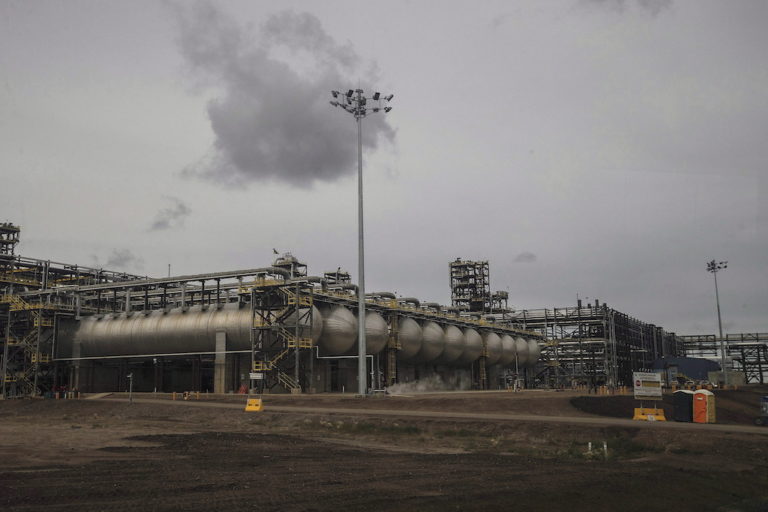
OTTAWA — Every year, Whitecap Resources squirts almost two million tonnes of carbon dioxide into its oilfield near Weyburn, Sask., keeping some of the waste gas from a coal-fired power plant and a North Dakota coal-gasification plant from venting into the atmosphere.
Skip to content

News
Federal parties’ plans for promoting carbon capture feature duelling incentives and punishments
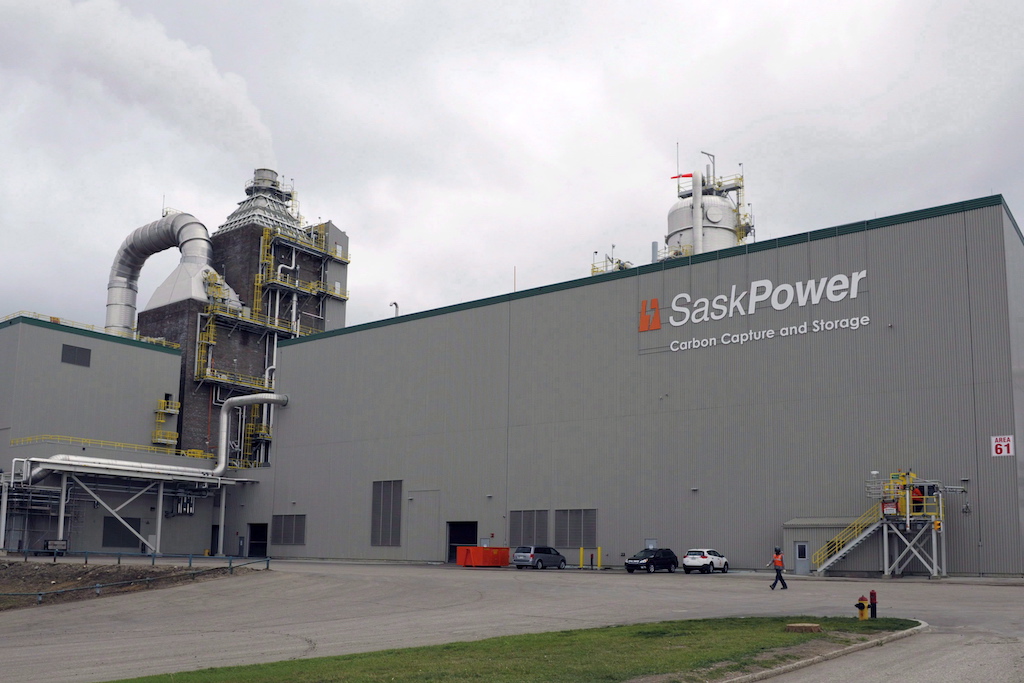
The SaskPower carbon-capture and -storage facility at the Boundary Dam Power Station in Estevan, Sask., in October 2014. Photo: The Canadian Press/Michael Bell
OTTAWA — Every year, Whitecap Resources squirts almost two million tonnes of carbon dioxide into its oilfield near Weyburn, Sask., keeping some of the waste gas from a coal-fired power plant and a North Dakota coal-gasification plant from venting into the atmosphere.
That’s half of the four million tonnes of CO2 that Canada captures and stores each year, and Whitecap’s CEO Grant Fagerheim says it could be a lot more.
Talking Point
Canada sequesters about four megatonnes of CO2 each year and both the biggest federal parties want it to be more. How to make that happen is a real divide between the Liberals and the Conservatives.
“If we have the policy and regulatory support from our federal government, we think they can take it up to nine million tonnes per year,” Fagerheim said in an interview with The Logic.
The Liberals and Conservatives now campaigning for votes both want to see a lot more carbon dioxide captured, used and stored, making explicit promises in their platforms for how they’ll support the effort.
In their last budget, the Liberals set a target of sequestering 15 million tonnes a year and promised tax incentives to help. They launched a government consultation in June on what those should look like. They also pledged research and development funding for Natural Resources Canada to develop new technology, totalling $319 million over seven years.
The Conservatives’ platform promises $5 billion in support for carbon capture, utilization and storage (CCUS), with extra incentives for companies that have projects running by 2030. For the Conservatives, CCUS is “a key part of what will allow our energy sector to become even cleaner and a major building block of the energy transition.”
“If I lean one way, I have to lean to the Conservatives,” Fagerheim said. “What they’re looking at is direct incentive programs.… We’re going to need to put in huge amounts of capital and that they have to do incentive programs that I believe to improve behavior.”
The main thing Fagerheim wants to see is a reliable market in carbon credits, so companies like Whitecap can make more money taking carbon dioxide off other people’s hands and putting it in the ground.
“In Canada, unless we have a similar, what we’ll call a credit market, to what the U.S. has, or even better, there won’t be a change in behaviour,” he said.
The Conservatives’ platform includes a pledge to set standards for natural carbon offsets “associated with land-management practices,” so they can set up a national carbon-offset market, though the Tory platform talks about that as an “eventual goal,” not an immediate priority.
By itself, CCUS won’t save us from a changing climate: Canada emitted 730 million tonnes of CO2 and its equivalents in 2019, and has an official target of 438 million tonnes by 2030.
In that light, 15 million tonnes is “certainly not transformative, but it’s not insignificant,” said Nic Rivers, a University of Ottawa associate professor of climate policy. Without carbon sequestration, cutting our emissions by an equivalent amount would be distinctly more expensive, he said.
The technology isn’t yet widespread. Rivers compared CCUS to nuclear fusion: a magnificent scientific advance whose proponents keep saying is just around the corner.
“We have thought that CCUS is going to play a big role, even as far back as 15, 20 years ago. And it hasn’t really materialized in a substantial way in Canada or around the world,” he said.
Alberta has built the Alberta Carbon Trunk Line, connecting a refinery and a fertilizer plant near Edmonton to an oilfield near Red Deer and using the plants’ waste gas to boost production. It’s operating at a fraction of its 14.6-million-tonne annual capacity, with the hope that the pipe will get new input and output locations in the coming years.
Saskatchewan was a world leader when it retrofitted a coal power plant with carbon-capture technology. The Boundary Dam 3 project near Estevan sends carbon dioxide scrubbed from its smokestacks to Whitecap’s oilfield to make the oil easier to pump, and it’s never quite lived up to the goal of keeping a megatonne of CO2 out of the atmosphere each year.
In June, the plant’s CO2 scrubber was turned off for maintenance, and then it broke down in July, according to SaskPower, so it’s operated well below its nominal capacity this year.
For scale, the carbon-capture technology at Saskatchewan’s coal plant cost about $917 million, according to Canada’s parliamentary budget officer, for the promise of up to one megatonne a year of reduced emissions.
“This is not a start-and-stop exercise,” Fagerheim said. “It’s going to take a very long period of time, and it’s going to take what I would call copious amounts of capital.”
Rivers said not burning fossil fuels for power at all is a much better way of reducing emissions from electricity generation than burning them and trying to catch the greenhouse gases. Solar and wind power have become much cheaper than anybody expected and are emissions-free.
“But there are sectors out there—I’m thinking of things like fertilizer production and aluminum production and steel production and cement production—where we don’t really have wind and solar as a potential to displace the CO2 production. These are areas where we need super-high-intensity heat that electricity can’t provide, or where there’s carbon emissions that go with the process rather than just providing energy,” he said.
Although the Liberal platform mentions carbon capture in several spots, including an explicit reference to “incentiviz[ing] clean innovation and the adoption of clean technologies, including [CCUS],” it doesn’t talk about putting any more money toward that end.
The Liberals’ incentives are largely negative: an order to petroleum companies to reach net-zero emissions by 2050, and the promise of a steadily rising carbon price, from $40 a tonne now to $170 a tonne in 2030. The NDP’s platform doesn’t speak to carbon capture specifically, but the party has backed the Liberals’ carbon-price plans.
Fagerheim, who is in the fossil-fuel business, prefers the government supports.
“It’s like your children, in that I don’t believe you get much better behavior if you penalize them on a continual basis,” he said.
But the promise of a rising carbon price is a mighty motivation, Rivers said.
“CCUS avoids the emissions of carbon and a carbon price charges people for the emissions of carbon, so it is a direct incentive, a direct monetary reason for people to invest in CCUS,” he said. “If there’s a $170-a-tonne carbon price, and every tonne of CO2 that I emit to the atmosphere I’m charged $170 for, that gives me a pretty big incentive to inject it underground rather than emit it.”



Loading...
Thanks for sharing!
You have shared 5 articles this month and reached the maximum amount of shares available.
CloseThis account has reached its share limit.
If you would like to purchase a sharing license please contact The Logic support at [email protected].
CloseGift the full article!
You have gifted 0 article(s) this month and have 5 remaining.
Recipients will be able to read the full text of the article after submitting their email address. They will not have access to other articles or subscriber benefits.
Photo: The Canadian Press/Michael Bell
Most Popular This Week



In-depth, agenda-setting reporting
Great journalism delivered straight to your inbox.
Commentary
Carmichael: Canada’s biggest companies aren’t wired for growth. That’s a problem for us all
Briefing
Stellantis considering selling Ontario factory, union says
Intellectual property from failed New Brunswick nuclear developer sold to Ontario’s Nuclea Energy
Drone maker Volatus reports revenue dip as it struggles with its supply chains
Best business newsletter in Canada
Get up to speed in minutes with insights and analysis on the most important stories of the day, every weekday.
Exclusive events
See the bigger picture with reporters and industry experts in subscriber-exclusive events.
Membership in The Logic Council
Membership provides access to our popular Slack channel, participation in subscriber surveys and invitations to exclusive events with our journalists and special guests.