As semiconductor shortages idled factories around the world in May, two Toronto chip companies got their unicorn horns. Canadian software startups have had most of the attention in recent decades, but the investments were another sign of a resurgent hardware sector. “That’s very [typical] of semi—everybody’s under the radar until they’re not,” said Melissa Chee, CEO of Markham, Ont.-based tech hub VentureLab and a former hardware executive.
Skip to content

 A 300-millimetre wafer with semiconductor chips at a Bosch factory in Dresden, Germany in May 2021. Photo: Jens Schlueter/AFP via Getty Images
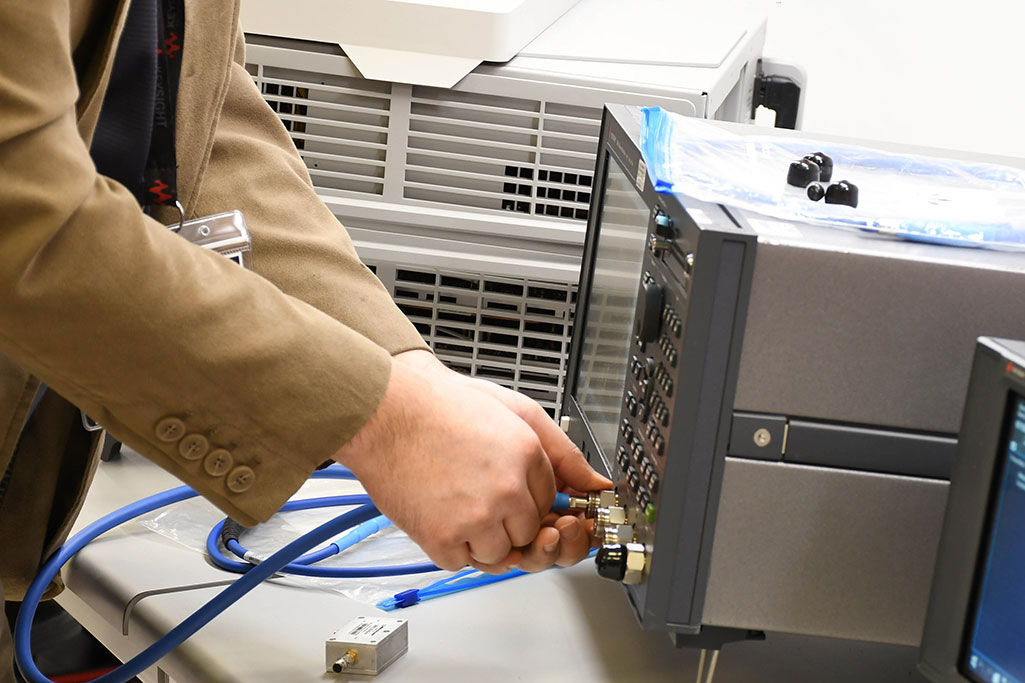 Equipment at the Hardware Catalyst Initiative at VentureLab in Markham, Ont. Photo: Photo courtesy of VentureLab

The Big Read
Chips off the old block: A new batch of semiconductor startups hopes to restore Canada’s hardware edge
A 200-millimetre silicon wafer in a lithography scanner at the X-Fab Silicon Foundries SE semiconductor plant in Corbeil-Essonnes, France in June 2021. Photo: Nathan Laine/Bloomberg via Getty Images
As semiconductor shortages idled factories around the world in May, two Toronto chip companies got their unicorn horns. Canadian software startups have had most of the attention in recent decades, but the investments were another sign of a resurgent hardware sector. “That’s very [typical] of semi—everybody’s under the radar until they’re not,” said Melissa Chee, CEO of Markham, Ont.-based tech hub VentureLab and a former hardware executive.
We used to make chips in this country. But a passel of U.S. takeovers in the 2000s gobbled up scaling Canadian semiconductor companies, and hardware-related employment and exports dropped. A decade on, executives from the last batch of firms are starting and backing a new one, as AI and other advanced technologies heat up the sector.
Talking Point
Canada’s semiconductor sector is experiencing a revival, as startups led by experienced chip executives and new founders chase the huge market created by the growth of AI and other disruptive technologies. Larger U.S. competitors absorbed the last cohort of promising firms a decade ago. Industry executives and investors say capital, customers and talent are needed to help the current generation thrive.
Chips are at the heart of smartphones, enterprise applications like data-centre servers and industrial machinery, and growth sectors like electric vehicles, AI and agtech systems. “The semiconductor is a really foundational technology,” said Salim Teja, a partner at Toronto-based Radical Ventures. Companies that sell them made nearly US$450 billion in revenue in 2020, according to research firm Gartner.
Manufacturers that use these components are currently facing supply shortages caused by pandemic-induced demand spikes for consumer electronics and longer-term capacity shortfalls. That’s lengthening wait times for gaming consoles and idling auto factories. Manufacturers expect the shortage to continue into 2022. In response, governments around the world are pledging billions for semiconductor R&D and production.
Canada’s homegrown chip sector once challenged for a considerable share of the chip market. From the 1980s through the early ‘00s, a cluster of companies in uptown Toronto and the neighbouring York Region made major advancements in graphics and video processing, while firms around Ottawa innovated in computer-memory and radio-frequency technology.
Philsar Semiconductor, based in the capital, “did the dominant Bluetooth chipset for a while,” said Martin Snelgrove, a former Carleton University research chair whose graduate lab provided the company’s engineering core. Newport Beach, Calif.-based Conexant Systems bought the 75-person firm for up to US$186 million in April 2000.
Canadian firms “were very good at building complex chips,” said Sally Daub, who co-founded and ran ViXS Systems. The Toronto-based firm’s chipset was “fundamental to video over IP streaming,” the technology that enables Netflix and other such services. ViXS had US$38.4 million in revenue the fiscal year before she departed as CEO in February 2015. San Jose, Calif.-based Pixelworks acquired it two years later.
In the decade and a half between Philsar and ViXS, a cohort of promising and established Canadian firms sold to larger U.S. competitors. Markham, Ont.-based ATI Technologies was by far the biggest. Founded by three engineers in 1985, it went public in 1993, riding the personal-computer boom. “The graphics card market was basically ATI and Intel,” recalled Chee, then working at Nortel Networks. ATI ended its 2005 fiscal with US$2.22 billion in revenue and over 3,300 employees. In July 2006, Advanced Micro Devices (AMD) of Sunnyvale, Calif. announced it would buy the company for US$5.4 billion.
The sector’s economic impact waned. Exports by semiconductor and other electronic-component manufacturers fell to about $1.75 billion in 2020, from a recent high of $4.17 billion in 2005, while employment dropped more than a third.
Canadian chip companies faced major challenges getting domestic capital and customers, and competition from foreign workers for workers, according to Daub, also a former ATI executive. “Down in the States, there [were] much bigger checks being written, whereas up here, we were trying to build companies on a fraction of the dollar,” she said. Even the companies following the common “fabless” model can spend millions on tools and development before outsourcing production to a foundry like the dominant Taiwan Semiconductor Manufacturing Company (TSMC).
Large chip-consuming sectors like telecom and consumer electronics didn’t buy locally. At ViXS, “I had to sell my chips to Comcast before I could sell them to Rogers,” recalls Daub, now founder and managing partner at VC firm Pool Global Partners. Meanwhile, multinational semiconductor giants established Canadian satellite offices; Intel, Qualcomm, Broadcom and Nvidia all have a presence. “They really did come up here and take the best of the best,” said Daub.
***
Today, some of Canada’s best are building chip companies of their own. The semiconductor sector is experiencing a revival, inspired in part by AI, another field in which the country is looking to stake a claim.
In Toronto, a trio of companies founded by experienced chip executives have attracted significant funding and leaders from industry giants. In January, Tenstorrent hired former Intel and AMD star chip architect Jim Keller, and in May it raised US$200 million at a unicorn valuation ahead of shipping its new processor. The same month, Alphawave’s IPO on the London Stock Exchange brought in £856 million; its market cap is over £2 billion.
Untether, which Snelgrove co-founded, begins shipping commercial-ready processors this month. “It’s a new generation of computer architecture that’s built around the mathematics that neural nets like to do,” he said, referring to today’s dominant AI systems. The company’s chip works alongside a central processing unit (CPU), helping solve very large AI problems more efficiently. Applications include running quant-trading strategies at financial firms or integrating the views of multiple cameras in an autonomous vehicle.
Founded in 2018, the firm has raised US$27 million so far, per PitchBook data, from backers including Intel Capital and Radical. Chip production is outsourced to TSMC. “That’s the nice thing: you don’t differentiate [anymore] based on your process technology,” said Robert Beachler, Untether’s vice-president of product and a longtime Silicon Valley semiconductor executive. “How you get better or worse is really about things that come out of Martin’s head.”
Untether’s team is “a good combination of people that are bold in their technology bets, but conservative in their execution path,” said Tomi Poutanen, who co-founded Radical and helped build Yahoo’s and Microsoft Bing’s search algorithms, each a massive machine learning system.
For example, Untether’s first chip was taped out—the final stage before fabrication—for the well-established 16-nanometre manufacturing process. Competitors are using the more advanced seven-nm technology, which adds costs and risk. While Untether’s product uses an older process, “it still beats the pants out of anything else that’s out there in the market,” according to Poutanen.
Toronto AI chip companies have a talent advantage thanks to the city’s key role in advancing the technology. “I was a professor at Toronto, and down the hall was Geoff Hinton,” said Snelgrove, who worked at U of T in the ‘80s and early ‘90s. “The whole AI business was forming up at that time.” Hinton, one of the world’s leading AI researchers, pioneered deep learning, or neural nets, which mimics the way the human brain works; his graduate students figured out how to run the models at scale on graphics-processing units (GPUs). Today, semiconductor success “really rests on the ability to build complementary software on top,” said Poutanen. “That’s an area where Toronto’s ecosystem excels.”
The AI chip market’s growth is “accelerated,” said Matt Bryson, senior vice-president of equity research at Wedbush Securities. He cited Nvidia as a proxy. Its computer and networking business was up 109 per cent year over year in fiscal 2021. TSMC estimates the semiconductor market as a whole will grow 12 per cent this year. Canadian innovations will continue to benefit the big players. “ATI is a very important piece of AMD’s holistic vision for where it’s going two [to] five years out” in both AI and PC applications, said Bryson.
Ten minutes from the former ATI headquarters in Markham that AMD now occupies, Chee is trying to help a new generation of semiconductor founders scale. VentureLab’s Hardware Catalyst Initiative (HCI) is an incubator for chip startups, offering companies access to development tools, lab equipment and advice on subjects like IP and fundraising.
Bringing a semiconductor to market is “a very capital-intensive program,” said Chee—a single licence for design software can run $1 million, while a radio-frequency analyzer can cost as much as $600,000. “Companies who are selected for HCI have access to these millions of dollars of tools.” That’s helped speed up development. One enrolled startup took just nine month to turn an algorithm into an AI chip prototype it could demo to major manufacturers, according to Chee.
Regional-development agency FedDev Ontario has awarded the program $9.7 million in grants, while companies like Arm, Keysight Technologies, AMD and TSMC donate equipment, software and services. Participating semiconductor giants are drawn by chance to work with local talent and cultivate “future customers,” said Chee, although she acknowledged the interest could also be “from an acquisition perspective at some point.”
Chee and other experienced executives in the semiconductor space say foreign takeovers shouldn’t always be viewed as a loss to Canada. “We’re too small a market to not have global multinationals present,” she said, noting that AMD now has more than 2,000 employees in the country and that semiconductor jobs typically pay significantly more than software ones.
“It is a business-pages mistake to think companies are being pulled out of Canada,” said Snelgrove. “The engineers are still there, they’re still doing the same work, they’re drawing a salary. [They’re just] not choosing the projects.” Some of those employees eventually leave to found new startups, often using cash from the earlier exit. “The ecosystem builds.”
***
While Canada’s chip sector is resurgent, some gaps remain.
“There’s not a lot of people in Toronto who’ve taped out a chip,” according to Poutanen, a skill set he said is necessary for a “fully standalone semiconductor industry.” Untether, for example, hired a former Altera and Xilinx executive as CEO in September 2019. There also aren’t many domestic “funds willing to invest in deep tech,” Poutanen said. “That certainly has been, up till now, a missing ingredient in our tech ecosystem.”
Snelgrove saw that while trying to find financing for Untether, which now has a staff of about 60. “Historically, if you want to venture-fund a company in Canada, you go down to Silicon Valley or Boston,” he said, calling Poutanen’s Radical “the smartest Canadian VCs around.” The Business Development Bank of Canada launched a $200-million deep tech fund in May.
Then there’s manufacturing. Each fab costs billions of dollars to set up, and most production capacity is located in East Asia, where governments offer tax incentives and favourable access to infrastructure like power and water. But Teja predicts more reshoring of production to Europe and North America over the next decade. “There are one or two areas of specialization where there could be manufacturing capability set up in Canada,” he said, citing chips specially designed for machine learning, edge or distributed computing, and quantum applications.
After playing a key role in developing the processing technology that’s in such high demand today and watching foreign companies reap the profits, Canada now has several promising AI chip firms. “Are we going to just allow that to go all to—let’s be honest—the Americans?” asks Daub. “We need to make sure they’re [protecting] their IP and help foster commercial opportunities [for them].”
Alphawave provides a cautionary tale. In April, the firm announced it had moved its headquarters to the U.K., planned to list in London, and would open a research centre in Cambridge. “Our entire business model … was born in the U.K.,” chair John Lofton Holt told The Logic last month, noting that British investors are well acquainted with semiconductor firms. Alphawave also wants to hire in the country’s deep semiconductor talent pool.
A new industry association formed by Chee, Teja and others argues that Canada needs a national chip policy. The federal government has allocated hundreds of millions to national strategies for AI, quantum and genomics, and billions more to electric vehicles, emissions reduction and other cleantech fields. But “we cannot be leaders without the hardware and semiconductor piece being developed and scaled in this country,” said Chee.
Governments around the world are pledging staggering sums to boost development and production of the micro components. The Biden administration’s infrastructure plan includes US$50 billion for the sector. India is reportedly offering US$1 billion to any company that sets up a plant or “fab” in the country—more than Ottawa has budgeted for its sector-spanning AI and quantum strategies combined. Sector proponents say it’s worth fronting the money to get a stake of the semiconductor market, and build domestic capacity for other chip-hungry priority industries.
The next ATI, or even the next Alphawave, may be forming in a suburban Ottawa office park or a Markham incubator. “We want more built-to-scale opportunities here, homegrown [firms] that [can] eventually become multinationals,” said Chee.



Loading...
Thanks for sharing!
You have shared 5 articles this month and reached the maximum amount of shares available.
CloseThis account has reached its share limit.
If you would like to purchase a sharing license please contact The Logic support at [email protected].
CloseGift the full article!
You have gifted 0 article(s) this month and have 5 remaining.
Recipients will be able to read the full text of the article after submitting their email address. They will not have access to other articles or subscriber benefits.
Photo: Nathan Laine/Bloomberg via Getty Images
A 300-millimetre wafer with semiconductor chips at a Bosch factory in Dresden, Germany in May 2021.
Equipment at the Hardware Catalyst Initiative at VentureLab in Markham, Ont.
Most Popular This Week




In-depth, agenda-setting reporting
Great journalism delivered straight to your inbox.
Commentary
Carmichael: Canadian ignorance about India is a strategic weakness
Briefing
Aritzia shares pop after earnings rise 204%
First Nation in Alberta goes to court over fast-tracked oil pipeline
Chinese EV maker Geely Auto Group to launch in Canadian market in 2027
Best business newsletter in Canada
Get up to speed in minutes with insights and analysis on the most important stories of the day, every weekday.
Exclusive events
See the bigger picture with reporters and industry experts in subscriber-exclusive events.
Membership in The Logic Council
Membership provides access to our popular Slack channel, participation in subscriber surveys and invitations to exclusive events with our journalists and special guests.





