OTTAWA — Canadians are split right down the middle on whether retaliation—including with counter-tariffs—is the best way to handle U.S. President Donald Trump, according to a new The Logic poll by Abacus Data.
Skip to content


News
Canadians evenly split on whether retaliation is best way to fight Trump, says poll
Conservative voters more likely to favour persuading Trump, while Atlantic Canadians in survey take hardest line
Consumers have fought back against U.S. tariffs, but Canadians overall are divided on the best way to react. Photo: The Canadian Press/Ethan Cairns
OTTAWA — Canadians are split right down the middle on whether retaliation—including with counter-tariffs—is the best way to handle U.S. President Donald Trump, according to a new The Logic poll by Abacus Data.
Talking Points
- A new survey by Abacus Data suggests just as many Canadians would prefer to retaliate against U.S. tariffs as those who would rather find another way to get them lifted
- Alberta respondents in the poll who want Canada to fight back outnumber those who do not
Evenly split
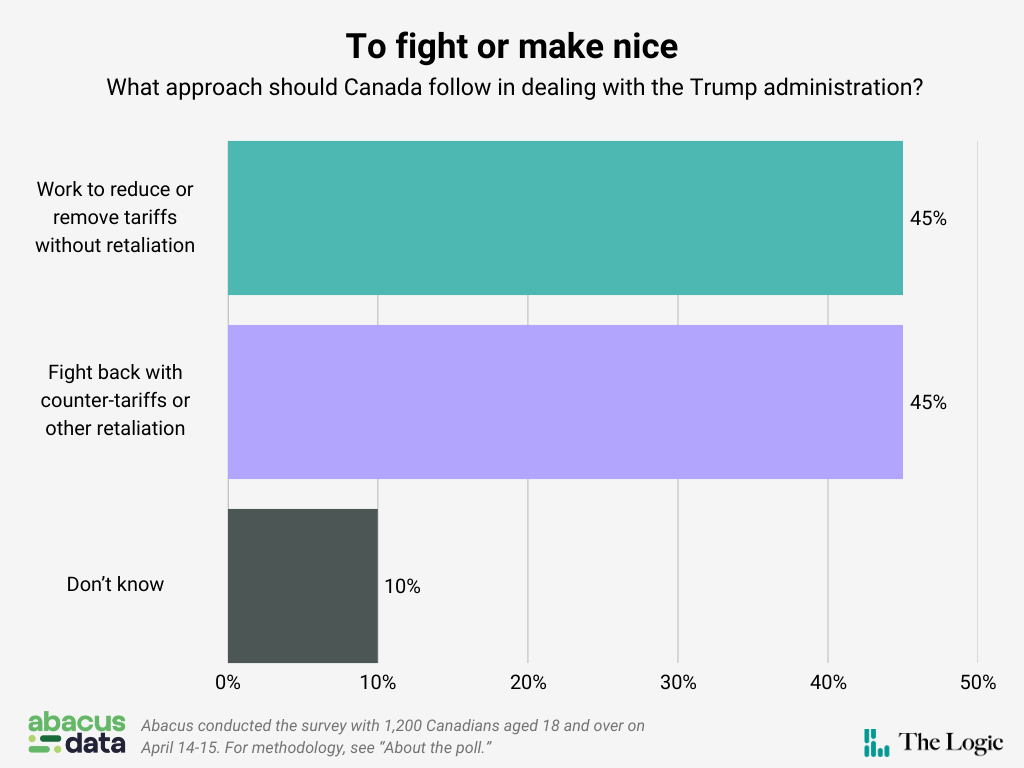
The survey asked respondents how they would recommend dealing with the Trump administration. Would they try to convince the White House to lift tariffs on Canadian goods without retaliation? Or fight back with counter-tariffs or other retaliatory moves? Forty-five per cent chose the first option. Another 45 per cent chose the second. (Ten per cent did not know.)
David Coletto, the CEO of Abacus Data, said the results suggest Canadians see “no one-size-fits-all” response to Trump. “I think it’s also due to a little bit of confusion on the best approach, given how unpredictable he is,” Coletto said.
About the poll
The Logic and Abacus Data have partnered to poll Canadians on key economic issues in advance of the April 28 federal election. The surveys take stock of voters’ priorities and their views of the parties’ policies on matters ranging from affordability to making Canada more competitive. On questions of economic stewardship, we are tracking attitudes over time. We are seeking responses on other issues as they emerge in the public conversation. For today’s story, Abacus surveyed 1,200 Canadians aged 18 and over from April 14 to 15 through an online panel. The margin of error for a comparable probability-based random sample of the same size would be 2.82 percentage points, 19 times out of 20.
Where you stand depends on where you sit
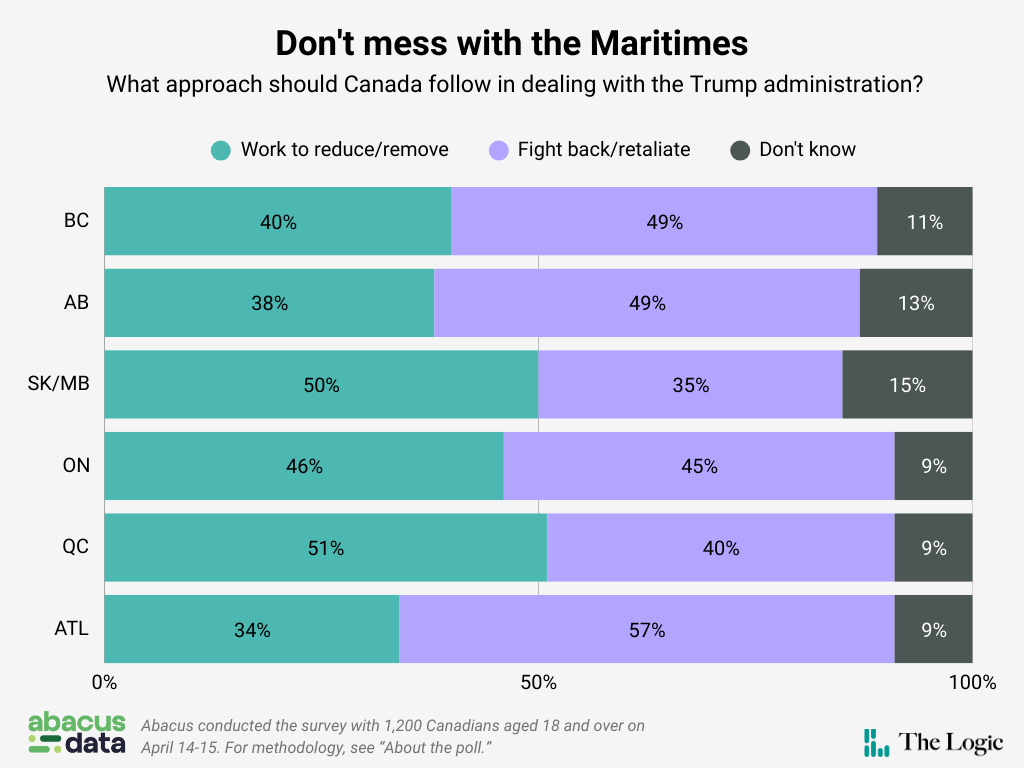
The tie breaks down when it comes to the regions. Atlantic Canada had the highest proportion of respondents who said it would be best to fight back, at 57 per cent, compared to 34 per cent who recommended trying to work it out a different way. Saskatchewan and Manitoba, which the results group together, had the lowest percentage picking retaliation, at 35 per cent, while 50 per cent wanted to convince Trump to lift the tariffs. It was similar in Quebec, where 40 per cent wanted to retaliate and 51 per cent wanted to avoid doing so.
Related Articles

Those numbers align in some cases with how premiers have been handling things. Saskatchewan Premier Scott Moe, who has said China’s 100 per cent duties on Canadian canola oil and canola meal are more urgent for his province than the U.S. ones, has taken a non-confrontational approach. The U.S. decision to carve out energy products and potash from the fentanyl-related tariffs has also spared the province from more severe damage.
Yet in Alberta, where Premier Danielle Smith has supported Canada’s targeted counter-tariffs but also championed a more diplomatic approach, 49 per cent said they wanted retaliation and 38 per cent said they wanted to convince Trump to give Canada a break.
Who you vote for
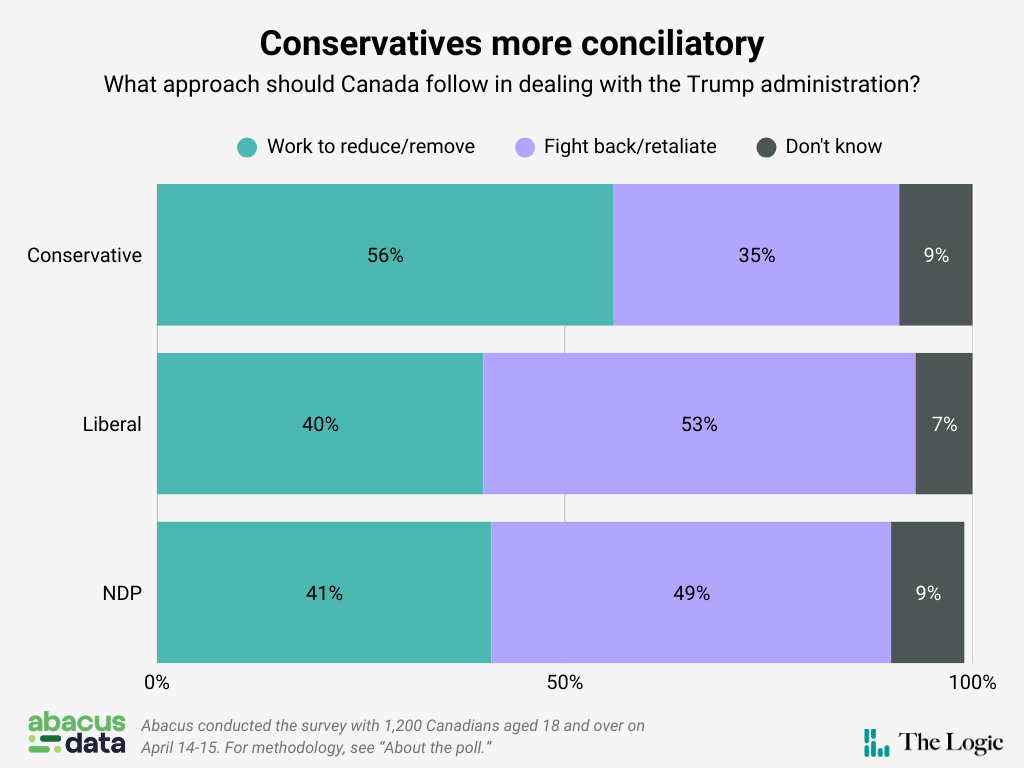
The answers also varied along partisan lines. Among Conservative voters, 56 per cent chose not to retaliate and 35 per cent supported counter-tariffs or other ways to push back. When it came to Liberal voters, 40 per cent wanted to work it out and 53 per cent support retaliation. Forty-one per cent of NDP voters wanted to avoid retaliation and 49 per cent would choose it.
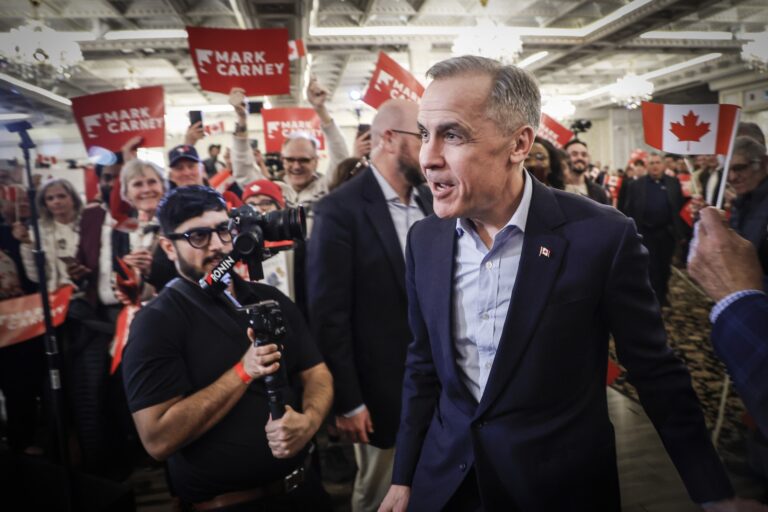
“The Liberals have benefited from the more patriotic, ‘elbows up’ rhetoric that I even think [Liberal Leader] Mark Carney has used himself when he called the election,” Coletto said. Conservative Leader Pierre Poilievre, he said, has “struggled” to find the right tone.
Poilievre said Tuesday he would not drop Canada’s retaliatory tariffs against the U.S. should the Conservatives win the April 28 election. Both he and Carney have also said they would be ready to negotiate with Trump.
And how you feel about Trump
The impressions that Canadians have of Trump could also be shaping their responses. Additional data provided by Coletto suggested 73 per cent of respondents who would prefer to work with the U.S. administration to remove the tariffs without retaliation said they have a very positive or mostly positive impression of the president. Eighty-seven per cent of those who chose to fight back have either a very negative or mostly negative impression of Trump.
Coletto suggested some of the hardliners might be insulated from Trump’s actions by socio-economic status or other factors, such as whether their region or employment sector is hit hard. “Some have the luxury of being mad at him,” he said, while others are “mad but are still wanting their federal government to approach this in a way that doesn’t necessarily hurt them.”



Loading...
Thanks for sharing!
You have shared 5 articles this month and reached the maximum amount of shares available.
CloseThis account has reached its share limit.
If you would like to purchase a sharing license please contact The Logic support at [email protected].
CloseGift the full article!
You have gifted 0 article(s) this month and have 5 remaining.
Recipients will be able to read the full text of the article after submitting their email address. They will not have access to other articles or subscriber benefits.
Photo: The Canadian Press/Ethan Cairns
Most Popular This Week




In-depth, agenda-setting reporting
Great journalism delivered straight to your inbox.
News
Cohere plans to acquire cyber startup Aisle and set up a new security division
Briefing
Banks should have kill switches, IDs for AI agents, says global finance watchdog
B.C. First Nations decry rushed consultations as Major Projects Office CEO promises to do better
Feds pledge $100M to back Nova Scotia’s plans for offshore wind farms
Best business newsletter in Canada
Get up to speed in minutes with insights and analysis on the most important stories of the day, every weekday.
Exclusive events
See the bigger picture with reporters and industry experts in subscriber-exclusive events.
Membership in The Logic Council
Membership provides access to our popular Slack channel, participation in subscriber surveys and invitations to exclusive events with our journalists and special guests.