Commentary
Letter from the editor: Tilting the playing field
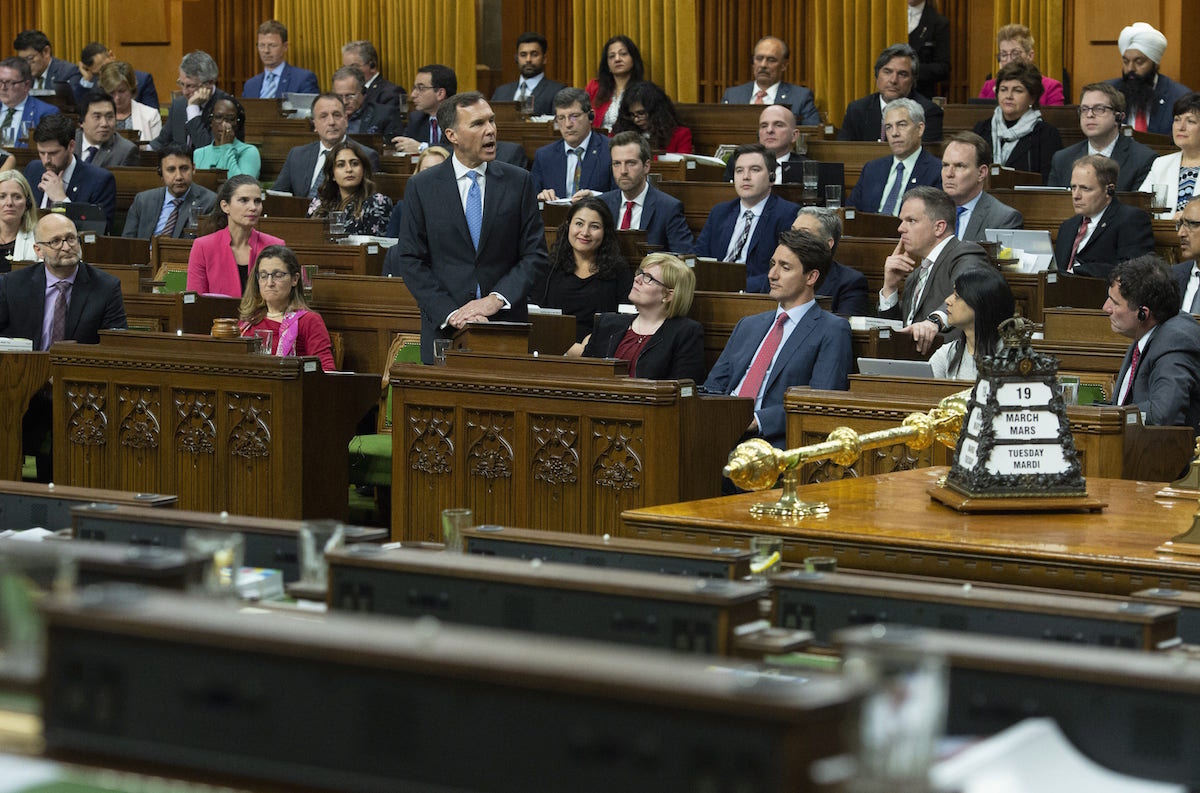
Finance Minister Bill Morneau delivers the federal budget in the House of Commons in Ottawa, Tuesday March 19, 2019. Photo: THE CANADIAN PRESS/Sean Kilpatrick
Well, it happened.
The government capitulated to the demands of traditional publishers with its financial package of “support for Canadian journalism.”
If you missed the news, it’s probably because after months—make that years—of lobbying, public awareness campaigns and many, many editorials written in the country’s newspapers, there’s been almost no coverage of the media (don’t call it a bailout) package from the country’s traditional newspapers and airwaves since it was announced on Tuesday. Make of that what you will.
I wrote a column last year providing seven recommendations that the government should consider in any journalism policy. None of them were included in the announcement.
I was still willing to accept whatever was proposed if it kept the playing field fair for all journalism organizations, but this tax measure was even more prescriptive than I anticipated.
For an organization to qualify for a 25 per cent refundable tax credit on salary or wages capped at $55,000, they must be:
“Primarily engaged in the production of original news content and in particular, the content must be primarily focused on matters of general interest and reports of current events, including coverage of democratic institutions and processes, and must not be primarily focused on a particular topic such as industry-specific news, sports, recreation, arts, lifestyle or entertainment.”
In plain terms, the government is creating a two-tiered system where publications that “primarily focus” on current events yet also happen to have a sports or arts section will get all of their reporters subsidized—but a publication that does the inverse will get nothing.
As Andrew Coyne—one of the few voices that could be found on the topic—wrote this week in the National Post, “The government will subsidize department stores, but not boutiques. Why?…Because that description neatly excludes anyone outside the existing Canadian newspaper industry. And that’s who this policy is designed for: not the future of news but the past; not the scrappy startups who might save the business, but the lumbering dinosaurs who are taking it down.”
They’re also getting into the minds of editors to dictate what areas of coverage are deemed more important than others.
I’ve been working in newsrooms for almost two decades and can tell you with the utmost certainty that there isn’t a single topic area—whether in sports, entertainment or teen fashion—that doesn’t at some point focus on matters of general interest, current events and coverage of democratic institutions and processes.
Would a sports publication in Calgary focused on covering the Calgary Flames’ ongoing arena-subsidies discussions with the city not be eligible?
Would an entertainment publication reporting on the Canadian film tax credit or Netflix’s relationship with Quebec not be eligible?
Would a teen fashion publication focused on gender and LGBTQ+ rights not be eligible?
Under the proposed outline, it seems they would not be.
One only has to look at the tremendous influence Teen Vogue has had on American discourse since the election of President Donald Trump to recognize how labelling some coverage as worthy of subsidy and others not shows a lack of understanding on the role journalism plays in society.
This is a problematic policy because it will have a direct impact on the daily assigning and editing of a journalism product.
But worse, the policy is an insult to the audience.
A great mentor of mine once lashed out at me for lamenting my inability to commission deep investigations at the publication I was working for at the time. “How dare you assume that the recipe in the entertainment section isn’t as important to the reader!” she argued. “Maybe their spouse just died from a sudden illness and the only thing getting that person through the day is the delight they get from baking those cookies from the recipe in your newspaper.”
Never assume to know what “real journalism” is. The program assumes any subject that doesn’t fit its narrow criteria isn’t worthy of support. It speaks to a fundamental misunderstanding of all the important roles that journalism fills in our lives.
There were some other things that also stood out to me.
For an organization to be eligible, it needs to employ two or more journalists who work a minimum of 26 hours per week, on average, and who are employed for at least 40 consecutive weeks. I conducted a straw poll of several emerging digital media publications to get a sense of how many full-time employees (FTE) they employ.
Publications younger than 24 months old were far more likely to have fewer than two FTEs. The program will hinder seed-stage journalism development by favouring mature publications (and, generally speaking, publications that don’t reflect a diversity of voices) at the very time it should be kickstarting new approaches.
As Erin Millar, founder and CEO of The Discourse, told me, “If we want to see a more diverse and sustainable ecosystem that includes different types of players, the announcement sets us back, not forward.”
The mandatory full-time status for eligibility also ignores the vital role that freelance journalists play in the news ecosystem.
According to Statistics Canada, as of 2016, there are about 12,000 people who identify “journalist” as their profession. Of those, it’s safe to assume that the number of people not employed full-time with a newsroom is in the thousands.
In a time with more independent workers who need support than ever, this policy contains nothing that would satisfy those gig economy workers.
Finally, there was no mention of the role the CBC could play in helping to solve some of the legitimate news-desert concerns the policy was aiming to fix.
The same day the Canadian government was announcing its program, the BBC announced plans across the pond to launch a charity to fund local news reporting in Britain.
It remains a mystery to me why the government chose to create a new policy tool instead of leveraging the one that was sitting right under its nose the whole time.
For the record, I do believe that The Logic would be eligible for the program because we cover democratic institutions. But as I’ve stated since the beginning, and as I’ve tried to outline here, a do-no-harm mantra should’ve been applied to any policy approach. On that, this policy has failed.



Loading...
Thanks for sharing!
You have shared 5 articles this month and reached the maximum amount of shares available.
CloseThis account has reached its share limit.
If you would like to purchase a sharing license please contact The Logic support at [email protected].
CloseGift the full article!
You have gifted 0 article(s) this month and have 5 remaining.
Recipients will be able to read the full text of the article after submitting their email address. They will not have access to other articles or subscriber benefits.