Skip to content

Canada's Business and Tech Newsroom

  • Professional Subscription
  • Partnerships & Advertising
  • Licensing & Syndication
Log In Subscribe
Welcome,
  • My Account
  • Log Out
  • Business
  • Tech
  • National
  • The Big Read
  • Briefings
  • Commentary
Search
Log In Subscribe
Welcome,
  • My Account
  • Log Out
Commentary

Letter from the editor: Tech’s mobility omission

Mobility is a term the tech community has co-opted to mean everything from transit-as-a-service to autonomous vehicles to what Ford CEO Jim Hackett called “a ‘catch-all’ phrase encompassing all non-traditional businesses.”

At its core, mobility is about offering greater accessibility and convenience to more people. But too often that isn’t the case.

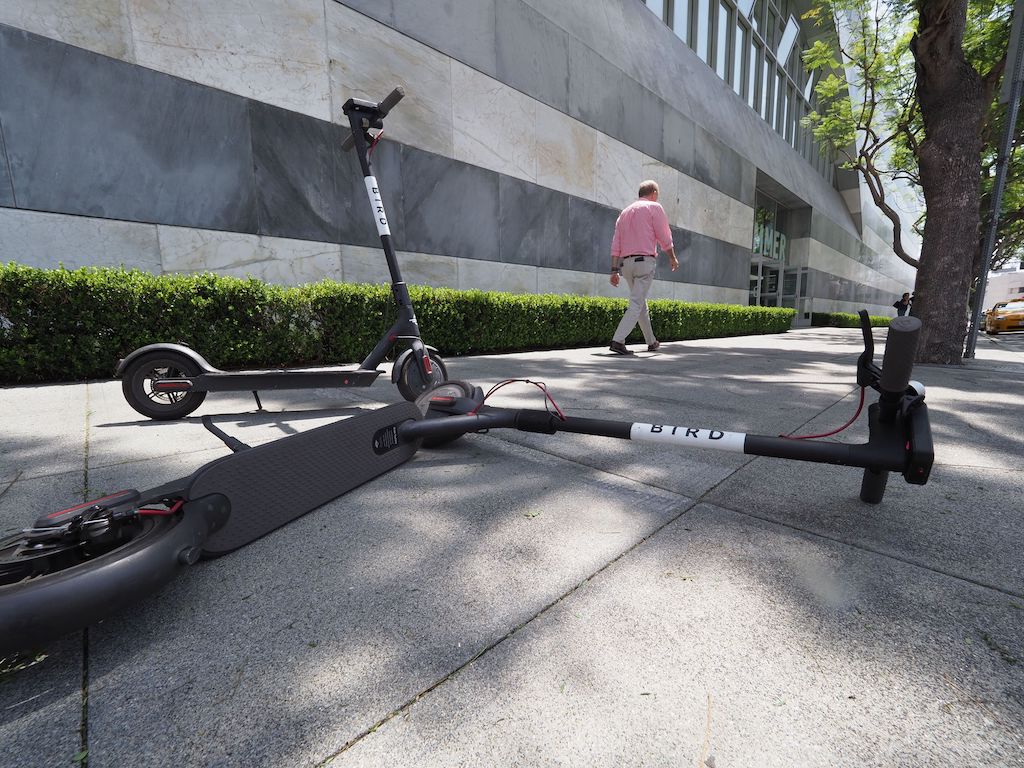
After we published our story about Lime and Bird’s e-scooter expansion plans in Canada, a reader pointed me to a Twitter thread highlighting concerns over what abandoned dockless scooters mean for wheelchair users.

“You are literally sticking up walls all over the city that wheelchair users can’t get past. And what’s worse is they aren’t even predictable walls,” wrote Twitter user @mssinenomine.

These omissions arise when not all users are included—or even considered, and when businesses treat accessibility as an afterthought or as a costly regulatory obligation. With almost a quarter of Canadians living with disabilities, the tech ecosystem—in both product development and hiring, has overlooked the massive market opportunity that comes from universal design.

Commentary

Letter from the editor: Tech’s mobility omission

By David Skok
A pedestrian walks past two Bird dockless scooters, one laying on its side, in the middle of a sidewalk in the Westwood section of Los Angeles, California, July 10, 2018. Photo: (ROBYN BECK/AFP/Getty Images)
Jan 12, 2019
A A
A Small A Medium A Large
Share

Share

Mobility is a term the tech community has co-opted to mean everything from transit-as-a-service to autonomous vehicles to what Ford CEO Jim Hackett called “a ‘catch-all’ phrase encompassing all non-traditional businesses.”

At its core, mobility is about offering greater accessibility and convenience to more people. But too often that isn’t the case.

After we published our story about Lime and Bird’s e-scooter expansion plans in Canada, a reader pointed me to a Twitter thread highlighting concerns over what abandoned dockless scooters mean for wheelchair users.

“You are literally sticking up walls all over the city that wheelchair users can’t get past. And what’s worse is they aren’t even predictable walls,” wrote Twitter user @mssinenomine.

These omissions arise when not all users are included—or even considered, and when businesses treat accessibility as an afterthought or as a costly regulatory obligation. With almost a quarter of Canadians living with disabilities, the tech ecosystem—in both product development and hiring, has overlooked the massive market opportunity that comes from universal design.

Brooke Ellison is a professor at Stony Brook University and the first quadriplegic person to graduate from Harvard University. She told me that too often, companies come to her after they’ve built their product, by which time it’s too late.

“If it’s useable for someone with a disability,” she said, “then it’s useable for most, and usually in a way that is more intuitive, more streamlined and easier overall.”

Ellison pointed me to Microsoft Enable, a dedicated research arm within Microsoft that’s doing things the right way. The Enable team installed eye-gaze technology in her home, pairing a camera that doubles as a mouse to her eyes.

It’s great for Ellison and, as she points out, it’s also great for Microsoft, who can see endless potential for the hands-free device.

“The technology is not only very useable for me, but for others who may not have use of their hands at that time, like a surgeon or a pilot,” she said.

Some of these product oversights come from not hiring people with disabilities.

Maayan Ziv, founder and CEO of AccessNow, a for-profit social enterprise that maps accessibility, argues a company that wants to build inclusive products must ask itself, “How many people with disabilities do you actually employ to make sure this is happening from a lived experience perspective?”

Ellison agrees. “People with disabilities are worthy, are extremely capable in many aspects of their lives and among the most creative when it comes to getting through the day. If that can be captured in as many opportunities as possible, then everybody benefits.”

A recent column in The New York Times cited an Accenture study that showed companies that championed people with disabilities actually outperformed others on measures of profitability and shareholder returns.

With an aging population, what is good for people is also good for the bottom line. According to research conducted by industry analyst Rich Donovan, people with disabilities make up an emerging market the size of China. Their friends and family add another 2.3 billion potential consumers. Together, they control over US$8 trillion in annual disposable income.

Recognizing this unique opportunity, Australia implemented the National Disability Insurance Scheme (NDIS) in 2013, which covers any additional costs an employer may incur in hiring a person with disability. According to Tony Abrahams, who co-founded Ai-Media, a technology company that makes content accessible to everyone, the NDIS legislation was supported unanimously in the Australian parliament and has nearly 80 percent public support.

Public Works Minister Carla Qualtrough—who, herself lives with a visual impairment, has personally championed Bill C-81: The Accessible Canada Act, which is making its way through Parliament. That legislation will become the first-ever federal disability legislation removing barriers to accessibility, but unlike Australia, it won’t cover the costs for employers to hire persons with disabilities.

But government can only go so far. Eventually, the private sector has to step in. As Microsoft has demonstrated, the technology sector, with its focus on innovation and problem solving, is well-positioned to seize the moment.

Which begs the question: why are there no accessibility-focused venture-capital funds?

Not a single expert I spoke to this week could name one.

The Canadian government committed roughly $22 million to accessibility investing over five years in the 2017 budget. So far, just $3 million has been allocated. The commitments to accessibility investment are a mere 1.6 percent of the $1.4 billion the federal government committed to financing women entrepreneurs.

For Ziv, this has been frustrating to watch.

“Often a lot of the conversation when we speak about diversity [is that] we speak about people who are not white and people who are women, and we completely forget that disability is part of that diversity,” said Ziv.

In two weeks, Canada’s innovation minister will join world leaders in Davos, Switzerland for this year’s World Economic Forum. The forum promises to highlight disability inclusion.

Wouldn’t it be great for Canada’s innovation ecosystem to lead the way forward?

Disclosure: My spouse serves on the board of Tony Abrahams’ organization.
Loading...

Thanks for sharing!

You have shared 5 articles this month and reached the maximum amount of shares available.

Close
This account has reached its share limit.

If you would like to purchase a sharing license please contact The Logic support at [email protected].

Close
Want to share this article?

Upgrade to all-access now

Close
Gift the full article!

You have gifted 0 article(s) this month and have 5 remaining.

Copy link and gift
Copy Link
Email to a friend
Send Email
Gift on Social Media

Recipients will be able to read the full text of the article after submitting their email address. They will not have access to other articles or subscriber benefits.

Photo: (ROBYN BECK/AFP/Getty Images)

Most Popular This Week

A shot of a placard on a table reading "Let Alberta Decide." There is a person out of focus in the foreground wearing a cowboy hat.
The Big Read

What Alberta’s corporate heavyweights really think about separation

By Meghan Potkins
Carney and Trump at a photo op in Sharm El-Sheikh, Egypt, against a white backdrop that features a peace-themed logo for the gathering. Carney is leaning toward a scowling Trump and pointing his index finger at the U.S. president.
News

The U.S. has chosen not to extend CUSMA. Here’s what happens next

By Joanna Smith
A person in glasses and a blue top is sitting and typing on a laptop in an office. A desktop screen next to the laptop displays some blurred-out coding work.
News

A niche white-collar role is becoming the AI industry’s hot new job

By Anita Balakrishnan
A logo that reads AI in blue lettering against a light yellow background.
News

What happened when a VC firm let AI do almost everything

By Catherine McIntyre

In-depth, agenda-setting reporting

Great journalism delivered straight to your inbox.

A cityscape featuring two tall buildings; the right one has a large orange "Q" logo and a Quebec flag atop. The sky is clear and blue.
Commentary: Quebec Ink

Quebec’s era of endless, cheap electricity is coming to an end

By Martin Patriquin

Briefing

GFL stock jumps on report of takeover interest

By Anita Balakrishnan   |   Jul 3, 2026

McKinsey to challenge internal leaders on AI plans under new leadership structure

By Anita Balakrishnan   |   Jul 3, 2026

Lobby group can participate in crypto miners’ lawsuits against Hydro-Québec, judge rules

By Martin Patriquin   |   Jul 3, 2026

Best business newsletter in Canada

Get up to speed in minutes with insights and analysis on the most important stories of the day, every weekday.

Exclusive events

See the bigger picture with reporters and industry experts in subscriber-exclusive events.

Membership in The Logic Council

Membership provides access to our popular Slack channel, participation in subscriber surveys and invitations to exclusive events with our journalists and special guests.

Recent Popular Stories

The Big Read

What Alberta’s corporate heavyweights really think about separation

By Meghan Potkins   |   Jul 2, 2026
A shot of a placard on a table reading "Let Alberta Decide." There is a person out of focus in the foreground wearing a cowboy hat.
News

A niche white-collar role is becoming the AI industry’s hot new job

By Anita Balakrishnan   |   Jun 30, 2026
A person in glasses and a blue top is sitting and typing on a laptop in an office. A desktop screen next to the laptop displays some blurred-out coding work.
News

What happened when a VC firm let AI do almost everything

By Catherine McIntyre   |   Jun 29, 2026
A logo that reads AI in blue lettering against a light yellow background.
News

Carney’s new deal for B.C. paves way for West Coast pipeline

By David Reevely and Meghan Potkins   |   Jul 2, 2026
Workers position pipe during construction of the Trans Mountain pipeline expansion in Abbotsford, B.C., in May 2023.
Analysis

Canada’s ETF industry is almost a trillion-dollar business

By Chaimae Chouiekh   |   Jul 3, 2026
Despite a down year a sign board displays the TSX's upbeat close on the final day of the year, in Toronto's financial district on Monday, Dec. 31, 2018.
Analysis

It turns out Trump does need something from Canada—aluminum

By Joanna Smith   |   Jun 25, 2026
A close-up of a made-in-Canada stamp on the end of a cylindrical piece of raw aluminum.

Canada's most influential executives and policymakers are reading The Logic

  • CPP Investments
  • Sun Life Financial
  • C100
  • Amazon
  • Telus
  • Mastercard
  • bdc
  • Shopify
  • Rogers
  • RBC
  • General Motors
  • MaRS
  • Government of Canada
  • Uber
  • Loblaw Companies Limited
logic-logo

Canada's Business and Tech Newsroom

100% human-crafted journalism

Newsroom

  • News Tips
  • AI Policy
  • Editorial Disclosures
  • Story Pitches

Company

  • About Us
  • Terms of Service
  • Privacy Statement
  • Corporate Information

Contact

  • Contact Us
  • Advertise
  • FAQs
  • Work at The Logic

© 2026 The Logic Inc. All Rights Reserved.

Trusted by leaders

Error

Account creation failed.

Please email us at [email protected].

Create Account

[wppb-register form_name=”cozmo-registration-form-for-modal”]

I do have an account
Login
or

[wppb-login]

I don’t have an account