Walmart Canada’s warehouses in the country now take up the space of roughly 108 Canadian football fields. The retailer will open another facility of roughly 550,000 square feet this year as it aims to establish itself as a dominant e-commerce player in the country.
Skip to content


Why Axis
Walmart’s Canadian footprint grows in step with e-commerce ambitions
Retail giant still behind Amazon but visible in rearview mirror
A Walmart grocery distribution centre that opened in Surrey, B.C., in April 2022. Photo: Walmart Canada/Handout
Walmart Canada’s warehouses in the country now take up the space of roughly 108 Canadian football fields. The retailer will open another facility of roughly 550,000 square feet this year as it aims to establish itself as a dominant e-commerce player in the country.
Walmart, which arrived in Canada with its 1994 acquisition of a Woolworth Canada division and its 122 stores, has long had distribution centres here to move goods to its retail locations, but has since been adding fulfillment centres from which to fill and ship online orders.
Talking Points
- Walmart Canada will crack 10 million sq. ft. of distribution space in the country after it opens a location in Vaughan, Ont., this year
- The retailer is also relying on its roughly 400 stores in Canada to help fulfill online orders as it works to offer speedier delivery times to compete with Amazon and other e-commerce players
It now has 14 warehouse facilities across four provinces, totalling nearly 9.5 million sq. ft., according to data from MWPVL International, a Montreal-based supply-chain and logistics consulting firm that tracks the growth of Walmart, Amazon and other retailers. Walmart Canada had about 8.75 million sq. ft. in 2017, according to its public disclosures.
This year, the retailer is set to open one more centre, which will see its Canadian distribution footprint crack 10 million sq. ft. The Vaughan, Ont., facility will give Walmart Canada about 40 per cent of Amazon Canada’s distribution footprint as it competes for Canadians’ online orders.
The two companies aren’t exactly an apples-to-apples comparison. Unlike Amazon, a creature of the internet age, Walmart is building from its mid-century origins as a brick-and-mortar retailer that grew to more than 10,600 locations.
“I think for Walmart, this growth in their online order fulfillment centre is probably driven by their long-term goal of moving more towards the e-commerce domain,” said Ming Hu, a professor of operations management at the University of Toronto’s Rotman School of Management. (Hu is also an Amazon Scholar.) “For Amazon, I think they want to solidify their position.”
Related Articles
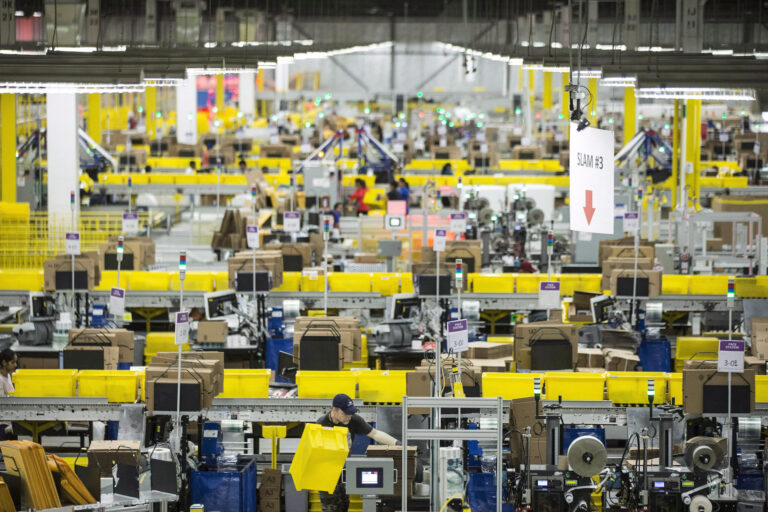

They’ve already encroached on each others’ traditional business models. Amazon has moved into physical retail with mixed results. Walmart, like most traditional retailers in the digital age, has had to build an online shopping and home delivery business to meet customers’ evolving needs. Its e-commerce business has given competitors—including Amazon—something to worry about.
“Our value proposition continues to resonate with customers, helping us gain share and drive e-commerce growth,” said Walmart CEO Doug McMillon during the company’s most recent quarterly earnings call. The company has made e-commerce one of its four major investment areas, especially after the pandemic accelerated its expectations for adoption.
Walmart Canada’s senior manager of corporate affairs Stephanie Fusco confirmed in an email that the company has about 10 million sq. ft. across 16 centres in the country as it continues to expand its footprint. Three of those are fulfillment centres—two in Mississauga, Ont., and one just outside of Calgary.
(The discrepancy between Walmart and MWPVL’s figures for number of centres comes down to differences in how they define facilities. Walmart Canada counts four facilities in Cornwall, Ont., even though they’re located at two addresses, whereas MWPVL only accounts for two locations there.)
Like most traditional retailers, Walmart had to build an online shopping and delivery business to meet customers’ evolving needs.
In addition to its warehouse network, Walmart relies on its retail stores to fulfill some online orders. By the company’s calculation, 90 per cent of people in the U.S. live within about 16 kilometres of one of its locations, making them convenient hubs for last-mile delivery. Last year, CFO John David Rainey said half of Walmart’s available online items in the U.S. came from its stores.
To amp up speed and efficiency, Walmart has started opening what it calls high-tech market fulfillment centres in the U.S.—facilities located within retail stores where autonomous carts retrieve items and bring them to staff; the employees then double-check, bag and deliver the order. Walmart expected to have seven of these in-store facilities operating in the U.S. by the end of November.
In Canada, the company has grown from 122 stores when it first started operating in 1994 to 402 as of last year, according to its corporate filings. Walmart employs more than 100,000 workers at these locations—a number that’s stayed relatively consistent over the past decade, according to its public disclosures.
The company recently nixed plans, though, for a roughly 457,000-sq. ft. warehouse west of Montreal that would have been its first in Quebec. The $100-million facility would have served the province and Atlantic Canada, and construction was well underway. Instead, Walmart plans to beef up what Fusco called the local stores’ “omnichannel capabilities,” meaning e-commerce integration. To do so, it’s spending about $100 million to remodel eight stores in Quebec, Fusco said, as part of a $300-million investment to upgrade 55 locations across the country.
Whether Walmart’s vast retail store network confers an advantage in the e-commerce game is yet to be seen. Amazon has built out a network of small delivery stations to address last-mile logistics, while Hu noted that in-store fulfillment raises complications, adding to staff workload and requiring a high level of automation to serve customers at a competitive pace.
Speed, Hu observed, is the lifeblood of the business—“a competitive dimension that’s pushed up to the limit by Amazon.” The e-commerce giant has made a name for itself offering widespread access to same-day orders and experimenting with even quicker windows.
Walmart has been working on doing the same as it builds out its infrastructure. In major Canadian cities last year, it launched Delivery Pass, a subscription service providing same-day delivery that it aims to extend across the country. In June, as it opened its newest fulfillment centre near Calgary, the company said it could now serve 97 per cent of Canadian households with two-day delivery.
That speed helps Walmart strengthen its position in the face of new e-commerce competitors like Shein and Temu, said Hu, which both try to attract customers with low prices and quick deliveries. “I think Walmart also wants to fend off that competition,” he said.



Loading...
Thanks for sharing!
You have shared 5 articles this month and reached the maximum amount of shares available.
CloseThis account has reached its share limit.
If you would like to purchase a sharing license please contact The Logic support at [email protected].
CloseGift the full article!
You have gifted 0 article(s) this month and have 5 remaining.
Recipients will be able to read the full text of the article after submitting their email address. They will not have access to other articles or subscriber benefits.
Photo: Walmart Canada/Handout
Most Popular This Week




In-depth, agenda-setting reporting
Great journalism delivered straight to your inbox.
News
A tech firm born from post-Brexit trade chaos sets its sights on Canada
Briefing
Dozens of Canadian researchers join chorus of scientists calling for a global AI oversight
TC Energy strikes deal with Indigenous groups for ownership stake in Coastal GasLink pipeline
Canada’s Tailscale taps Google Moonshot alum to lead sovereign AI push
Best business newsletter in Canada
Get up to speed in minutes with insights and analysis on the most important stories of the day, every weekday.
Exclusive events
See the bigger picture with reporters and industry experts in subscriber-exclusive events.
Membership in The Logic Council
Membership provides access to our popular Slack channel, participation in subscriber surveys and invitations to exclusive events with our journalists and special guests.





