OTTAWA — With Canada’s two major freight railways frozen, Labour Minister Steven MacKinnon has ordered them and the Teamsters they’ve locked out to take their labour disputes to binding arbitration.
Skip to content

News
Labour minister orders railways, union to arbitration to end lockouts
Steven MacKinnon’s direction could face legal challenge
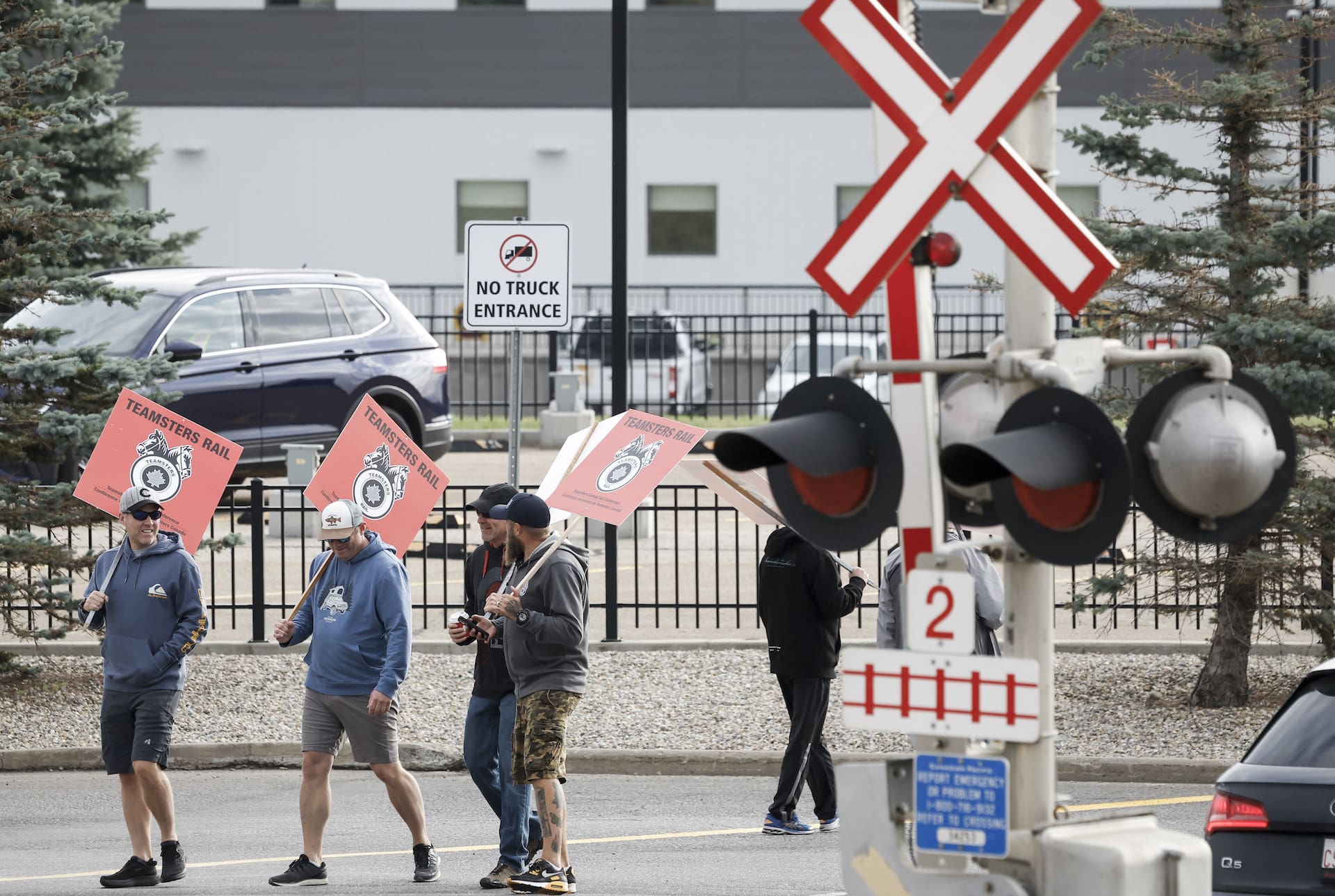
Teamsters Canada Rail Conference members walk a picket line at CPKC headquarters in Calgary, on Aug. 22, 2024. Photo: The Canadian Press | Jeff MacIntosh
OTTAWA — With Canada’s two major freight railways frozen, Labour Minister Steven MacKinnon has ordered them and the Teamsters they’ve locked out to take their labour disputes to binding arbitration.
“An agreement has so far proven elusive,” he said in a news conference. “The impacts of the current impasse are being borne by all Canadians.”
Talking Points
- Business groups demanded Labour Minister Steven MacKinnon order Teamsters and railways to resolve outstanding differences through arbitration, either by ministerial order or a bill in Parliament
- MacKinnon obliged late Thursday afternoon, abandoning his insistence that the parties needed to reach deals on their own
Whether the minister’s use of his power under the Canadian Labour Code to end the twin lockouts at Canadian National (CN) and Canadian Pacific Kansas City (CPKC) will hold up to a potential court challenge remains to be seen.
Calls to act now: Multiple business groups, including the Canadian Chamber of Commerce and the Canadian Federation of Independent Business, had demanded that MacKinnon end the work stoppages.
“The minister of labour must use the tools at his disposal to immediately resolve this conflict through binding arbitration,” Chamber CEO Perrin Beatty said in a statement.
“We’re calling on the federal government to intervene immediately by introducing binding arbitration or enacting back-to-work legislation,” the CFIB’s Dan Kelly said in a statement of his own.
MacKinnon had previously been adamant that the bargaining teams needed to reach deals themselves.
Binding arbitration: During negotiations, the railways had sought binding arbitration, which the union rejected.
Related Articles

On Wednesday, the business groups pointed to Section 107 of the Canadian Labour Code, the sweeping provision MacKinnon acted under that gives him power to “do such things as to the minister seem likely to … promote conditions favourable to the settlement of industrial disputes.” That includes sending “any question” to the federal labour board and giving the board any directions he deems necessary.
But it’s not a magic wand.
Just this month, the labour board issued a long decision on a case that MacKinnon’s predecessor Seamus O’Reagan sent it, seeking to avert a strike at WestJet with binding arbitration. O’Regan’s referral didn’t quite spell out that the board should order any strike ended, though, and the board refused to read such an instruction into the referral.
The Supreme Court has found that free collective bargaining is a Charter right, the board’s ruling said, strikes and lockouts are included in that, and the board wasn’t going to interfere with this one.
In this case, MacKinnon directed the labour board to order the railways to stop their lockouts and forbid the potential strikes the lockouts pre-empted. But the union, the railways or all of them together could still go to court to try to get that direction overturned.
The CIRB’s previous ruling that none of the railways’ services meet the legal standard to be treated as “essential,” despite the pain that rail lockouts or strikes cause, would likely help their arguments.
The Teamsters Canada Rail Conference didn’t immediately respond to a question from The Logic about whether the union will turn to the courts.
Back-to-work legislation: Historically, a bill passed by Parliament has been a big hammer. The Liberals wielded one in 2021 to end a strike at the Port of Montreal. Go back to work, the bill told the Canadian Union of Public Employees local that was striking, or you’ll be fined up to $100,000 a day. Whatever the workers and the port employers couldn’t agree on would go to binding arbitration.
Passing such a bill for the railways would mean recalling Parliament before its scheduled resumption Sept. 16, but that part’s not difficult, especially with rules allowing MPs to vote remotely. Once introduced, the 2021 port bill quickstepped through Parliament in four days.
A bill to end the rail lockouts—which MacKinnon said will come as well—could be tougher. NDP Leader Jagmeet Singh has twice told the Liberals his party won’t support back-to-work legislation, period.
The Conservatives backed the governing party on the bill ending the Port of Montreal strike. But as they’ve sought support from organized labour, they’ve more recently supported “anti-scab” legislation, and during last summer’s port strike in British Columbia, leader Pierre Poilievre wouldn’t say whether he’d support a back-to-work bill.
The Tories didn’t respond to a question from The Logic on Thursday about whether they would back such a bill this time. Nor did the Bloc Québécois, whose MPs voted against the Port of Montreal bill.
Pain: CIBC Economics’s Avery Shenfield and Andrew Grantham wrote in a note that the economy can absorb a brief rail halt without too much trauma, but the pain would get worse and worse, faster and faster as inventories run out. Railways carry more than $1 billion worth of goods a day, including most intercity freight and half of Canada’s exports, the note said.
Grain Growers of Canada said the lockouts would cost grain farmers $43 million a day this week and that the number would increase. Fertilizer Canada was expecting $55 million to $63 million a day in lost sales. Mining companies activated contingency plans.
Rail commuters in Toronto, Montreal and Vancouver found some of their lines disrupted where regional trains rely on CN or CPKC services.
Still bargaining: The bill for the Montreal port strike allowed for the possibility that a negotiated deal could pre-empt an arbitrated one. Despite the lockouts and fierce language from both railways, the Teamsters said early Thursday that they were still at the negotiating tables with the two companies.
This story has been updated to reflect MacKinnon’s order for binding arbitration.



Loading...
Thanks for sharing!
You have shared 5 articles this month and reached the maximum amount of shares available.
CloseThis account has reached its share limit.
If you would like to purchase a sharing license please contact The Logic support at [email protected].
CloseGift the full article!
You have gifted 0 article(s) this month and have 5 remaining.
Recipients will be able to read the full text of the article after submitting their email address. They will not have access to other articles or subscriber benefits.
Photo: The Canadian Press | Jeff MacIntosh
Most Popular This Week




In-depth, agenda-setting reporting
Great journalism delivered straight to your inbox.
News
Panel decries Canada’s chaotic way of funding world-class science
Briefing
RBC weighs blocking Meta’s AI agent from accessing customer accounts
Feds pledge $15M for U.S. satellite navigation company Xona to expand in Montreal
Inovia raises US$200M for new VC fund as it eyes AI’s impact
Best business newsletter in Canada
Get up to speed in minutes with insights and analysis on the most important stories of the day, every weekday.
Exclusive events
See the bigger picture with reporters and industry experts in subscriber-exclusive events.
Membership in The Logic Council
Membership provides access to our popular Slack channel, participation in subscriber surveys and invitations to exclusive events with our journalists and special guests.





