Nicholas Malisani plucks a vintage T-shirt from a clothing rack brimming with Apple insignia. The words “think different” stretch across the front in baby blue font. He then pulls up his own sleeve, revealing a cluster of tattoos on his left bicep. One matches the shirt exactly.
Skip to content
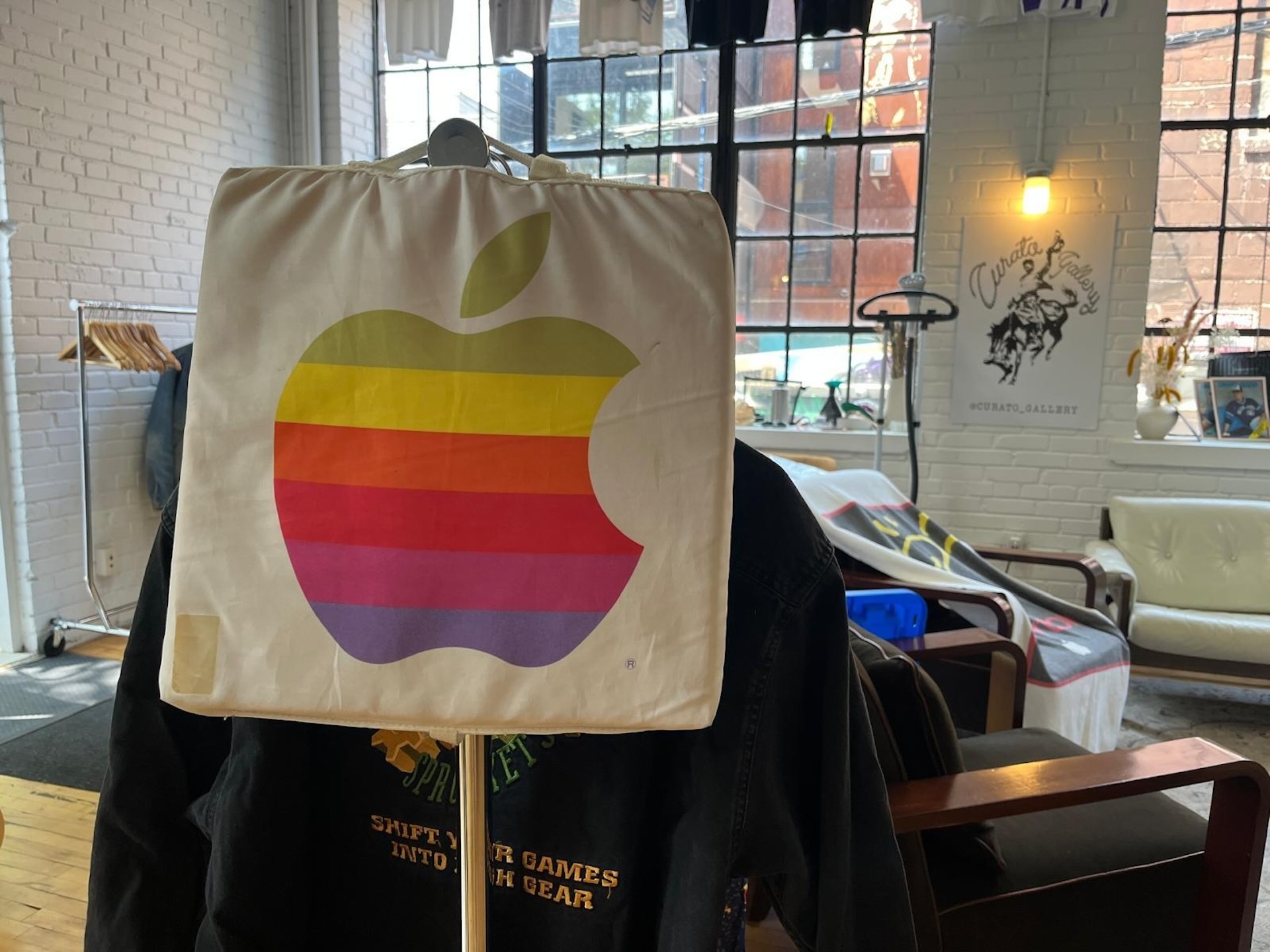 A sports stadium seat cushion with the Apple logo hangs on a clothing rack in Curato Gallery. Photo: Aimée Look for The Logic

News
This Toronto Apple store sells history, not hardware
Nicholas Malisani has amassed 200 collector’s items, from calculators to employee-only jackets. Now he’s selling them in-store for the first time.
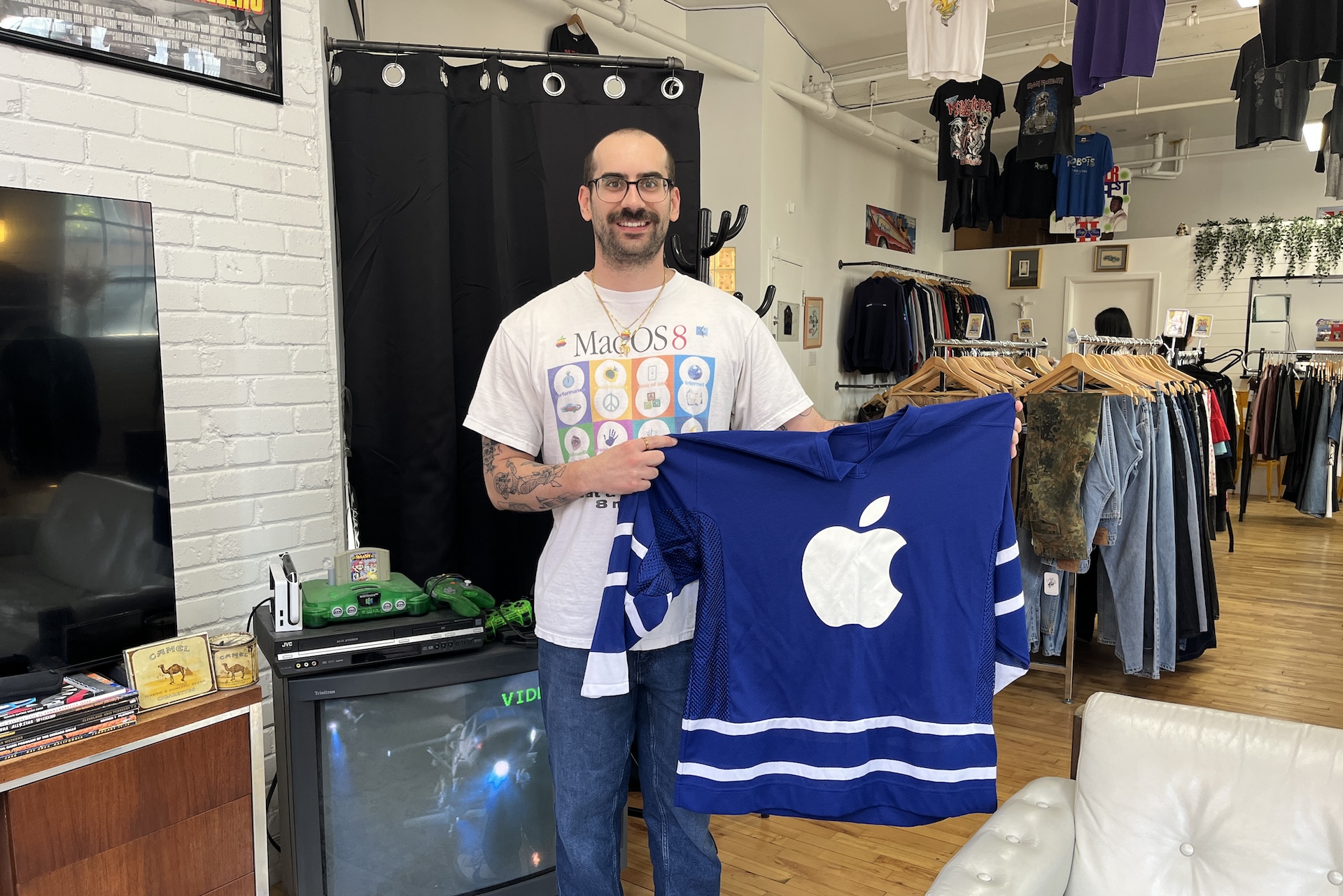
Nicholas Malisani poses with a Toronto Maple Leafs-inspired jersey in his pop-up store in downtown Toronto. Photo: Aimée Look for The Logic
Nicholas Malisani plucks a vintage T-shirt from a clothing rack brimming with Apple insignia. The words “think different” stretch across the front in baby blue font. He then pulls up his own sleeve, revealing a cluster of tattoos on his left bicep. One matches the shirt exactly.
Malisani isn’t just obsessed with Apple. The 30-year-old from Maple, a town north of Toronto, sports a turquoise-rimmed Apple watch with a ticking heartbeat and owns a large collection of Apple-branded clothing and accessories. Now he’s selling some of it, at a pop-up shop this weekend at Toronto’s Curato Gallery.
His fixation began in 2005 with the iPod Nano, and from there, everything “just spiraled,” Malisani told The Logic. “I became obsessed with Apple as a company, and just wanted every product,” he said.
He was particularly drawn to Steve Jobs. The Apple founder and former chief executive’s marketing approach encouraged Malisani to start his own marketing branding company, Got Branding, alongside his full-time work as a millwork detailer.
Related Articles

In high school, he discovered eBay, and bought a belt buckle—his first vintage Apple piece. Since then, he’s tracked down around 200 unique items through Facebook Marketplace, eBay and direct outreach. Malisani keeps it all in bins and storage, hoping to one day have a dedicated room to display it in. A video collaboration with the tech influencer Canoopsy around two years ago put some of his rarest items on display and reached hundreds of thousands of eyeballs.
Now that he’s more established as a seller and on Instagram, people come to him, offering up items they no longer want, or that family members have obtained from working at Apple. “I get a lot of cool stories from old employees,” Malisani said. By cold-messaging former employees on LinkedIn, he’s been able to find full collections of merchandise from the ‘80s and ‘90s.
Malisani has already sold around 50 to 75 items from his collection, and he says his biggest market is Japan. “They have some pretty big collectors over there and pay a premium for it,” he said.
Anything kids-related is hard to find, he says, because the market is so small. On his wish list are promotional accessories for Apple’s Newton MessagePad, one of the personal digital assistants created in the ‘90’s recognized as the predecessors for today’s tablet. “It didn’t last that long, so there wasn’t much available out there,” he said, referencing its discontinuation from Apple.
While his pop-up at Curato Gallery will be the first time he’s selling wares in a physical store, he’s also been approached by ThriftCon, a large U.S.-based thrifting convention, but says the costs of shipping so many of his items over to the U.S. is too high.
It’s unclear if demand for vintage goods will hold up in the face of a trade war. In the last few years however, consumer interest in vintage and thrifting has exploded, with the vintage and resale market expected to reach US$367 billion by 2029, according to a recent report commissioned by retailer ThredUp with findings from GlobalData. Canada’s resale apparel market hit $4.2 billion in 2023, estimates marketing intelligence firm Trendex.
The refurbished smartphone sales market is also growing, around five per cent year over year to 2024, according to technology research firm Counterpoint. Apple products are leading the trend, capturing 56 per cent of sales in 2024, compared to 51 per cent in 2023. Unlike the resale apparel market, much of the smartphone resale market dates back only a few years—in 2023, iPhone 11 and 12 models were most popular—and these models were released in 2019 and 2020, respectively. Apple considers a product “vintage” if the company has halted distribution more than five and less than seven years ago. (After that they become “obsolete.”)
Besides a collection of vintage T-shirts, hats, sweatshirts and jackets, Malisani will have all sorts of oddities on display this weekend. He’s got an Apple-branded toy truck, stadium-seat cushions, and a calculator made in partnership with Canon on display. One big ticket item is the Macintosh table, which he expects to go for around $1,400, and will be propping up a 1984 Macintosh on display at the pop-up.
Another high-value item was an employee-only Apple Cafe jacket he recently sold for US$1,200. Before the Apple Store got its name, the company toyed with a different, but ultimately abandoned concept: the Apple Cafe—part internet cafe, part retail space for merchandise and tech. An exclusive jersey made when the OSX software was released is another crowd pleaser. It looks like a Toronto Maple Leafs jersey, but features an Apple logo on the front and a big X on the back.
An employee-only Apple denim jacket remains his favourite, with buttons shaped like apples and a large logo on the back. He says he’ll never sell it.



Loading...
Thanks for sharing!
You have shared 5 articles this month and reached the maximum amount of shares available.
CloseThis account has reached its share limit.
If you would like to purchase a sharing license please contact The Logic support at [email protected].
CloseGift the full article!
You have gifted 0 article(s) this month and have 5 remaining.
Recipients will be able to read the full text of the article after submitting their email address. They will not have access to other articles or subscriber benefits.
Photo: Aimée Look for The Logic
A sports stadium seat cushion with the Apple logo hangs on a clothing rack in Curato Gallery.
Most Popular This Week




In-depth, agenda-setting reporting
Great journalism delivered straight to your inbox.
Analysis
Flaws in CPP legislation have left billions of dollars at stake ahead of Alberta’s referendum
Briefing
EverWind plans $10B data centre and wind development in Nova Scotia
Canada ready to force Stelco to sell its Canadian operations, Joly says
Feds plan a 60 MW defence-oriented data centre for Ottawa
Best business newsletter in Canada
Get up to speed in minutes with insights and analysis on the most important stories of the day, every weekday.
Exclusive events
See the bigger picture with reporters and industry experts in subscriber-exclusive events.
Membership in The Logic Council
Membership provides access to our popular Slack channel, participation in subscriber surveys and invitations to exclusive events with our journalists and special guests.