Tucked behind Web Summit’s main stage at the Vancouver Convention Centre was a room lined with rows of sand-coloured interview pods resembling horse stalls. Inside one sat Microsoft president and vice-chair Brad Smith. In an interview with The Logic before his keynote, Smith offered a sleek vision of the future of AI that formed a stark contrast with the rustic backdrop.
Skip to content

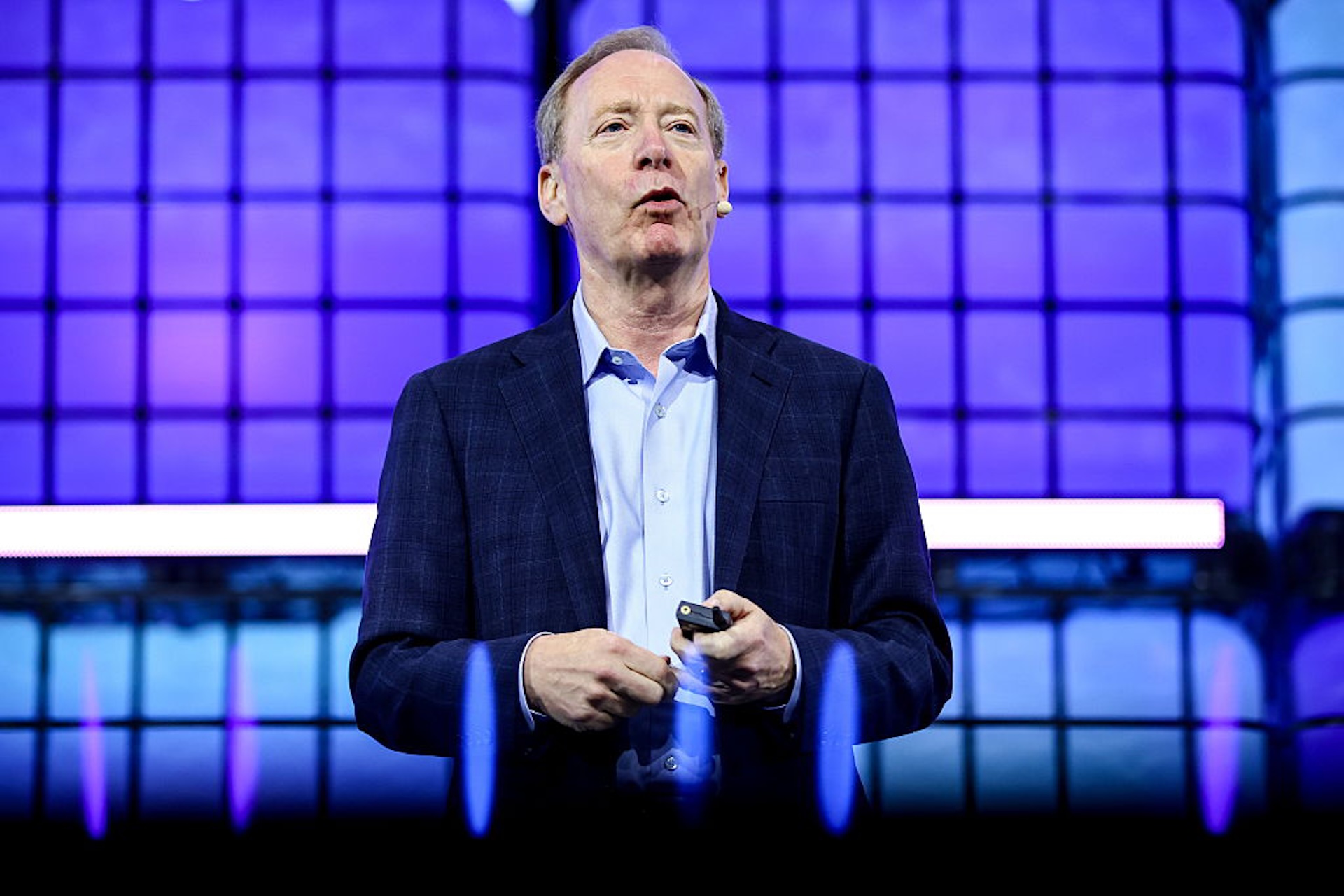 Brad Smith, vice-chair and president of Microsoft, on centre stage during day one of Web Summit Vancouver 2025 at the Vancouver Convention Centre. Photo: Vaughn Ridley/Web Summit

The Interview
Why Microsoft is still bullish on Canada
President Brad Smith on data centres, data sovereignty and the tech giant’s open relationship with OpenAI
Brad Smith, vice-chair and president of Microsoft, backstage at centre stage on day one of Web Summit Vancouver 2025 at the Vancouver Convention Centre. Photo: Sam Barnes/Web Summit
Tucked behind Web Summit’s main stage at the Vancouver Convention Centre was a room lined with rows of sand-coloured interview pods resembling horse stalls. Inside one sat Microsoft president and vice-chair Brad Smith. In an interview with The Logic before his keynote, Smith offered a sleek vision of the future of AI that formed a stark contrast with the rustic backdrop.
Though Microsoft has walked away from some data centre leases globally, it’s continued to prioritize building in Canada, with the country’s data-friendly cool climate and vast energy resources. They’re fuelling the cheaper and faster large language models that are the company’s priority. As Microsoft and OpenAI reportedly redefine the terms of their multibillion-dollar partnership, the tech giant is also undergoing internal shifts. It recently confirmed plans to lay off thousands of employees, and Smith predicts the tech sector is leading a broader shift in which companies direct more of their resources towards AI.
This transcript has been edited for clarity and brevity.
Related Articles


Microsoft has slowed some of its data centre projects in the U.K., Asia Pacific and the U.S. It also has some data centres in Canada. Is Microsoft still committed to its US$80 billion data centre spend? And what does the future of data centres look like in Canada?
We will spend, as we said, more than US$80 billion this fiscal year. That ends at the end of June. We will spend more in the next fiscal year than we spent this fiscal year.
So the spending on data centres is continuing to grow. The growth rate is slowing, but it has reached a point where the amount is enormous. I think that’s the only word I can use to describe it. And let me just say Canada is getting more than a significant share of the total. Let me put it that way.
We’ve long been building out in Canada and across Canada, in part because we recognize Canada’s data sovereignty needs. Those have been apparent for more than a decade, and it enables us to serve the people of Canada, the government of Canada, businesses here. So we do remain committed.
And I think in context, the definition of “pulling back”—is growing more slowly than we might have, but still growing, and I think, probably remaining the largest investor and builder of data centres for customers in the world. You look at a company like Amazon, they’re building a bit for their own use. We’re really building for the use of our customers, and we’re going to continue doing that.
Is Microsoft diversifying away from its relationship with OpenAI? And if so, why?
I wouldn’t say diversifying away from. I think both firms are diversifying, which is perhaps a natural aspect of the evolution of the industry and the growth of both firms.
OpenAI is participating with other firms. So are we. But I would not for a moment understate the importance of our partnership or our appreciation for OpenAI.
Microsoft CEO Satya Nadella has said Microsoft can create near-ChatGPT-quality models for a lot less. What do you think?
We benefit from the partnership we have with OpenAI. So it is a partnership where we, on many days, get to stand on their shoulders. We also have the opportunity to develop other models as fast followers, so to speak.
The AI market is evolving. There is a niche there where fast followers are able to sometimes develop more narrow functionality, but are able to do it less expensively. You see that in a lot of examples across the industry.
I think the market as a whole has become more diverse. You see the leading proprietary models, the so-called frontier models, not only from OpenAI, but say, Claude or Gemini from Google. You see open source, you see a variety of fast followers, and I think that’s the future. It’s really the ability of customers to be able to access many different models for different uses and different needs.
Are you prioritizing cheaper AI models more, less, or about the same as other types?
We participate in all three layers of the tech stack. We’re building the infrastructure, both for ourselves and everyone else. At the platform layer, which is where you tend to put the models, there is an aspect of our strategy and our work that does involve building smaller models on a faster basis, and that’s important.
But I would say our broader perspective is building out all the platform services that applications developers need. We look at the ecosystem as a whole, and we think about how we have our work fit together as a whole, rather than a distinct piece by itself.
Within Microsoft, how rapid has the adoption of AI been? Is Microsoft softening its hiring plans as it increasingly integrates AI?
Everything I see shows that our own employees are adopting AI in a variety of different ways at a very rapid rate. We have data on daily usage, weekly usage… Most of the teams that are using AI—92, 93, 94 per cent of them are using it on a daily or weekly basis. Mostly on a daily basis.
Jobs are changing. Different jobs are changing in different ways. People are, in many instances, doing the most innovative work by taking initiative themselves, by figuring out how to just add AI as a tool that helps them do their work better.
That includes me personally. If I want to learn something for an interview, or I’m testifying before Congress and I think a question is going to come up. I often turn to AI and then ask somebody rather than the other way around.
I do think that the tech sector is restructuring economically, and the tech sector is at the leading edge of an economic restructuring where a higher percentage of our resources are going to capital in the form of AI—both AI in the form of co-pilots and other tools, and now agentic AI.
And we’re seeing real breakthroughs there in terms of productivity that will, over time, reverberate throughout the entire economy. I think the ultimate question for people is how to use AI to improve their own skill set and improve the work they do. And people who do that, I think will be successful. I think they’ll have the opportunity to pursue more interesting work and more successful careers. So change is coming, and it will have a variety of different ramifications.
Are there certain areas of the Canadian startup ecosystem that are particularly attractive to Microsoft, or that you’d like to grow in?
We’ve had more than 3,500 startups engage with us over the last three years in our programs here. And it changes over time. But AI is infused into everything and what you see is this extraordinary nexus, because you sort of add AI to other things. We were talking earlier about building “digital twins” [virtual representations of an object or system] of customer facilities. It may be a physical facility, like an airport. It may be a supply chain that you build out a digital twin. Once you have that digital twin, then you can put AI to work to optimize it.
The real question is, what’s the problem of the day? How can AI solve it? And that’s why startups are typically created. Somebody has a vision of a problem they want to help solve…this is where we fit in as the platform provider to enable the applications creators to go to work. And I think that’s what we see across Canada.
The Canada of 2025 has a potential that far exceeds the Canada of the year 2000 or the year 2010 when the Olympics were here because so much talent has come to Canada, because you’ve got this startup ecosystem, all of these digital natives. So the political clouds can sometimes look stormy, but if you look over the horizon, the future in Canada for the people who live here and the companies that are being built here is very bright, especially when AI is added to the equation.



Loading...
Thanks for sharing!
You have shared 5 articles this month and reached the maximum amount of shares available.
CloseThis account has reached its share limit.
If you would like to purchase a sharing license please contact The Logic support at [email protected].
CloseGift the full article!
You have gifted 0 article(s) this month and have 5 remaining.
Recipients will be able to read the full text of the article after submitting their email address. They will not have access to other articles or subscriber benefits.
Photo: Sam Barnes/Web Summit
Brad Smith, vice-chair and president of Microsoft, on centre stage during day one of Web Summit Vancouver 2025 at the Vancouver Convention Centre.
Most Popular This Week



In-depth, agenda-setting reporting
Great journalism delivered straight to your inbox.
News
Tech firms want AI models to create better versions of themselves
Briefing
U.S. banking regulator accuses TD and BMO of discriminating against conservative clients
Fashion brand Smythe names former Canada Goose president as its first CEO
Dozens of Canadian researchers join chorus of scientists calling for a global AI oversight
Best business newsletter in Canada
Get up to speed in minutes with insights and analysis on the most important stories of the day, every weekday.
Exclusive events
See the bigger picture with reporters and industry experts in subscriber-exclusive events.
Membership in The Logic Council
Membership provides access to our popular Slack channel, participation in subscriber surveys and invitations to exclusive events with our journalists and special guests.