When Canada declared a pandemic last year, doctors shifted en masse to offering their services remotely. In Ontario, they were encouraged to use any platform they could—including Skype, FaceTime and Zoom—for virtual visits.
Roughly a year later, the province has created new guidelines for the types of telehealth services it suggests clinicians use to connect safely with patients, and a verification process for companies to prove their software meets privacy standards. But some of those companies worry they won’t find takers for their services until the province makes permanent doctors’ ability to bill for virtual consultations.
Talking Point
In the early months of the pandemic, doctors conducted 60 per cent of primary care visits virtually, according to a survey by Infoway, up from 10 to 20 per cent in 2019. That mass adoption of telehealth prompted governments to examine best practices for keeping patient medical data safe. Earlier this year, Ontario started verifying services that meet certain security criteria for virtual appointments and four companies have met the bar so far. But, onboarding clients in the public sector may be difficult with temporary billing codes for these virtual visits.
When OntarioMD, a subsidiary of the Ontario Medical Association that advises its doctors on the use of technology, encouraged the use of “any direct-to-patient telephone, telemedicine or video-calling platform” to connect with patients as the province went into lockdown last March, instead of its in-house platform, it was part of a dramatic nationwide shift.
In 2019, doctors across the country conducted just 10 to 20 per cent of primary-care visits virtually, according to a survey by Infoway, a federally funded non-profit looking to accelerate the development of digital health in Canada. In March and April 2020, that number skyrocketed to 60 per cent. By January 2021, more than 85,000 health-care providers had adopted virtual-visit tools and facilitated more than 4.3 million remote visits, according to Infoway.
But privacy must be paramount in telemedicine, and many of the platforms suddenly hosting medical consultations proved susceptible to intrusions. Uninvited participants popped into video calls so frequently in the early days of the pandemic that “Zoom-bombing” became a buzzword.
Letting doctors use whatever technology worked for them “was kind of an odd choice, given the agenda of privacy and security being such a central theme for so long,” said Nicholas Chepesiuk, chief executive at OnCall Health. “But it was necessary in the pandemic.”
In recognition of doctors’ apparent need for help identifying digital best practices, the Ontario Telemedicine Network (OTN)—part of Ontario Health—started assessing virtual-visit medtech platforms earlier this year, verifying whether their video or messaging technologies met standards for privacy and security. Four platforms, including OnCall, have made the list so far.
“The provincial standard, which was released in March 2020, is intended to foster confidence that virtual care solutions meet privacy, security and technical requirements,” Ontario Health said in a statement.
Without this kind of certification process, “you’re leaving [it] up to the doctors and patients to fend for themselves,” said Patrick Lo, CEO of Privacy Horizon. Lo’s company provides telehealth privacy- and security-consulting services, and is working with several clients seeking OTN verification. He thinks health-care providers should be able to focus on delivering care to patients rather than trying to understand technology. He compares doctors faced with a choice of telehealth services to locked-down workers suddenly having to buy chairs for their new home offices: they just want something safe and easy to use for their new work circumstances.
That’s the promise the verification system offers, though OTN is careful to note verifications are not endorsements and users should still conduct their own due diligence.
For OnCall, the process took several months. Founded in 2016, the Toronto-based company offers white-label virtual care solutions, including electronic medical record systems, that clients can deploy with their own branding. Last September, it announced a US$6-million Series A round, led by Base10 Partners that brought its total raised so far to more than US$8 million. “Our vision is to provide a Shopify-like experience to enable any organization to streamline and successfully deliver virtual care,” Chepesiuk said in a statement at the time.
Many of OnCall’s more than 600 clients in North America are private health-care providers, in fields like mental health, nutrition or physiotherapy. With the verification, Chepesiuk hopes that will change. “We haven’t really been able to work that much in Ontario with any sort of hospitals or physicians or public-sector organizations,” said Chepesiuk. “We really had to do much more in the private sector.”
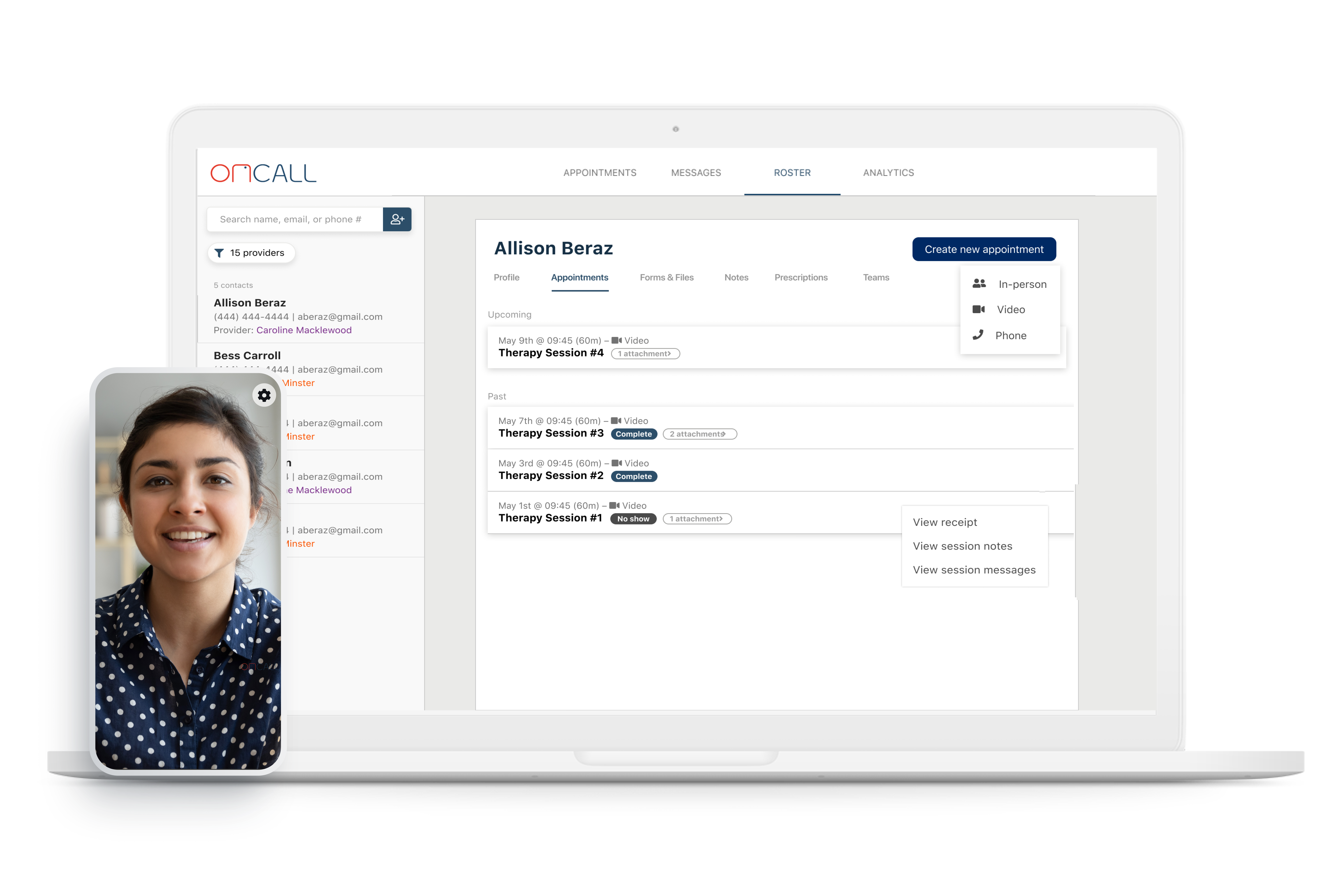
The OnCall Health app screen. Photo: OnCall Health
Another of the verified companies, Maple, saw the process as “a great opportunity” to bring the platform to more people in the province, said Shelly-Ann Rampersad, vice-president of clinical operations, in a statement. Loblaw bought a $75-million stake in the Toronto-based company in September, and Maple expects the growth it’s seen during the pandemic to propel it to an IPO. It already established partnerships with some of the province’s hospitals and clinics during the pandemic, including Toronto’s Michael Garron Hospital, which uses Maple’s platform for virtual visits to the emergency room. “We know that physicians and health systems are looking for platforms they can use to deliver safe, reliable and user-friendly care to their patients, and the verification process reinforces our ability to continue and expand on programs like these,” Rampersad’s statement said.
Despite their verified status, however, both OnCall and Maple, share a concern about when—if ever—the province will make some telehealth changes permanent.
In the early days of the pandemic, the province introduced temporary billing codes, letting public health-care providers bill OHIP, Ontario’s health-care plan, for virtual care they were delivering to their patients without using OTN’s in-house platform. Without a billing code, OHIP can’t pay doctors for their services. Even after the introduction of the temporary codes, some doctors have raised concerns about long delays in processing payments.
More than a year into the pandemic, those billing codes remain temporary, and Chepesiuk said that’s preventing some potential public-sector clients from using his company’s services. “They want to see a permanent billing code in place before they can really adopt it,” he said.
Maple has seen a similar reluctance. While the company is “optimistic that providers will be keen to see how Maple can fit into their virtual care model,” said Rampersad, she acknowledged that the temporary billing codes present a challenge. “Certainly it is difficult to commit to any long-term contract without assurance that these codes will remain in place, however, we have seen organizations be nimble and make the most of the temporary [billing codes] while they are here.” (The other two verified companies—aTouchAway and Adracare—did not respond to requests for comment by deadline.)
A report Deloitte released last year on how telehealth can become a permanent fixture of Canada’s health-care system identified reimbursement issues as a longstanding barrier to wider adoption of virtual care. Governments introduced and endorsed billing mechanisms for these types of visits during the pandemic, the report notes. “This is a step in the right direction … however, it’s not yet clear if this model will be sustainable.” If Canada can deliver, among other things, “innovative payment and funding models such as fee codes,” growth in virtual care can be sustained after the pandemic subsides. Alberta, for one, announced in June 2020 its virtual-care codes would be permanent.
Chepesiuk said OnCall is continuing to work with the Ontario government on a permanent solution. The Ontario Health media team referred questions about billing to the provincial ministry of health, which did not respond by the time of publication. However, it referred The Logic to a March statement saying five of the temporary billing codes had been extended through the fall.
The accelerated telemedicine adoption amounts to “a lot of progress,” said Chepesiuk, and in his estimation the government is doing the right things. But as long as the billing codes remain temporary, he believes they’ll pose a challenge to public-sector adoption of “these better, more convenient, virtual appointment options.”