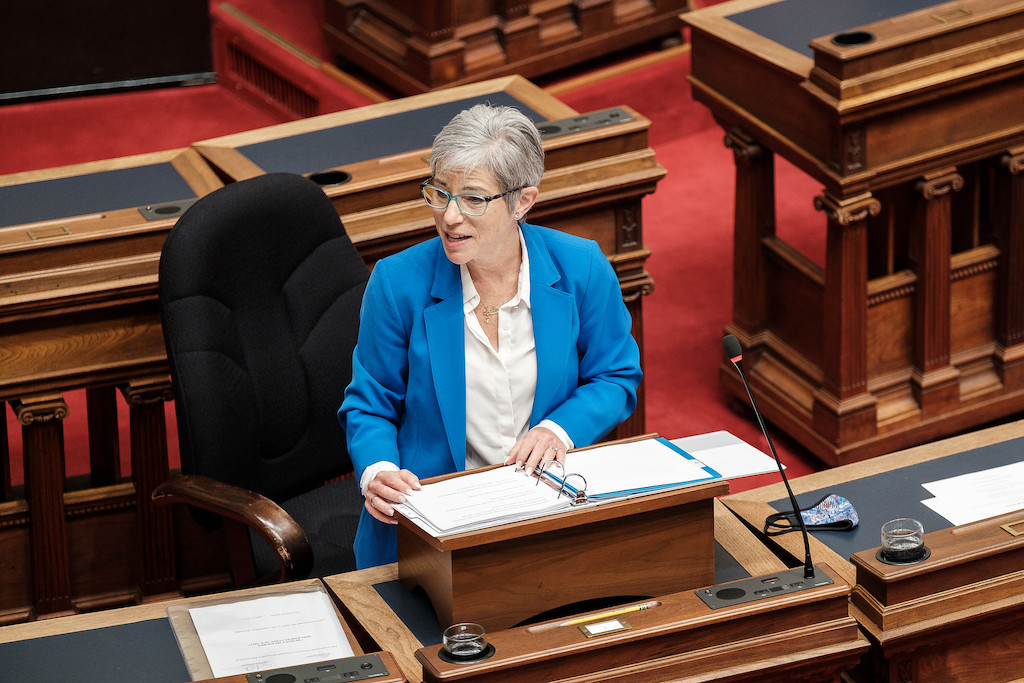
VANCOUVER — British Columbia’s NDP government tabled the first budget of its majority mandate Tuesday as the province works to control the third wave of the COVID-19 pandemic.
The budget, which had been delayed until after the start of the new fiscal year, projects an $8.1-billion operating deficit for 2020–21, an improvement of $5.5 billion from the fall economic update’s forecast of $13.6 billion. The rosier deficit forecast comes from better-than-expected revenues, including taxes from a strong housing market and retail sales, as well as “moderately” less spending. The document anticipates balanced budgets will return within seven to nine years, and expects to present a “specific timeline, approach and plan” in next year’s budget.
It also commits $8.7 billion in new spending over three years in an effort to include everyone in the economic recovery, which it admits will continue to be uneven. There’s more information on the province’s promised strategic investment fund, an expansion of its universal child-care plan and a boost to cleantech and local business.
Here’s what you need to know:
Talking Point
The province tabled its budget Tuesday, delayed from its usual timeline, as B.C. works to control the third wave of the COVID-19 pandemic. The government committed $8.7 billion in new spending over three years, as well as a $4.6-billion pandemic- and recovery-spending contingency fund. It projects an $8.1-billion operating deficit for the fiscal year. The budget outlines more information on the province’s promised Strategic Investment Fund, expands its universal child-care plan and offers a boost to cleantech and local business.
What: Money for a strategic investment fund.
How much: The budget set aside a previously promised $500 million in financing for the InBC Strategic Investment Fund. The funds will come over three years—with $100 million in 2021–22, and $200 million over each of the next two years—and be financed through a fiscal agency loan. The government anticipates the fund will start making investments later this year. The fund’s investment strategy and criteria will also be published this year, according to its website. Its decisions will be made independent of the government, but will be guided by the NDP’s stated priorities, including “moving toward a greener economy and advancing reconciliation.”
What’s happened so far?: The government announced the fund in September 2020; last week’s throne speech said it would introduce legislation in this session to “support” the provincial investment agency, but did not offer further explanation as to what that meant.
Who benefits: Local small- and medium-sized businesses that would otherwise struggle to grow into anchor firms in the province—a major problem identified by nearly a dozen organizations in B.C. working on a plan to help startups grow. That plan asked for a combined $41 million from the federal and provincial governments for a local version of the Scale-Up Platform in Ontario. While ScaleUp BC did not receive a shout-out in either budget, it’s possible the new B.C. regional development office and the Strategic Investment Fund will dole out money to the proposal.
In a question-and-answer period with the press ahead of the budget’s release, B.C. Finance Minister Selina Robinson acknowledged the tech sector identifies this as a challenge. “InBC is available to help that happen, but also to recognize that we want them to meet our priorities, making sure that they have an environmental, social and economic benefit for British Columbians. And so that’s going to help keep those companies here in B.C. and continuing to evolve, and mature and grow,” she said.
The reaction: The fund allocation “is a hopeful sign,” said Jill Tipping, head of the BC Tech Association, in a statement emailed to The Logic. The federal government’s RDA announcement also “provides a clear mechanism for federal funding” for the ScaleUp BC proposal, she said, adding the group will continue its work on finding a way to launch the program over the coming weeks.
***
What: An expansion of $10-a-day child care.
How much: The government committed an additional $233 million over three years to advance its 10-year plan, dubbed Childcare BC. Of that total, $111 million will help add 75 child-care centres to the $10-a-day (or less) program, providing an estimated 3,750 spots at the reduced rate. The money will also expand a pilot to add child care to schools, growing the Seamless Day program from four districts to 24, and help fund an increase in the Early Childhood Educator Wage Enhancement, from an extra $2 an hour to $4. There’s also a $20-million allotment over three years to add 400 spaces to the Aboriginal Head Start program.
What’s happened so far?: The NDP’s previous minority government first announced the Childcare BC program in 2018, with the aim of bringing universal child care to the province. It promised tens of thousands of new spaces, fee reductions and other measures. Later that year, the government announced 53 centres to prototype what universal affordable child care could like in the province, with costs to families capped at $200 monthly per child.
Meanwhile, the federal government announced in its budget Monday that it was creating a national child-care initiative with $10-a-day services across the country by 2025–26, promising up to $30 billion in spending over the next five years, with more to come. The money will bring the federal government to a 50-50 share of child-care costs with provincial and territorial governments as part of initial five-year agreements. “Now that the federal government is in the game, finally, we have some real opportunities to really move forward,” said Robinson, adding that she looked forward to sharing that plan after the province has a better understanding of the federal government’s commitment.
Who benefits: Parents who manage to secure a spot for their child or children at one of the new designated centres; they’ll pay significantly less than what they’d typically shell out.
Also women, who have, throughout the pandemic, overwhelmingly retreated from their careers to take care of their children, so much so that some economists called their experiences a “she-cession.”
More broadly, everyone. Supporting women’s participation in the workforce tends to pay off in GDP growth.
The reaction: The province is “well-positioned to take advantage of the federal government’s recently announced investments,” wrote the Greater Vancouver Board of Trade in its budget report card, which gave the province’s economic recovery a B.
***
What: A boost to CleanBC.
How much: New spending worth $506 million to support CleanBC, which encourages cleaner transportation, energy-efficient builds and emissions reductions in the province. The budget sets aside $130 million for supporting the transition to cleaner transportation. That includes $94 million for the Go Electric program that offers rebates for purchases of zero-emissions vehicles, among other things.
There’s $60 million in one-time funding for the Centre for Innovation and Clean Energy, which will support developing and commercializing cleantech in the province, and for cleantech investments to support and expand partnership opportunities with the federal government.
There’s also $173 million in new funding in 2023–24 for the CleanBC Program for Industry, which aims to reduce emissions at industrial operations through incentives and financing of emissions-reduction projects.
What’s happened so far?: The government first released its CleanBC plan in 2018 as a roadmap to reducing greenhouse-gas emissions by 40 per cent by 2030. This budget brings the total funding for CleanBC to nearly $2.2 billion over five years.
On Monday, the federal government also announced a long list of supports and tax breaks for cleantech and the green economy, pegging the total amount it plans to spend on a “green recovery” at $17.6 billion.
Who benefits: The cleantech industry in the province, which has argued it’s poised to become a global leader. And those wanting to buy electric vehicles in the province will continue to see subsidized prices.
***
What: More money for businesses recovering from the pandemic.
How much: The budget expands pre-existing grants and services. There’s $150 million this fiscal year for the StrongerBC Increased Employment Incentive, a tax credit for private-sector employers that increased payroll costs by hiring new employees or raising wages in the last quarter of 2020, compared to the third quarter. The Small and Medium Sized Business Recovery Grant, for businesses that lost revenue during the pandemic, will receive $195 million. The program grants businesses up to $30,000 to help with their recovery plans.
Additionally, $35 million will go to B.C. farmers to keep their temporary foreign workers safe from COVID-19; another $10 million will help three local strategies in the agriculture sector to expand the domestic market for provincial products.
The budget singles out some of the province’s hardest-hit sectors. The tourism sector will receive additional support, with a $100-million injection to support the industry’s recovery starting this fiscal year. That includes support for major anchor attractions. The industry will also benefit from $20 million for community destination development grants to improve trails, airports and other infrastructure. The Arts Infrastructure Program will receive $6 million over three years for grants supporting capital improvements. There was no additional funding provided specifically for the restaurant and hospitality industry.
Robinson pointed to the budget’s $4.6-billion pandemic and recovery contingency fund as a source of potential support for businesses after the province extended its current pandemic circuit-breaker measures through the May long weekend. The money can also be used beyond that time frame, she said. “I’m hoping and I’m confident that British Columbians are going to do the right thing, and that we will continue with the vaccination program. But as the pandemic has shown us, things can change, and so that’s why we have a significant pandemic and recovery contingency, so that we have the flexibility to support as things evolve over time.”
What’s happened so far?: The provincial government has already allotted tens of millions of dollars to help businesses survive the pandemic through its economic-recovery plan. That includes $44 million to help companies with their e-commerce capabilities, a property-tax reduction and its participation in the Canada Emergency Commercial Rent Assistance program in partnership with the federal government.
Who benefits: Businesses that have managed to survive the pandemic to date and qualify for the extended measures or can access the contingency fund.
The reaction: For small businesses, the budget “misses the mark,” said the Canadian Federation of Independent Business in a statement. While the group acknowledged that the government did not introduce tax increases or other new costs for business owners, it said the budget failed to “provide a big vision for post-pandemic economic recovery.” Local businesses wanted to see help with rising property taxes, red-tape reduction and extension of provincial relief efforts, it said.
The budget “primarily re-announced measures from [the government’s] StrongerBC plan, announced last fall,” wrote the Greater Vancouver Board of Trade, noting the bright spot of new funding for tourism and the arts.
The BC Tech Association saw a possible silver lining for Science World, thanks to the nod to anchor attractions. The Vancouver-based science centre has called its future “uncertain” due to the pandemic.
***
What: A training and retraining effort.
How much: There’s a one-time funding boost of $32 million for training initiated in the province’s recovery plan, including $5 million more to develop 30 micro-credential training courses, meaning short programs, rather than longer degrees. An additional $6 million goes toward 3,000 student work-integrated placements. Short-term skills-training programs will get a $4-million injection to help unemployed or underemployed people train to work in high-demand sectors, including technology.
Another $96 million over three years will help train people for health-care careers. Initiatives to help youth employment will receive $36 million from the contingency fund. That includes $15 million for a program to incentivize businesses to hire young people into tech or tech-enabled positions.
What’s happened so far?: This has been a key part of the province’s recovery plan. It committed $417 million to creating jobs, and providing training and retraining opportunities. That included creating thousands of new positions in the health-care sector, like contract tracers, and $20 million to train about 2,8000 people to work in industries with skills shortages, including technology. The province lost a staggering number of jobs at the start of the pandemic, with its unemployment rate averaging 8.9 per cent last year. It has since bounced back to pre-pandemic levels, though not all sectors have recovered equally.
Who benefits: People looking for work or wanting to learn a new skill where the employment horizon may be more promising, as well as businesses needing to fill jobs.
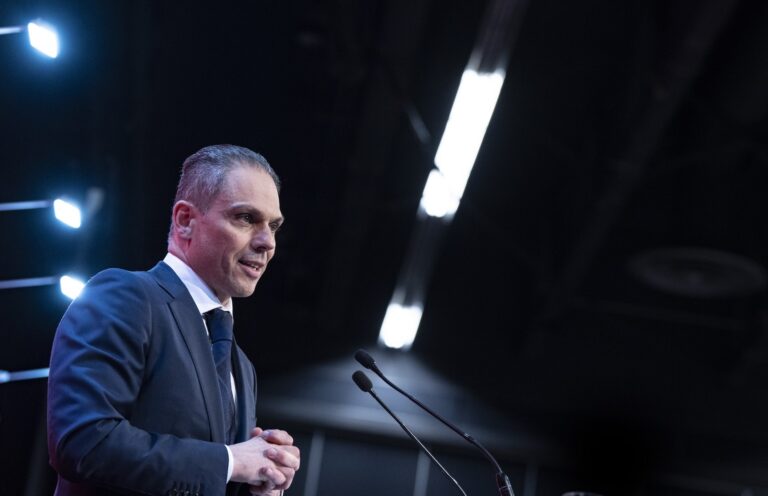
The reaction: The micro-credentials and other retraining tools are “a step in the right direction,” said Benjamin Bergen, executive director of the Council of Canadian Innovators, in a statement. The council represents more than 140 tech companies, including many in B.C. “A shortage of highly skilled talent is among the most pressing concerns for scaling companies in the knowledge-based and data-driven economy.”
***
Also of note:
- Base funding of $40 million over the next three years for high-speed internet and cell coverage in remote and rural communities, including Indigenous ones.
- A PST exemption on electric-bike purchases.
- Free public transportation for kids 12 years old and younger.
- An extra $100 million to continue funding the BC Recovery Benefit, a one-time, tax-free payment of up to $1,000 for families and single parents, and up to $500 for individuals; people have until June 30 to apply.
- $17 million for the Indigenous Skills Training program.
***
What’s missing: Bergen highlighted several areas on which the council’s members had hoped for more detail, but that the government failed to address. They include “plans to develop a ‘made-in-B.C.’ IP strategy, create sector-specific growth strategies for the province’s advanced manufacturing and technology sectors, and establish innovation clusters,” he wrote, adding that Premier John Horgan had included these as priorities in his mandate letters to ministers. Innovation Minister Ravi Kahlon told The Logic in December that he was working on an intellectual property strategy, after the provincial government promised to create a first patent program to give local businesses a rebate on some of the costs of filing their first patent.
The CCI also said it remained concerned that the budget did not extend the Provincial Nominee Program Tech Pilot, which offers a faster path to immigration for people with tech skills, and has only been extended to June. “This is an all too important program for B.C.’s fastest-growing tech companies, and should be made permanent,” Bergen wrote.