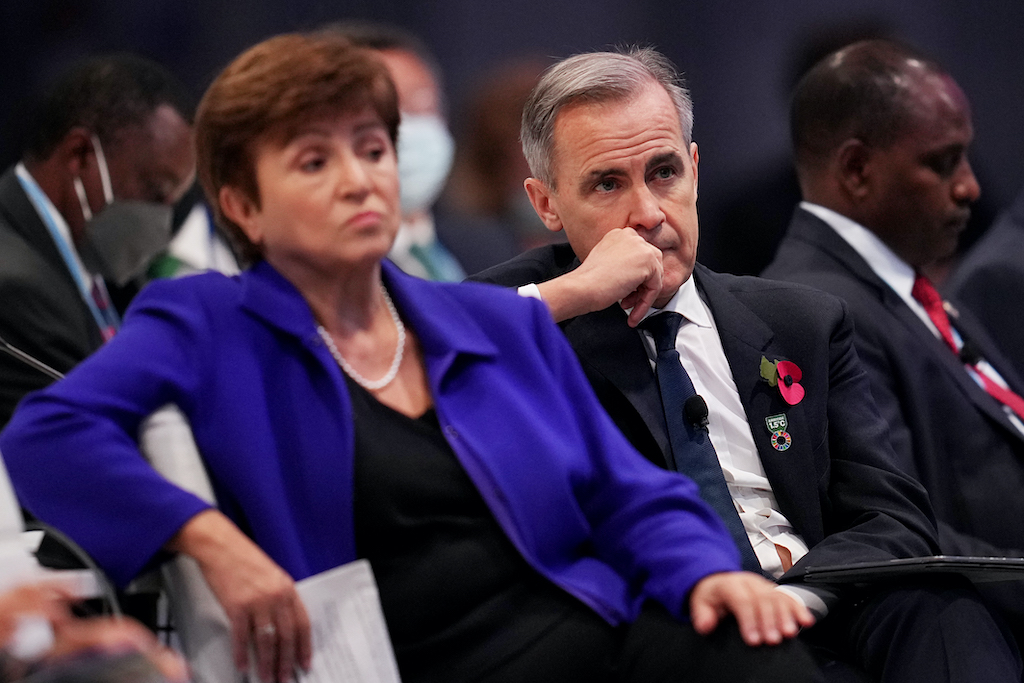
GLASGOW — As heads of state departed COP26 Wednesday, some of the world’s most prominent bankers and investors moved in on Glasgow’s Scottish Exhibition Campus, promising to create “a framework to ensure every financial decision takes climate change into account.”
Tensions around money have been on full display during the first week of this United Nations conference, as student activists and advocates from developing nations accuse the political elites, royalty and celebrities who have made the scene here of getting rich off the same industries that are fueling the climate crisis. Financial-sector leaders say they’re prepared to right that imbalance, for the sake of both the planet and the economy. But climate activists at the conference aren’t convinced the sector—which has facilitated nearly US$4 trillion in fossil-fuel financing since the 2015 Paris Agreement, according to Bloomberg—is truly committed to getting the world to net-zero emissions, with all that entails. Here’s what you need to know about the financial sector’s big day at COP26:
‘The money is here’*: Mark Carney kicked off the day by announcing that more than 450 financial firms controlling some US$130 trillion in assets—up from US$90 trillion in October—had committed to reaching net zero by 2050 and limit global warming to 1.5 C. Support for his Glasgow Financial Alliance for Net Zero (GFANZ) is almost double what it was when it launched in April, and now covers about 40 per cent of the world’s financial assets, said the former Bank of Canada and Bank of England governor, who is serving as the UN special envoy for climate and finance.
Talking Point
Governments and financial-industry leaders announced a deluge of commitments to ensure money flows to assets that help stem global warming. From new funding for developing countries, commitments to phase out fossil-fuel funding and a progress report from Mark Carney, here’s what happened during the financial sector’s big day at COP26.
“The money is here, but that money needs net zero-aligned projects, and there’s a way to turn this into a very, very powerful virtuous circle, and that’s the challenge,” Carney said Wednesday morning.
GFANZ is one of six UN-endorsed net-zero alliances that banks, insurers and asset owners have signed onto in recent years, according to a recent report. But when we met Wednesday morning after Carney’s announcement, Angus Satow of Reclaim Finance, a sustainable-finance advocacy and research group that published the paper, told me they fall short by not requiring their backers phase out support for the fossil-fuel industry. (The Net-Zero Asset Owner Alliance agreed today to phase out support for “most thermal coal assets by 2030.”) “There’s been change in recent years, and that’s welcome; the financial sector is responding, but is it doing it at the pace and scale required?” he asked, rhetorically. “When Mark Carney says the financial sector is ready to ride to the rescue on climate, that’s not where we’re at.”
* The money is 70% here: A new report commissioned by the UN found that GFANZ has the capacity to unleash US$100 trillion, or about 70 per cent of the financing needed, to fund the global net-zero push. Avoiding the “worst physical impacts of climate change” will cost US$125 trillion, according to the report, called the Financing Net Zero Roadmap.
Cutting fossil-fuel funding: The U.K. has convinced about 20 countries, including Canada, and a handful of financial institutions to stop financing fossil-fuel projects. The agreement, expected to be formally announced Thursday, isn’t binding and could leave room for some funding for foreign projects.
The Bank of Canada steps up: The central bank said it’s planning to create tools to weigh the impact of climate change on price stability and the economy. It will also report its own risks related to climate change, following recommendations from the globally recognized Task Force on Climate-related Financial Disclosure.
Finance experts and activists have pressed the bank to take a more active role in ensuring money isn’t flowing to assets contributing to global warming and the physical and economic turmoil that comes with that. But it’s the federal government, not the bank itself, that sets its mandate. The Bank of Canada’s mandate is up for review this year, giving Ottawa a chance to require the institution to oversee climate-related financial risk and scenario-planning. “While the Government of Canada has the primary responsibility for climate-change policy, the Bank of Canada recognizes the importance of including climate-change considerations in its work to promote the economic and financial welfare of Canadians,” the bank said in a statement Wednesday.
The ISSB comes to Montreal: Frankfurt will host the board and chair of the new International Sustainability Standards Board (ISSB), but Montreal clinched one of the other three global offices announced here Wednesday. The ISSB is being set up to create common rules for financial reporting and accounting practices related to climate change. The Montreal office “will be responsible for key functions” and “deeper cooperation with regional stakeholders,” said the board’s governing body, the International Financial Reporting Standards Foundation (IFRS), in a statement.
The Logic was first to report that Canadian cities, including Montreal and Toronto, were pushing to become the new body’s home, with the federal government’s backing. Stéphane Paquet, CEO of Montreal International, which helped lead the city’s bid, said that while he’d hoped to land the headquarters, he hadn’t assumed the city would have, and was pleased with the outcome. “Getting the office is good for us, but it’s not the goal in itself. We have to make sure this office delivers the rules that will govern the financial community,” Paquet told me at COP26 Wednesday.
As we sat near the dozens of pavilions that blanket one of the Exhibition Campus’s halls, showcasing how countries and organizations are addressing the climate crisis, Paquet explained how Montreal International began courting the IFRS in January, after Miville Tremblay, a well-connected accountant, told him the organization was seeking a headquarters for its new sustainability board.
Paquet, along with CPA Canada, rallied a group of Montreal boosters to assemble a bid. In late summer, the team—which included the Montreal mayor and Quebec premier, as well as Desjardins president and CEO Guy Cormier, among other stakeholders—logged onto Zoom to present their 60-page deck to the IFRS and answer questions about why it should choose Montreal.
Paquet said they highlighted the city’s high concentration of international companies and its reputation as a leader in sustainable finance. The promise of a “welcome fund” also featured in their pitch. He wouldn’t say how much they promised, but said it was pooled from private and public contributors who agreed to back any Canadian city that clinched an office. (The Toronto group bidding to host the headquarters also got an interview.)
“The financial component of this COP feels more important than it’s been previously,” said Paquet. “The private sector is here with concrete arguments to make our lives better. With the ISSB in Montreal, that means we are in the loop.”
A win for Wilkinson: Also Wednesday, several wealthy nations promised to up their contributions to the US$100-billion annual fund to help developing countries cope with climate change. The fund was meant to be ready for COP26; instead, Canada’s Natural Resources Minister Jonathan Wilkinson and Germany’s State Secretary Jochen Flasbarth—responsible for wrangling the money—are targeting 2023. New pledges come from the U.K., Spain, Japan, Australia, Norway, Ireland and Luxembourg.
A word from Larry Fink: The CEO of BlackRock, the world’s largest private-asset manager, said on stage during a panel discussion that policymakers and industry leaders need to put the same pressure on private firms as they do on public ones to factor in climate change. Not doing so could create “the biggest capital-markets arbitrage in my lifetime,” he said. “We are seeing more hydrocarbons moving away from public entities to private entities. If we’re serious about this … we have to ask all of society to move forward, or we’re lying to ourselves; we will not get to a net zero.”
Activists aren’t buying it: While Carney touted progress on GFANZ, climate-advocacy organization Insure our Future presented its 2021 scorecard arguing the insurance industry has made little progress in reducing its risks related to climate change. The advocacy group’s analysis showed that relatively few major insurers have committed to phasing out the underwriting of coal (35) and oil and gas (3). Lucie Pinson, founder and executive director of Reclaim Finance, said insurance companies “have been hiding behind engagement” as an alternative to creating firm policies to get out of the fossil-fuel business. “But numbers talk,” she said, noting that only five insurers voted on any of the eight climate resolutions presented at companies’ annual meetings this year.