Major automakers are chasing battery breakthroughs—now a new Canadian lab could play a role.
The University of Waterloo is launching a new battery centre to study advanced technologies such as solid-state and sodium-ion batteries with a $5-million investment that could help Canadian startups keep pace with the technologies being coveted by giants like Toyota and CATL.
The Ontario Battery and Electrochemistry Research Centre will be backed with more than $2 million from the Canada Foundation for Innovation and about $2.5 million from the University of Waterloo. In addition, roughly $700,000 of vendor in-kind funding will go towards building a lab that one leader said could serve a dual purpose, helping to train talent for larger businesses in the electric-vehicle supply chain.
Canada has invested heavily in multinational battery companies as automakers seek to build out their supply chains. But until now, many domestic startups have hit a hurdle: scaling up to build a pilot plant for a potential supply deal often requires having a prototype of their new technology, and prototypes can’t always be completed in a traditional lab, said Linda Nazar and Michael Pope, who are leading the Waterloo centre.
“There’s sort of a dearth of industry in Canada, in terms of battery startups … it’s not as rapid as Silicon Valley,” said Pope. “We were called the Silicon Valley of the North in Waterloo Region … there’s a huge opportunity.”
The big idea: Automakers are racing to improve their electric-vehicle batteries with cutting-edge tech, and Canada wants a piece of the action.
Range anxiety—concerns that an electric-vehicle battery won’t be able to make a full trip on one charge—is one of the biggest roadblocks for automakers that are trying to convert drivers of gas-powered vehicles to EVs, followed closely by high prices.
That’s led battery makers like Toyota to try and create more powerful batteries, like solid-state ones, to see if they can improve EV range. Companies from China’s battery giant CATL to Sweden’s Northvolt are working on sodium-powered batteries with the hope that the world’s abundance of sodium will help them be more cost-competitive compared to other battery recipes.
Nazar said similar labs at U.S. universities are overrun with researchers chasing the next big battery breakthrough—and now, Waterloo could provide an alternative.
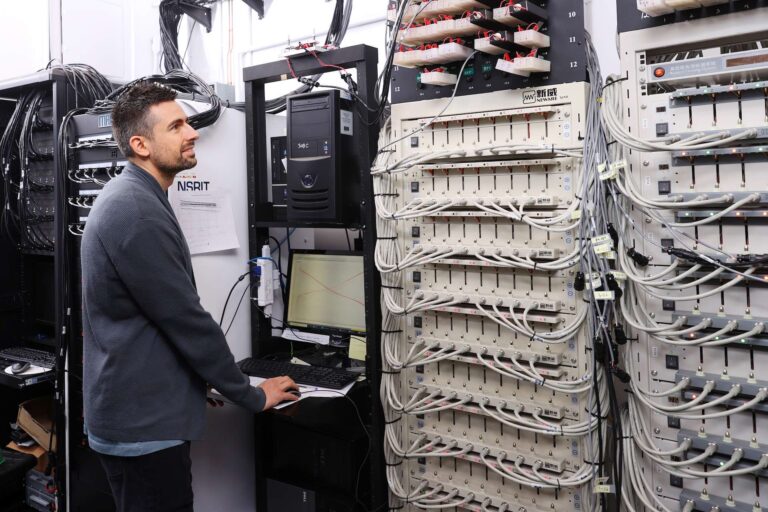
The details: The Waterloo lab will include a fabrication facility that can make large-format batteries like cell-phone batteries, rather than the small coin-sized batteries commonly made by researchers, said Pope. They also want to include equipment like cutting-edge scanning electron microscopes, used to slice thin cross-sections of batteries that can be examined to figure out why batteries fail.
Pope said the lab will also teach students how batteries are made, as southern Ontario gigafactories from Volkswagen or Stellantis, as well as suppliers like Umicore, vie for local talent.
The university is hoping that its track record in the world of tech startups will “launch highly entrepreneurial young researchers and R&D specialists” into the battery business, Pope said in a press release.
The takeaway: “The battery business is really taking off. And it would be foolish of Canada not to jump in. Other countries are far ahead of us in this game, so we’re still kind of playing catch up,” Nazar told The Logic.
“We need a lot more innovation in Canada, we need more startups,” she said. “There’s nothing to prevent Canada from being a leader in this area.”
Read Shift—The Logic’s authoritative weekly newsletter on automotive technology industry news—for more; and if you know someone who should be reading it, they can sign up here.