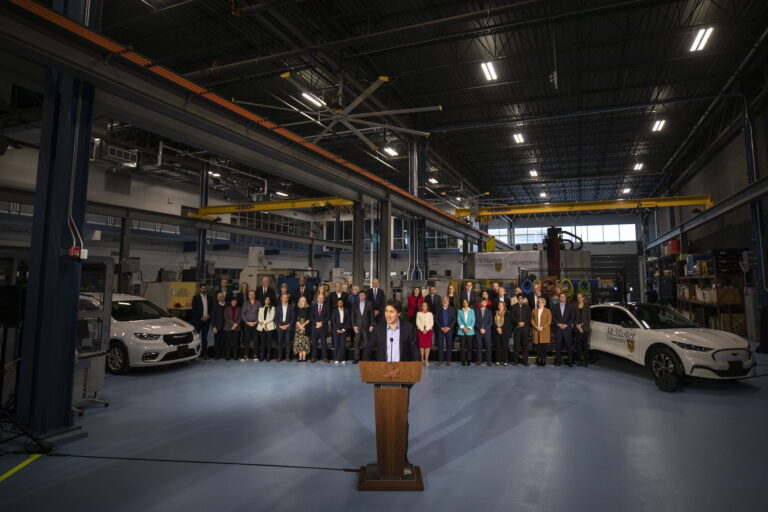
The auto industry is facing tough choices in a tight economy.
As Canada anticipates shedding jobs in a looming recession, the downturn is raising questions about how the auto industry will meet its job-creation goals.
The auto industry is facing tough choices in a tight economy.
As Canada anticipates shedding jobs in a looming recession, the downturn is raising questions about how the auto industry will meet its job-creation goals.
Job creation just got more complicated in the EV sector

The auto industry is facing tough choices in a tight economy.
As Canada anticipates shedding jobs in a looming recession, the downturn is raising questions about how the auto industry will meet its job-creation goals.
Ford’s fourth-quarter earnings came in well below forecasts, with CEO Jim Farley hinting that the company needs to streamline its workforce, including potential job cuts. The comments follow recent cuts at the EV upstart Rivian, and VinFast, where at least one Canadian worker was laid off in a round that’s impacted more than 30 people so far.
In the auto-manufacturing hub Windsor, Ont., Finance Minister Chrystia Freeland was pressed on Monday on the city’s high unemployment rates, amid concerns that EV manufacturing requires fewer parts—and could lead to lost jobs without government subsidies to grow the domestic supply chain. A 2021 report projected the U.S. could lose about 75,000 jobs by 2030 if it did not target subsidies toward domestic EV-parts manufacturing and gaining market share in the automotive market. Canadian researchers have also predicted that hundreds of thousands of jobs in sectors like battery making will depend on governments attracting more battery plants, funding domestic companies and ensuring technology and skills transfers are part of foreign direct investment efforts.
One challenge will be addressing a shortfall in skills essential for the EV transition, but underrepresented in Canada’s workforce. A report released this week by the Canadian zero-emissions vehicle trade group Accelerate and charging-station company ChargePoint estimates the EV charging industry will create about 3,500 full-time jobs by 2035, but notes that by 2028, there will be more than 3,000 electrician jobs left vacant, while other industries, like power-line and -cable workers, will have more job seekers than openings.
Suzanne Goldberg, director of policy in Canada for ChargePoint, said the survey showed the EV transition will require attracting new and diverse applicants to jobs from coast to coast, not just in specific mineral or manufacturing hubs. Each charger takes 54 to 304 job hours across at least eight different professions, the report found. Goldberg said Canada will need more programs like BCIT’s EV technician training and Skills Ontario’s outreach to young people, women and Indigenous workers.
“There are huge employment opportunities. But it’s going to take a lot of planning,” said Matthew Fortier, CEO of Accelerate.
“Government and industry and other institutions really need to focus on meeting the potential training demands of the zero-emissions mobility industry. … Who’s going to do this work? How do we train them to do it effectively? How do we make sure that they’re rewarded appropriately, so that all Canadians may experience a just transition?”
In Windsor, Freeland pledged to invest “aggressively” in the clean economy, with more investments to come in the EV sector in the coming federal budget. Pasted in block letters on her podium was the phrase “Jobs and Growth,” and Freeland said she was confident that Canada would get more than its share of EV investments with its highly educated workforce.
In spite of Farley’s comments this week, there are still automakers looking toward jobs and growth. A Tesla Canada construction leader has said the company is expanding its Canadian charger network. It recently commissioned a report on its Canadian economic impact, touting a 31 per cent year-over-year employment increase from 2020 to 2021 and saying its Canadian spending nearly doubled from 2018 and 2021, reaching $836 million. And General Motors CEO Mary Barra said no layoffs are planned as part of the company’s cost-cutting.
Sakina Evans, a tech talent manager who joined the metal-refining company Nth Cycle last month as vice-president of people, still sees opportunities in auto electrification, batteries and cleantech, despite the downturn. She said she’ll be recruiting candidates from a wide variety of sectors, including potentially those recently laid off from Big Tech.
“The war on talent [is] not going to stop, particularly in this space,” Evans said. “There are a lot of companies right now that we’re pulling from that are not necessarily the companies you would think about in this space. Because of the skills that they have.”
Read Shift—The Logic’s authoritative weekly newsletter on automotive technology industry news—for more; and if you know someone who should be reading it, they can sign up here.
Loading...
You have shared 5 articles this month and reached the maximum amount of shares available.
CloseIf you would like to purchase a sharing license please contact The Logic support at [email protected].
CloseYou have gifted 0 article(s) this month and have 5 remaining.
Recipients will be able to read the full text of the article after submitting their email address. They will not have access to other articles or subscriber benefits.
Photo: The Canadian Press/Chris Young
Great journalism delivered straight to your inbox.

Get up to speed in minutes with insights and analysis on the most important stories of the day, every weekday.
See the bigger picture with reporters and industry experts in subscriber-exclusive events.
Membership provides access to our popular Slack channel, participation in subscriber surveys and invitations to exclusive events with our journalists and special guests.