MONTREAL — In June 2019, Marc Tanguay found himself in an Uber on the way to a Formula One party, staring at a screen bungee-corded to the back of the passenger seat. As it advertised snacks the driver had for sale, Tanguay had two thoughts: 1) The driver was a smart dude, and 2) Why aren’t there screens like this in the back of every Uber?
Skip to content
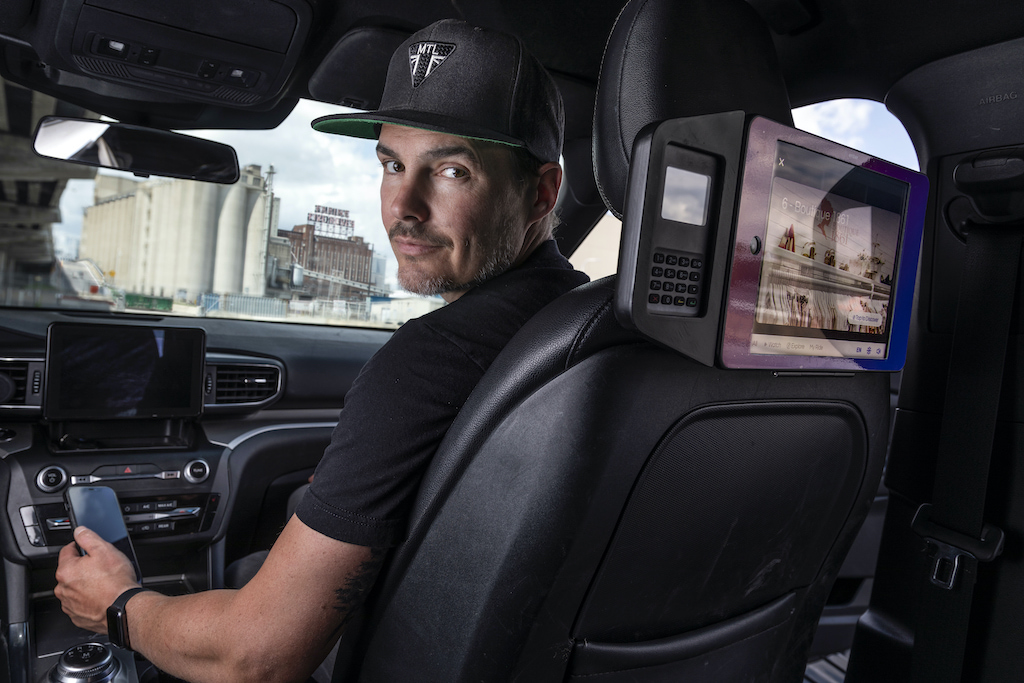
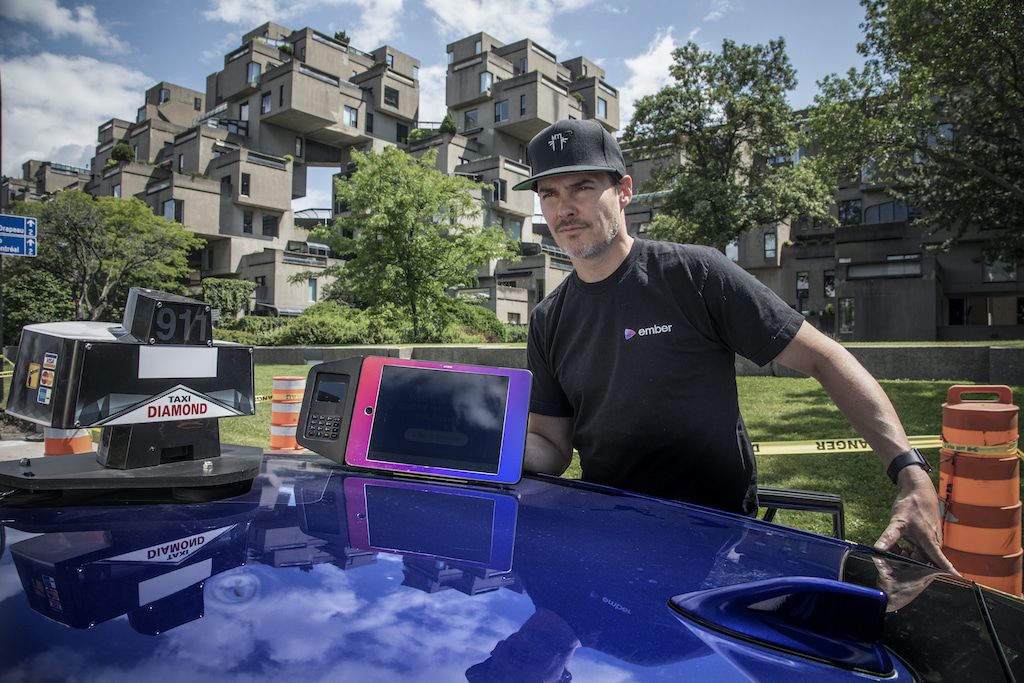 The shift in Ember’s strategy reflects a trend in the transportation industry in Canada and beyond: taxis are seeing a resurgence, and ride-shares are in trouble. Photo: Roger Lemoyne for The Logic

Commentary: Quebec Ink
Why a Montreal startup that bet on ride-sharing is pivoting back to taxis
Marc Tanguay, founder and president of Ember, in Montreal in July 2022. Photo: Photo illustration by Roger Lemoyne for The Logic
MONTREAL — In June 2019, Marc Tanguay found himself in an Uber on the way to a Formula One party, staring at a screen bungee-corded to the back of the passenger seat. As it advertised snacks the driver had for sale, Tanguay had two thoughts: 1) The driver was a smart dude, and 2) Why aren’t there screens like this in the back of every Uber?
Tanguay left the F1 party early to brainstorm. Weeks later, he launched his company, Ember, and within four months he had screens in 220 Ubers on the Island of Montreal, paying drivers between $40 and $60 a month to place the screens, which showed their passengers ads for Harvey’s, Couche-Tard and Expedia, among others. From the start, Tanguay limited his business to Ubers; Montreal’s taxi industry, plagued by an exodus of drivers and a customer stampede to ride-hailing services, needed not apply. “Ubers were king; taxis were dead,” Tanguay told me recently. “And then the old pandemic happened.”
Today, after more than two years of isolation and hardship, Ember’s business now focuses almost exclusively on the same long-unloved taxis we’d been told were going to die an app-enabled death. The shift in Ember’s strategy reflects a trend in the transportation industry in Canada and beyond: taxis are seeing a resurgence, and ride-shares are in trouble.
In a way, Uber and Lyft are prisoners of their own business model. Before the pandemic there were oodles of people who possessed both cars and a willingness to buy into the ride-share spiel of being their own gig-economy bosses. Passengers, meanwhile, enjoyed cheaper fares, underwritten by venture capital dollars fuelling the ride-share companies’ efforts to acquire customers. By May 2019, Uber had 25,000 drivers in Montreal alone, nearly triple the number of taxi drivers cruising the same streets two years before.
But the pandemic cratered demand, pushing this transient workforce out of their cars and into other jobs. As demand has picked back up, the end result has been a dearth of drivers. Uber is notoriously secretive about the number of drivers using its app, and the company didn’t respond to my request for comment. But ride-share prices increased by 45 per cent between 2019 and 2022, according to the market-research firm YipitData, in part because those venture dollars aren’t subsidizing rides to the same extent, and in part due to “surge pricing” designed to lure more drivers onto the roads.
Wall Street has certainly taken note. Uber’s stock price has decreased by more than 57 per cent since July 2021, while Lyft’s has gone down nearly 80 per cent in the same period.
Taxis, meanwhile, have muddled along. To be sure, driving a cab remains a difficult profession—one of the few, as Radio-Canada once pointed out, in which working conditions have actually deteriorated over time. Yet the industry has eked out modest post-pandemic gains in cities including Chicago, San Francisco and New York City. Coop Taxi Laval, which services the suburb north of Montreal, has 240 cars on the road today, 26 more than before the pandemic, according to company president George Tannous.
In one sense, the resurgence of taxis is due to the industry’s heavily regulated nature, which ride-share companies initially disrupted so successfully. Taxi fares are set by governments, not the whims of supply and demand. And driving taxi is a job, not a side hustle. “If it’s nice out, a lot of [ride-share drivers] take the day off to take advantage of the sunny weather,” Tannous, who also serves as vice-president of the province’s taxi association, told me. “Our drivers work.”
The industry has also done its best to ape Uber’s frictionless service. Taxelco, Montreal’s largest cab owner, began using iCabbi, whose app-based dispatching software is nearly identical to Uber’s familiar interface. Meanwhile, in places like Israel and Italy Uber increasingly finds itself working with established cab companies. “The taxi industry is becoming more like Uber, and Uber is becoming a taxi company,” Taxelco director general Frédéric Prégent told me.
Ember is self-financed, and has grown to six employees. The company’s screens are now in 60 Taxelco cabs, though the company has expanded beyond advertising. “We started studying the taxi business and realizing that the opportunities are fucking unbelievable for us, because these guys are still working like dinosaurs. They got eight-pound [point-of-sale] machines that they got to plug in and pass it through a weird plexiglass. It’s a disaster,” Tanguay said.
The result of this disaster: Ember is testing its screen-based tap-and-pay function in 25 Taxelco cars in two weeks, and with further pilot projects in Buffalo and Mississauga in the coming months. Technology, which the taxi industry stubbornly avoided to its great detriment, might save it yet.
Martin Patriquin is The Logic’s Quebec correspondent. He joined in 2019 after 10 years as Quebec bureau chief for Maclean’s. A National Magazine Award and SABEW winner, he has written for The New York Times, The Guardian, The Walrus, Vice, BuzzFeed and The Globe and Mail, among others. He is also a panelist on CBC’s “Power & Politics.” @MartinPatriquin



Loading...
Thanks for sharing!
You have shared 5 articles this month and reached the maximum amount of shares available.
CloseThis account has reached its share limit.
If you would like to purchase a sharing license please contact The Logic support at [email protected].
CloseGift the full article!
You have gifted 0 article(s) this month and have 5 remaining.
Recipients will be able to read the full text of the article after submitting their email address. They will not have access to other articles or subscriber benefits.
Photo: Photo illustration by Roger Lemoyne for The Logic
The shift in Ember’s strategy reflects a trend in the transportation industry in Canada and beyond: taxis are seeing a resurgence, and ride-shares are in trouble.
Most Popular This Week




In-depth, agenda-setting reporting
Great journalism delivered straight to your inbox.
Subscriber Survey
Half of you think AI tools belong in the classroom
Briefing
Canadian contractors brace for retaliatory duties on U.S. nuts and bolts
Blue Owl leads deal to lend Iren US$2.4B to buy equipment for B.C. data centre
Rare earth firm Cyclic Materials raises US$75M for U.S. expansion
Best business newsletter in Canada
Get up to speed in minutes with insights and analysis on the most important stories of the day, every weekday.
Exclusive events
See the bigger picture with reporters and industry experts in subscriber-exclusive events.
Membership in The Logic Council
Membership provides access to our popular Slack channel, participation in subscriber surveys and invitations to exclusive events with our journalists and special guests.