Skip to content

Canada's Business and Tech Newsroom

  • Professional Subscription
  • Partnerships & Advertising
  • Licensing & Syndication
Log In Subscribe
Welcome,
  • My Account
  • Log Out
  • Business
  • Tech
  • National
  • The Big Read
  • Briefings
  • Commentary
Search
Log In Subscribe
Welcome,
  • My Account
  • Log Out
News

New data shows dramatic decline in Canadian Airbnb bookings in summer 2020

Short-term-rental bookings in Canada’s three largest cities declined dramatically for the peak summer travel months, according to new data obtained by The Logic, showing just how severe and prolonged the pandemic’s impact has been on urban tourism and the companies that depend on it. 

For Airbnb, a behemoth in the online-vacation-rental space, the sharp declines in three of its biggest Canadian markets speak to the challenges facing the company as it gears up to go public after laying off thousands of workers amid months of tanking revenues.

News

New data shows dramatic decline in Canadian Airbnb bookings in summer 2020

By Vanmala Subramaniam
Airbnb co-founder and CEO Brian Chesky speaks during an event in San Francisco in February 2018. Photo: AP Photo/Eric Risberg, File
Sep 17, 2020
A A
A Small A Medium A Large
Share

Gift

Share

Short-term-rental bookings in Canada’s three largest cities declined dramatically for the peak summer travel months, according to new data obtained by The Logic, showing just how severe and prolonged the pandemic’s impact has been on urban tourism and the companies that depend on it. 

For Airbnb, a behemoth in the online-vacation-rental space, the sharp declines in three of its biggest Canadian markets speak to the challenges facing the company as it gears up to go public after laying off thousands of workers amid months of tanking revenues.

Talking Point

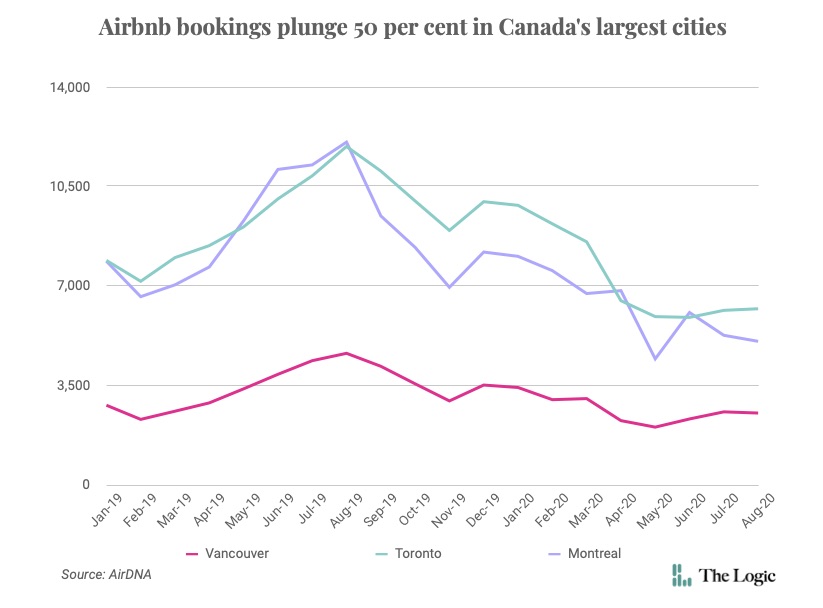
Data provided to The Logic by analytics firm AirDNA tracked monthly bookings made in Toronto, Vancouver and Montreal made on Airbnb and Expedia-owned vacation-rental site Vrbo over the course of 20 months beginning January 2019. In each city, the number of bookings of entire homes plunged by an average of 50 per cent year over year between August 2019 and August 2020. While Canada is a relatively small market for Airbnb, it’s a bellwether of the challenges the company faces as it rushes towards an IPO.

The data, provided to The Logic by analytics firm AirDNA, tracked monthly bookings in Toronto, Vancouver and Montreal made on Airbnb and Expedia-owned vacation-rental site Vrbo over the course of 20 months beginning January 2019. 

In each city, the number of bookings of entire homes (not including shared or private rooms), plunged by an average of 50 per cent year over year between August 2019 and August 2020. 

In Montreal, conventionally a hub of tourist activity (particularly from the United States), there were 12,060 listings booked on Airbnb and Vrbo in August 2019, but just 5,044 homes booked in August 2020—a 58 per cent decline. 

Montreal welcomed nearly four million international visitors last summer. Although statistics on the number of tourist dollars the city generated this summer is not yet available, its tourism board head Yves Lalumière recently said just a million tourists were expected for all of 2020, and that 90 per cent of the city’s tourism revenue is at risk. 

In Toronto, a similar trend was apparent, according to AirDNA data. The number of bookings on Airbnb and Vrbo plunged by 48 per cent from August 2019 to August 2020—there were 11,906 homes booked last August, and just 6,191 bookings this August.

June was Toronto’s worst month this year when it came to short-term rentals, with just 5,887 bookings, a figure that improved only slightly over the next two months. 

Although booked listings in Vancouver plunged by 46 per cent between August 2019 and 2020, the coastal city did experience a relatively healthy 25 per cent increase in bookings between May and August, largely due to how quickly the province embarked on a reopening plan compared to Ontario and Quebec, the latter of which has seen the biggest number of virus-related deaths in the country. 

While Canada is likely a relatively small market for San-Francisco-based Airbnb—the company does not offer such data publicly—the trends here are representative of the challenges the company faces. Just six months ago, it was on the brink of going public, last valued in 2017 at a monster US$31 billion. Then the pandemic hit, and travel, along with short-term-rental bookings, came to a virtual standstill. In May, Airbnb laid off 25 per cent of its staff, and subsequently announced a US$1-billion debt raise from private equity firms Silver Lake and Sixth Street Partners, which came with a rather uncomfortable interest rate of over 10 per cent. The company still intends to go public—this time at a value of US$18 billion—but it is still unclear when exactly that might happen, given its precipitous decline in revenue. 

Dan Wasiolek, a travel-sector analyst with Morningstar who has traditionally been bullish on vacation-rental companies like Airbnb, said that while Airbnb certainly has a “competitive advantage,” there is a chance it will delay its IPO if there is negative news regarding a vaccine, and most of North America goes into heavy lockdown again. “I think there will be a point when they say, ‘Listen, it’s probably not best to IPO right now,’” he told The Logic. 

While urban bookings in Canada have plunged, there is some data to suggest that Airbnb has had success with rural bookings. Company spokesperson Sam Randall told The Logic that the top two Canadian destinations for the Labour Day weekend were Collingwood in Ontario and Mont-Tremblant in Quebec—bookings were up 185 per cent and 166 per cent, respectively, over the last year. A similar trend is playing out in the U.S., where there was a 25 per cent surge in rural bookings in June 2020, compared to a year prior. Vrbo did not respond to a request for comment.

Additionally, Randall said, the share of longer-term stay searches in August this year is nearly double what it was this time in 2019. He did not, however, specify how that trend translated into actual bookings, and revenue for the company in Canada. 

“What I can tell you from the data that we have on hand is that most of the travel that is being done is away from urban areas to national parks, beaches. The hotel data we see is really strong for hotels that are not in urban areas,” Wasiolek said. 

AirDNA numbers also point toward the overall decline in the number of available listings in these three urban markets, suggesting that Airbnb and Vrbo are to some extent losing hosts. In Vancouver, the total number of short-term rentals available on the market that were entire homes declined by 18 per cent, while in Toronto and Montreal, those figures were 12 per cent and 19 per cent, respectively. 

Indeed, when the pandemic first hit, there was some evidence to suggest that the decline in short-term-rental availability in more expensive cities like Toronto and Vancouver had the effect of adding to the long-term-rental market. For instance, a particularly popular Airbnb building in downtown Toronto called Ice Condos saw a 234 per cent surge in the number of units available for long-term rent, data from condos.ca shows.

Gift the full article

Depending on the longevity of the pandemic, losing hosts could potentially have a negative effect on sites like Airbnb and Vrbo. Wasiolek believes that what distinguishes the success stories in the vacation-rental space is those that have a “network advantage” of having accumulated a critical mass of listings.

“Because these sites generate a lot of traffic, it incentivizes people to join the network. It’s kind of a positive, virtuous cycle. But it could also go in the opposite direction, it is tough to get into that cycle and get it moving in a positive direction,” he said.

#Airbnb #COVID-19 #short-term rentals #Vrbo

Sponsored Content

How to shift your workforce from AI experimentation to adoption

By Jessica Aftimus Rosa

The real-world economic offshoots of sovereign AI

By Deborah Aarts
Illustration of a plane flying above a mailbox

Increasing healthcare access across Canada

By Deborah Aarts
Paid promotional content

Loading...

Thanks for sharing!

You have shared 5 articles this month and reached the maximum amount of shares available.

Close
This account has reached its share limit.

If you would like to purchase a sharing license please contact The Logic support at [email protected].

Close
Want to share this article?

Upgrade to all-access now

Close
Gift the full article!

You have gifted 0 article(s) this month and have 5 remaining.

Copy link and gift
Copy Link
Email to a friend
Send Email
Gift on Social Media

Recipients will be able to read the full text of the article after submitting their email address. They will not have access to other articles or subscriber benefits.

Photo: AP Photo/Eric Risberg, File

Most Popular This Week

News

What it was like to pitch a project in the hurly-burly of the Canada Investment Summit

By David Reevely
A shot of Mark Carney, who is seated, watching Ursula von der Leyen speaking at a lectern before the European Parliament. Carney is in sharp focus; von der Leyen is out of focus in the foreground.
News

Making Canada an ‘associate member’ of the EU won’t be simple—whatever the label means

By Joanna Smith
Analysis

Carney’s $500B investment claim requires some generous math

By Claire Brownell
Special Report

Canada pitched itself to the world’s biggest investors. Now comes the hard part

By David Reevely, Anita Balakrishnan, Murad Hemmadi, Chaimae Chouiekh, Claire Brownell and Kevin Carmichael

In-depth, agenda-setting reporting

Great journalism delivered straight to your inbox.

A shot looking down the length of a tunnel with conduits along its sides and railroad-style tracks on its floor. There are two workers in the distance wearing hardhats and headlights and walking toward the camera.
The Big Read

Cameco’s high-stakes bid to be Canada’s next nuclear champion

By Joanna Smith

Briefing

Oilsands major Imperial Oil takes public stance against Alberta separatism

By Meghan Potkins   |   Sep 23, 2026 | 3:40 PM ET

TD Bank puts up $25M to develop AI banking tools with Cohere

By Murad Hemmadi   |   Sep 23, 2026 | 3:36 PM ET

Canadian data-centre job postings jump 68% as AI buildout takes shape

By Chaimae Chouiekh   |   Sep 23, 2026 | 3:33 PM ET

Best business newsletter in Canada

Get up to speed in minutes with insights and analysis on the most important stories of the day, every weekday.

Exclusive events

See the bigger picture with reporters and industry experts in subscriber-exclusive events.

Membership in The Logic Council

Membership provides access to our popular Slack channel, participation in subscriber surveys and invitations to exclusive events with our journalists and special guests.

Recent Popular Stories

News

Trump steps up effort to block Canadian goods from U.S. procurement—but his order leaves a lot untouched

By Joanna Smith   |   Sep 17, 2026
A nighttime shot of Donald Trump holding his hand while speaking. He's wearing a red hat with "USA" emblazoned on the front.
Analysis

The ‘red line’ in U.S. trade talks that sets Canada apart from other countries

By Joanna Smith   |   Sep 14, 2026
Donald Trump holding up a board bearing the names of countries and tariff rates. He's standing behind a lectern bearing the U.S. presidential seal.
Analysis

Carney’s $500B investment claim requires some generous math

By Claire Brownell   |   Sep 16, 2026
Commentary

Carmichael: The Canada Investment Summit did what it needed to do

By Kevin Carmichael   |   Sep 18, 2026
Exclusive

India seeks tariff rate quotas for crops, recognition of its economic heft as trade talks with Canada near finish line

By Joanna Smith   |   Sep 21, 2026
A shot of Dinesh Kumar Patnaik speaking to an interview while seated at an office desk. He's wearing a jacket and open-necked shirt and there is a small Indian flag among the objects on the desk.
News

Making Canada an ‘associate member’ of the EU won’t be simple—whatever the label means

By Joanna Smith   |   Sep 16, 2026
A shot of Mark Carney, who is seated, watching Ursula von der Leyen speaking at a lectern before the European Parliament. Carney is in sharp focus; von der Leyen is out of focus in the foreground.

Canada's most influential executives and policymakers are reading The Logic

  • CPP Investments
  • Sun Life Financial
  • C100
  • Amazon
  • Telus
  • Mastercard
  • bdc
  • Shopify
  • Rogers
  • RBC
  • General Motors
  • MaRS
  • Government of Canada
  • Uber
  • Loblaw Companies Limited
logic-logo

Canada's Business and Tech Newsroom

100% human-crafted journalism

Newsroom

  • News Tips
  • AI Policy
  • Editorial Disclosures
  • Story Pitches

Company

  • About Us
  • Terms of Service
  • Privacy Statement
  • Corporate Information

Contact

  • Contact Us
  • Advertise
  • FAQs
  • Work at The Logic

© 2026 The Logic Inc. All Rights Reserved.

Trusted by leaders

Error

Account creation failed.

Please email us at [email protected].

Create Account

[wppb-register form_name=”cozmo-registration-form-for-modal”]

I do have an account
Login
or

[wppb-login]

I don’t have an account










