OTTAWA — Canada’s push to build a domestic pharmaceutical industry and prepare for future pandemics is running into a problem: the same federal government that wants top-end biology research here doesn’t yet have the capacity to make sure that work is done in safe and secure laboratories.
Skip to content

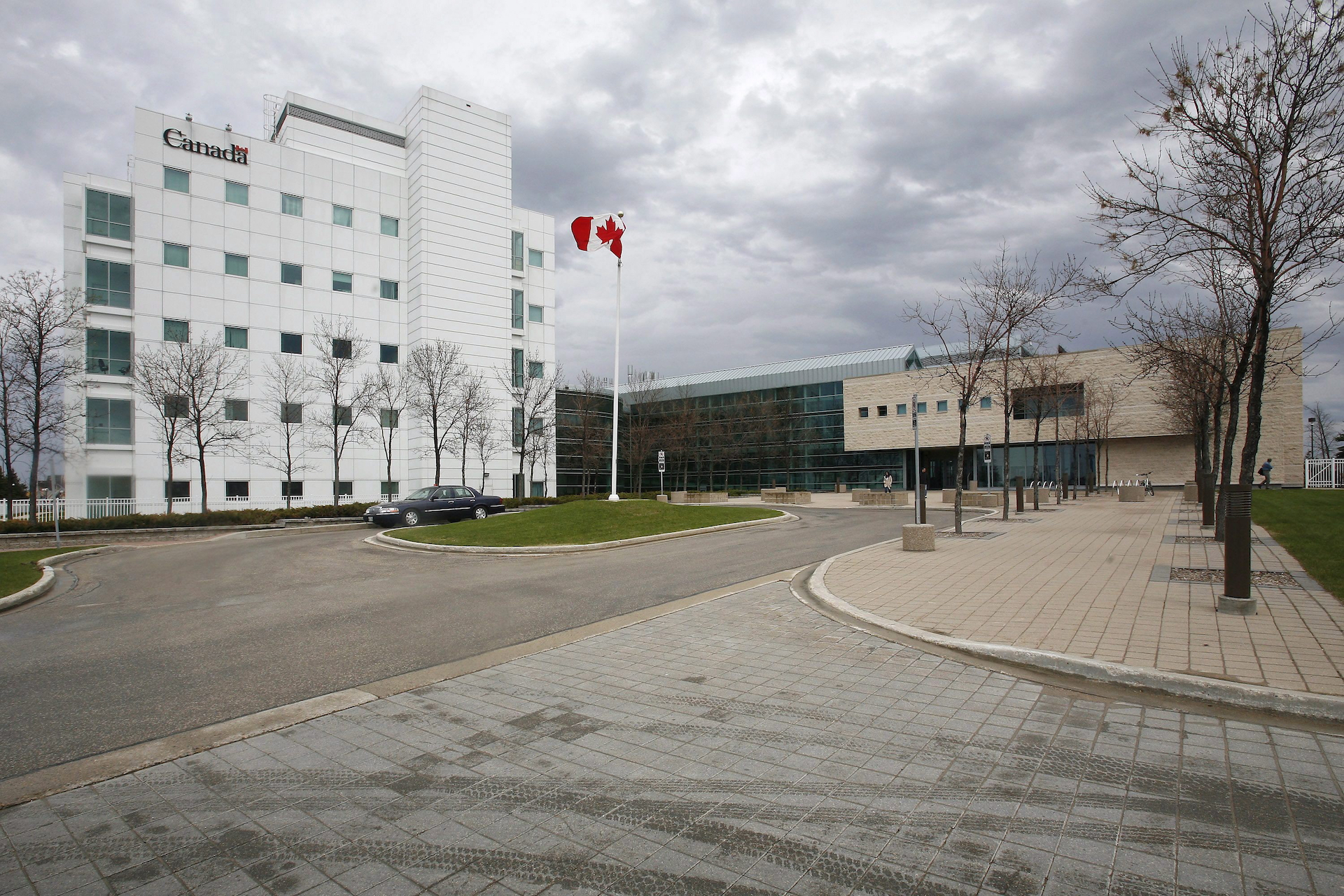 The National Microbiology Laboratory in Winnipeg on May 19, 2009. Photo: John Woods/The Canadian Press

News
Major gaps in Canada’s rules for high-security labs, federal experts warned
Outdated legislation and lack of expertise are about to meet a tidal wave of new lab projects
A lab technician works at a Level 4 lab at the National Microbiology Lab in Winnipeg, Manitoba, on Nov. 3, 2014. Photo: Lyle Stafford/The Canadian Press/Pool, Reuters
OTTAWA — Canada’s push to build a domestic pharmaceutical industry and prepare for future pandemics is running into a problem: the same federal government that wants top-end biology research here doesn’t yet have the capacity to make sure that work is done in safe and secure laboratories.
Until it does, the government will have a hard time advising would-be lab operators how to prepare their facilities, and dealing with a slew of projects to advance medical and pharmaceutical innovation that will stall without government approval.
Talking Points
- The Liberal government is striving to rebuild Canada’s life-sciences sector as an economic force and a shield against future pandemics
- Federal law assumes only the feds will run top-security research sites (they soon won’t), and authorities expect inspections of lesser labs could need to increase by half
According to a presentation prepared last June for a committee of deputy ministers and agency heads, Canada has gaps in its foreign and defence policies, its criminal law and the Security of Information Act that governs national secrets, and its rules on security clearances.
Also, the agencies overseeing laboratories that do potentially dangerous work don’t have the expertise to monitor physical and cybersecurity measures.
This matters because, as the presentation said: “Significant new investments to augment Canada’s domestic supply chain/biomanufacturing sector has led to an exponential increase in growth of new laboratories working with our highest risk group pathogens.”
Related Articles
The document was prepared by Kathy Thompson, executive vice-president of the Public Health Agency of Canada (PHAC) and Kimby Barton, director general of its centre for biosecurity. The Logic obtained a redacted copy through access-to-information law.
Thompson and Barton told the top officials that they knew about 34 high-end labs at various stages of construction or renovation, 31 of them outside direct federal control. Fourteen of those were still just proposals, but 20 were already funded and in at least early design phases.
This is happening with massive government backing: the feds have sunk $1.8 billion into “the biomanufacturing, vaccine and therapeutics ecosystem” to build up Canada’s life-sciences industry and prepare for future pandemics.
Many research-oriented universities and large hospitals have Level 3 labs, which can deal with germs like anthrax and monkeypox, and the SARS-CoV-2 virus that causes COVID-19.
‘I can’t get permission for a Level 4 lab, then work with whatever I want in there. Every experiment that is happening in our facility is being reviewed before we are allowed to start it.’ — Volker Gerdts of the Vaccine and Infectious Disease Organization
These labs do basic research that feeds commercial development. The Level 3 lab at the University of Toronto, called the Toronto High Containment Facility, has contributed to work on tuberculosis vaccines, immunotherapeutics and HIV-AIDS. During the pandemic, it ran around the clock doing COVID-19 research. The one at the University of British Columbia touts recent work on a fabric coating that kills germs, including ones that cause nasty infections in hospitals; the lab has a rate card for researchers wanting to use its facilities.
The federal government is used to working with Level 3 labs, though Thompson and Barton told the top officials they anticipated a 50 per cent increase in annual inspections of high-end labs if all those projects come to fruition.
And then there are two potential new Level 4 labs (one at the University of Saskatchewan, one by an unidentified organization outside the federal government), for which the government does not have adequate rules, because the current ones don’t account for the possibility that anybody but the federal government would run one.
Level 4 labs deal with the scariest germs on earth—typically hemorrhagic-fever viruses like Ebola. These bugs are some combination of lethal, relatively easily transmitted, and hard or impossible to vaccinate against or treat.
An academic attempt in 2021 to identify all the Level 4 labs in the world found 59 of them. Canada now has two, both in the federal government’s Canadian Science Centre for Human and Animal Health in Winnipeg.
One, the National Microbiology Laboratory, is run by PHAC; the other, the National Centre for Foreign Animal Disease, is run by the Canadian Food Inspection Agency (CFIA). Different but basically similar laws cover pathogens that threaten humans, which are in PHAC’s domain, and those that endanger animals, which are in CFIA’s.
The physical standards and operational requirements are public and apply to any facility working with a regulated pathogen. They spell out, for instance, that workers in Level 4 labs must wear positive-pressure suits hooked up to external air supplies (with backups), and that surfaces and handles inside those labs need to have smooth edges.
But some of the requirements stem from laws and policies that control only government operations. Those apply to the labs in Winnipeg, because they’re federal, but not elsewhere.
One of the new Level 4 labs is to be at the Vaccine and Infectious Disease Organization, known as VIDO, at the University of Saskatchewan. It’s home to the new Canadian Centre for Pandemic Research. VIDO began as a centre for animal diseases (the “V” once stood for “Veterinary”) but has added human illnesses to its ambit over the decades since its founding in 1975.
“We operate in an interface of human and animal health, and that’s where most of these new diseases emerge from—they jump from animals into humans or sometimes back from humans into animals,” said Volker Gerdts, VIDO’s director and CEO, in an interview with The Logic.
VIDO added Level 3 lab capacity in 2011, though Gerdts said those labs stayed in a sort of rehearsal mode for a year and a half before “going hot.” That project included building certain rooms and laboratory facilities to “near-Level 4 specifications,” so they can be upgraded without too much difficulty.
Still, he estimated it will be two to three years before the Level 4 facilities are ready for rehearsals.
Meanwhile, VIDO is talking to its regulators about what it can expect to have to do beyond the existing biosafety rules. Gerdts declined to discuss those measures in detail, but noted they include screening staff and adding physical and cyber security.
“There’s various aspects of the overall biosecurity that are necessary for us to ensure that we can operate this lab in a safe way and also [to] ensure that nothing will get out,” he said.
Furthermore, in an indication of the work all these additional labs will mean for their regulators at PHAC and CFIA, Gerdts said it’s not just the facilities that need approval for research involving dangerous pathogens, but every single project within them.
“I cannot say, ‘I would like to have a Level 4 lab,’ get permission for a Level 4 lab, and then in the future, work with whatever I want in there without telling anyone. That’s not how it works,” Gerdts said. “Every type of work, every experiment that is happening in our facility, is being reviewed before we are allowed to start it.”
The second potential non-federal Level 4 lab remains a mystery. The presentation released to The Logic has a whole slide outlining government dealings with VIDO in Saskatchewan but nothing about the other lab.
A spokesperson for Health Canada and PHAC, Anna Maddison, refused to say anything about it: ”The government of Canada does not share information on applications made by regulated parties,” she wrote in an email.
Numerous major universities with Level 3 labs told The Logic they’re not building a Level 4 lab or upgrading to one.
Laval University in Quebec City had been contemplating one, Marc Ouellette, director of Laval’s Infectious Disease Research Centre, said in an email. But that idea died after his predecessor, Gary Kobinger, left in 2021 to oversee a Level 4 laboratory in Texas, Ouellette wrote.
Kobinger had been involved in developing an Ebola vaccine in a previous posting at the National Microbiology Lab in Winnipeg—a vaccine ultimately licensed to pharma giant Merck. But when he left, he took key expertise with him, Ouellette wrote, and now Laval has “no current plans” for a Level 4 lab.
The June presentation released to The Logic included a section on what the Public Health Agency of Canada intended to do about the problems it had identified. Most of those were redacted, but one was to review the regulations and existing laws and prepare a report, to be done by “Fall/Winter 2022.”
Asked whether that report is complete or on schedule to be done this winter, Maddison pointed to a separate review of the law governing human pathogens that was published last March, months before the presentation, and said the government is still thinking about it.
“Should this lead to proposals for legislative or regulatory changes, the government will consult with external stakeholders,” she wrote.
Maddison did not answer whether the larger review is complete or on track.
The presentation said PHAC lacks expertise in security and needs access to people with the necessary skills. The Logic asked whether that is being addressed and how.
“PHAC works closely with Government of Canada security partners,” Maddison wrote.



Loading...
Thanks for sharing!
You have shared 5 articles this month and reached the maximum amount of shares available.
CloseThis account has reached its share limit.
If you would like to purchase a sharing license please contact The Logic support at [email protected].
CloseGift the full article!
You have gifted 0 article(s) this month and have 5 remaining.
Recipients will be able to read the full text of the article after submitting their email address. They will not have access to other articles or subscriber benefits.
Photo: Lyle Stafford/The Canadian Press/Pool, Reuters
The National Microbiology Laboratory in Winnipeg on May 19, 2009.
Most Popular This Week




In-depth, agenda-setting reporting
Great journalism delivered straight to your inbox.
News
Panel decries Canada’s chaotic way of funding world-class science
Briefing
AI is pushing insurers to become asset managers, Canadian CEOs say
Trump administration faces lawsuit over 50% tariffs on Canadian goods
Canada-U.S. trade war to reduce real GDP by 1.4% over 2024 levels after five years: PBO
Best business newsletter in Canada
Get up to speed in minutes with insights and analysis on the most important stories of the day, every weekday.
Exclusive events
See the bigger picture with reporters and industry experts in subscriber-exclusive events.
Membership in The Logic Council
Membership provides access to our popular Slack channel, participation in subscriber surveys and invitations to exclusive events with our journalists and special guests.





