OTTAWA — The federal government’s Canada Infrastructure Bank is taking all the risk if a $400-million loan to buy Ottawa’s transit system hundreds of new electric buses goes wrong, the city’s transit boss told city councillors last week.
Skip to content

News
Infrastructure Bank’s backing makes Ottawa the test bed for Canada’s electric-bus ambitions
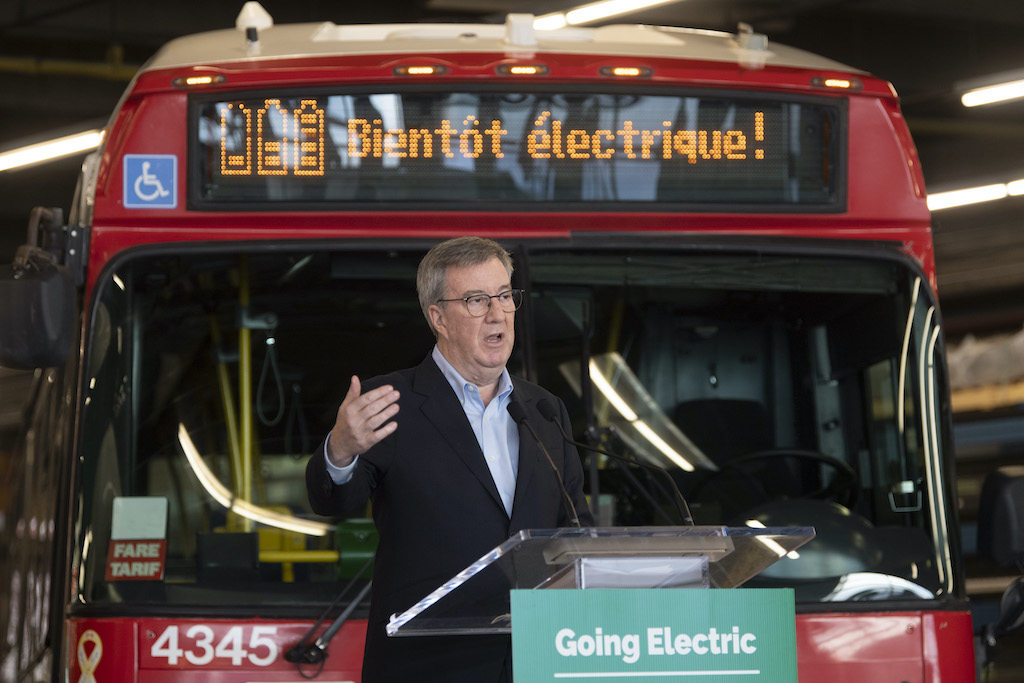
Ottawa Mayor Jim Watson speaks in Ottawa in March 2021. Photo: The Canadian Press/Adrian Wyld
OTTAWA — The federal government’s Canada Infrastructure Bank is taking all the risk if a $400-million loan to buy Ottawa’s transit system hundreds of new electric buses goes wrong, the city’s transit boss told city councillors last week.
The taxpayer-funded bank is lending the city government the money to cover the higher price of buying battery-powered buses instead of diesels, to be repaid with savings from the buses’ expected lower operating costs.
Talking Point
Ambitious plans to electrify Ottawa’s bus fleet depend on advances in battery technology that might not come through or major changes in how the capital’s transit system works. If electrification doesn’t save the money the city expects, it won’t have to pay back a loan from federal taxpayers.
“If the savings and the performance don’t come to the level that we expect, we don’t have to pay back the CIB loan,” John Manconi said in a council meeting, shortly before local politicians in the capital voted unanimously to push ahead with what’s been billed as the boldest transit-electrification plan in Canada.
The bank touts the effort as a bold move on its mandate from the federal government to invest up to $1.5 billion in zero-emissions buses (“ZEBs,” of which battery-electric models are one type), in service of the Liberals’ pledge to get 5,000 of them on the road. Infrastructure Minister and Ottawa MP Catherine McKenna cited “electrifying our entire bus fleet” as a major local accomplishment as she talked about her planned departure from politics Monday.
Ottawa has no electric buses yet, having decided just last fall to start with a four-bus experiment this autumn—a baby step it’s planning to turn into a triple jump.
“Little did I realize we’d go well beyond a pilot project and become the city with the most electric buses in all of Canada—something we can be very, very proud of,” said Mayor Jim Watson.
The reality of the plan the governments announced in early June is more complicated. It counts on the electric-bus industry, and specifically the batteries that power it, to advance far beyond their current states. Fast.
As billed, the deal with the City of Ottawa will see the federal infrastructure bank lend up to $400 million to the city to help it buy as many as 450 electric buses between 2022 and 2027, leapfrogging Toronto’s plan to add 300 electric buses to its current fleet of 60. The city is also counting on a grant from the federal infrastructure department in the hundreds of millions of dollars.
The expected first purchase is 74 buses next year.
Electric buses are more expensive to buy than traditional diesel models. An Ottawa city staff report says upgrading its main garage so numerous electric buses can charge there will cost $73 million, plus $14 million for a backup generator so the buses aren’t becalmed if the power goes out. Eventually, it will need to retrofit other garages to fit more buses, and a way to keep idle buses warm in winter so their charges don’t wane.
Altogether, the city expects the program to cost $986 million.
The city says it has to pay back the bank either the amount it borrows (plus one per cent annual interest) or the amount the electric buses save versus diesels, whichever is less. That’s cheaper money than it’s borrowed for other transit projects using municipal “green bonds.”
For the City of Ottawa, the plan is only a loser if the electric buses ultimately cost more to operate than diesels.
“Repayments of CIB’s loans under the initiative are sourced solely from actual savings generated by the lower cost of operating ZEBs compared to the higher cost of operating diesel buses,” bank spokesperson Félix Corriveau told The Logic. He emphasized that the bank does “robust due diligence … to ensure the bankability of a project.”
“Financial savings are estimated to be substantial, as lifetime operating costs for ZEBs could be as much as 35 per cent lower than diesel buses,” the bank’s announcement states, with electrical charge cheaper than diesel and the buses’ innards simpler to maintain.
A few days earlier, the bank announced a much smaller deal with the City of Edmonton to expand the fleet of electric buses the Edmonton Transit Service (ETS) already has.
Edmonton has been running a small fleet of electric buses for nearly a year; its transit service took a first delivery of 21 vehicles from U.S. maker Proterra last July and 19 more later in 2020. Edmonton’s planning to buy 20 with its loan from the CIB.
The Alberta capital’s experience with electric buses so far has been positive, said Carrie Hotton-MacDonald, the head of ETS, in an interview. It just doesn’t have room to charge and maintain more than 60 at once. They handled last winter fine, she emphasized.
“I need a new garage in order to do anything more aggressive,” she said in an interview with The Logic. “I would definitely swap more.”
Hotton-MacDonald estimates that Edmonton’s electric buses are about 30 per cent cheaper to run than diesel versions so far—not quite as good as the federal forecasts, but close.
No city in Canada has immediate plans to replace as much of its bus fleet with electric models as Ottawa does, making the capital a guinea pig for technology that doesn’t have an extensive track record.
A big unknown is what will happen as the vehicles and batteries age, because nobody has yet run enough of them for long enough to find out.
“With no data on the long-term reliability of battery-electric buses there is a risk that these buses will not perform as anticipated in the later years of their serviceable life,” Ottawa’s city councillors read in the formal staff report they were presented.
Practices meant to maximize the lifespans of today’s batteries, such as not running them dry every day and also not storing them fully charged, would limit 40-foot electric buses to about 60 per cent of the Ottawa routes now run by their diesel cousins. And the electric options for buses on heavier-duty routes—double-deckers or longer buses that bend in the middle—are scant.
Those larger buses are the bulk of Ottawa’s bus fleet—it has 507 of them, versus 432 smaller ones.
Even battery-powered versions of the shorter buses are supplied by five companies that meet Ottawa’s potential needs, according to the city’s analysis: Winnipeg-based New Flyer, Quebec-based Nova Bus (a division of Sweden’s Volvo), China’s BYD (which has a plant near Toronto), the U.S.’s Proterra and Scotland-based Alexander Dennis (a corporate cousin of New Flyer).
“If options for these high-capacity buses to meet OC Transpo’s service needs do not come to market, a higher number of 40-foot buses could be used to provide the same capacity, at a higher operating cost,” the city’s report says. That would mean a triple whammy of needing to buy more of the more expensive vehicles, paying more drivers to operate them and spending more on the charging and related gear to support them.
Ottawa has experience with this sort of letdown: it stopped buying hybrid-engine buses in 2012 when it already owned 175 of them, finding they didn’t save as much fuel as they were supposed to and their batteries needed replacing sooner than expected.
More critically, Ottawa’s electric-bus plan explicitly counts on battery technology to keep improving. Which is far from a sure thing, said Josipa Petrunic, the president of the Canadian Urban Transit Research & Innovation Consortium.
She and the CUTRIC are fans of transit electrification. But she’s also blunt about what the technology can do now and what we can reasonably expect it to do soon.
In a typical large transit system, she said, electric buses charged up overnight at depots—which is generally Ottawa’s plan—can swap right in for 20 to 30 per cent of equivalent diesels. The rest would run out of juice on the road. Avoiding that means shortening routes, installing roadside charging gear (which would be used when electricity is more expensive, plus costing $500,000 to $1 million per unit up front and taking up space the size of a small bedroom), or putting more buses out.
“The truth of the matter is it’s complicated. And the truth of the matter is battery innovation is not going to save us,” Petrunic said. “The rapid innovation in battery technology that everybody has been promising for the last five years will not be coming to the transit world at the same rate as it comes to cars.”
The main reason: the market for bus-size batteries is a lot smaller, totalling maybe hundreds a year across North America rather than the millions of batteries that could go into private vehicles, Petrunic said.
Powering larger buses with batteries is a difficult problem: units that can hold enough charge to keep the buses going can be so large they interfere with passenger capacity, and so heavy they push vehicles over safe weight limits on city roads, Petrunic said.
She adds the cost of disposal to the unknowns about bus-size batteries. “This is my generation’s nuclear-waste challenge,” she said.
Ottawa is a good place to try a large-scale deployment, she said, as one of just a handful of Canadian cities that already have experience with electric transit, in the form of a light-rail system. Smaller cities’ transit services need to build up basic expertise in electrical engineering, for instance, that those in Vancouver, Edmonton, Calgary, Waterloo, Toronto, Ottawa and Montreal already have.
(It doesn’t hurt that the City of Ottawa owns its own electricity utility, too. “You worry about the buses; I’ll get the extension cords to them,” its CEO Bryce Conrad told city councillors.)
Carmakers are generally profitable and highly competitive; transit agencies are neither, so their appetites for risk are smaller.
The bank’s agreeing to take on the risk if the electric buses don’t live up to expectations is a good policy for getting transit systems into electrification, Petrunic said. The unknowns with a new technology are vast, and “there’s going to be a whole lot of hard lessons learned.” Taking the financial risk out of the equation for perpetually strapped urban transit agencies makes the switch more attractive.
But the risk is there, and real, and the result might be a smaller battery-bus fleet than anybody is promising.



Loading...
Thanks for sharing!
You have shared 5 articles this month and reached the maximum amount of shares available.
CloseThis account has reached its share limit.
If you would like to purchase a sharing license please contact The Logic support at [email protected].
CloseGift the full article!
You have gifted 0 article(s) this month and have 5 remaining.
Recipients will be able to read the full text of the article after submitting their email address. They will not have access to other articles or subscriber benefits.
Photo: The Canadian Press/Adrian Wyld
Most Popular This Week




In-depth, agenda-setting reporting
Great journalism delivered straight to your inbox.
News
Brookfield’s new CEO flexes the firm’s soft power with its $50B Canadian bet
Briefing
Events software firm Hive raises US$27M from Frontier Growth
BMO CEO urges Ottawa to do more to help Canadian defence companies scale up
AI is pushing insurers to become asset managers, Canadian CEOs say
Best business newsletter in Canada
Get up to speed in minutes with insights and analysis on the most important stories of the day, every weekday.
Exclusive events
See the bigger picture with reporters and industry experts in subscriber-exclusive events.
Membership in The Logic Council
Membership provides access to our popular Slack channel, participation in subscriber surveys and invitations to exclusive events with our journalists and special guests.





