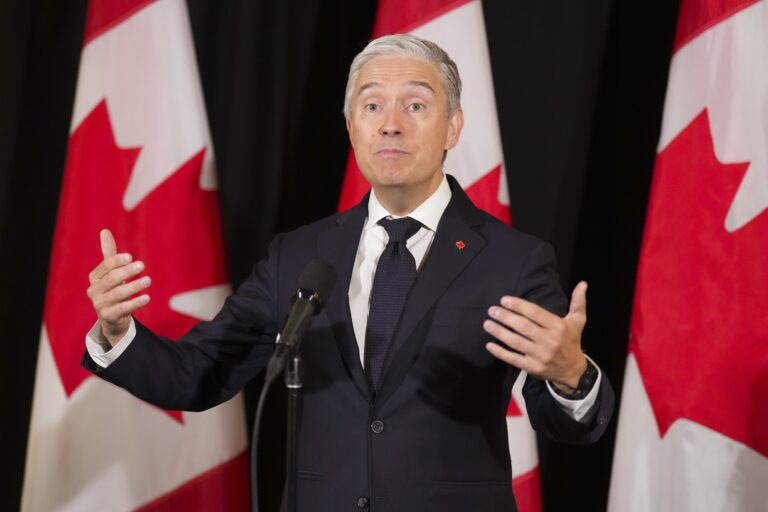
Industry Minister François-Philippe Champagne said Thursday that Zijin Mining Group’s $960-million offer to buy Toronto-based Neo Lithium underwent a sufficient national-security review in the first 45 days after the government learned of the deal.
Champagne told the House of Commons industry committee that the review—mandated for critical minerals under the Investment Canada Act—found that the Chinese company’s bid does not pose any national-security risk and therefore didn’t meet the legal threshold to be referred to the governor-in-council for a longer review, unlike China Mobile and TMAC Resources. The Conservatives, who triggered the committee hearing, said Champagne’s testimony didn’t prove 45 days was enough for a proper review.
Here are the key exchanges from the hearings, shortened and edited for clarity:
Sébastien Lemire, Bloc Québécois MP for Abitibi-Témiscamingue (translated from French): In the last committee meeting, [Wesley Wark] said that only one per cent of Canadian business assets acquired by foreign businesses are subject to national-security review. That seems like very little…. Do you not feel that these reviews should be broader in scope?
FPC: I think there is a misunderstanding of how the Investment Canada Act works. The minister’s power to inquire begins the day we are notified of the transaction, either through direct notification or publicly. The national-security inquiry begins the very first day … and continues throughout.
Brian Masse, NDP MP for Windsor West: You’re saying then, if an investment is from Russia, it wouldn’t matter, but we might go to some conflict with them with Ukraine?…. There is no connection whatsoever to a country and where the investment comes from and the moral, ethical issues at that nation’s doing?
FPC: We look at a number of factors. In the case of Neo Lithium, we looked at the mineral, at the location, where’s the operation, the impact on supply chain…. We are very well aware of the geopolitical circumstances … when it comes to supply chain; [we] have been talking to colleagues in Europe and the White House.
What’s at stake for industry: Flavio Volpe, president of the Automotive Parts Manufacturers’ Association, told the committee Wednesday that Neo Lithium’s Argentina site wouldn’t yield the most useful type of lithium, nor would it be easy to ship or qualify for free-trade agreements. Fighting over the distant mineral deposit wouldn’t be the way to combat China’s increasing dominance “given the current fragile nature of trade” in the sector, said Volpe, who favours prioritizing the development of Quebec’s lithium industry.
What’s at stake for national security: Other witnesses argued that Neo Lithium could have helped Canada’s local industry build up in the future—and that North America may have no choice but to import lithium in the meantime to meet electric-vehicle demand.
“What we are losing … is a startup,” said Wark, who studies national-security issues, adding that an additional review could have examined how Canada would be cut off from Neo Lithium’s future technological knowledge and intellectual property.