BANFF, Alta. — Group-of-Seven finance leaders closed their summit in Alberta on Thursday with no sign of progress toward phasing out punishing U.S. tariffs, extending trade uncertainty that the Bank of Canada’s governor warned is already sapping business investment.
Skip to content

News
G7 finance ministers decry anti-competitive trade practices, but not U.S. tariffs
The joint statement from the Alberta summit makes veiled reference to China’s trade policies, citing shared concern about ‘macro imbalances’
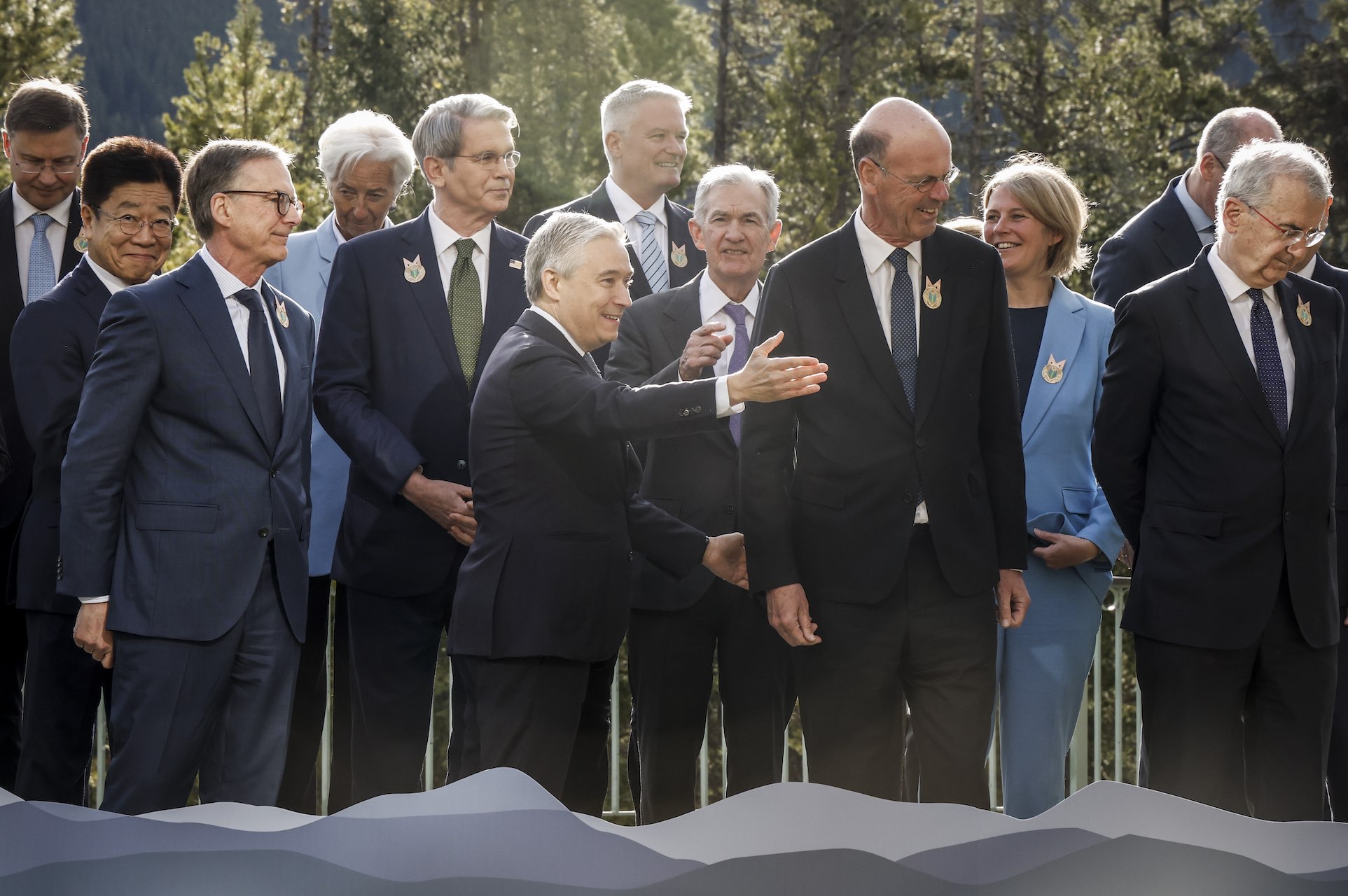
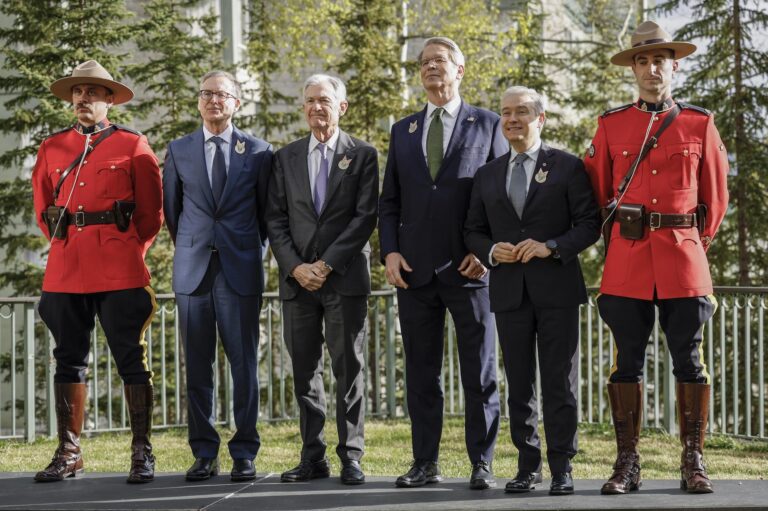
Finance ministers of the G7 ended their summit in Banff, Alta., with a communiqué focused on non-tariff matters. Photo: The Canadian Press/Jeff McIntosh
BANFF, Alta. — Group-of-Seven finance leaders closed their summit in Alberta on Thursday with no sign of progress toward phasing out punishing U.S. tariffs, extending trade uncertainty that the Bank of Canada’s governor warned is already sapping business investment.
In a joint statement, G7 finance ministers and central bankers found common ground on several fronts, notably an agreement to combat “non-market policies and practices” in an apparent reference to China. While not named in the statement, the country has flooded international markets in recent years with steel, EVs, electronics and other goods, angering allies and adversaries alike.
Other areas of consensus included AI, financial crime and support for Ukraine.
As expected, however, the finance ministers declined to directly address U.S. tariffs or outline a path forward on removing trade barriers.
Related Articles

Agree to disagree
Speaking to reporters after the meetings in Banff, Finance Minister François-Philippe Champagne cast the gathering as a show of “unity in the face of complex global challenges.”
Ministers from the seven countries had “frank discussions” around issues like trade, Champagne said, even as he acknowledged that U.S. tariffs continue to weigh on the global economy that G7 ministers and central bank governors were seeking to repair.
“If you want to restore stability and growth, the issue of tariffs obviously comes to the forefront,” he said.
A nameless adversary
Even if it wasn’t named, China was hard to miss in the joint statement. The ministers agreed to target anti-competitive policies that “aggravate imbalances, contribute to overcapacity, and impact the economic security of other countries.”
The group also committed to “exploring ways” to target low-value goods entering their borders in a “decentralized manner”—another likely nod to China’s dominance in many corners of the manufacturing and export market.
Charles St-Arnaud, chief economist at Alberta Central, noted that combatting anti-competitive trade was one of the topics of greatest agreement among G7 members, and comes as the U.S. seeks to curb China’s manufacturing dominance. Finance leaders—representing Canada, the U.S., Germany, France, Italy, the U.K. and Japan—likely opted to not name China to avoid amplifying the ongoing trade war, he added.
“I think they don’t want to target just one country, they want to keep it vague enough that they can still negotiate with China to ease tensions,” said St-Arnaud. “If they were explicitly mentioning China, it would become a diplomatic issue.”
What a drag
While observers don’t expect U.S.-Canada or U.S.-China trade spats to end soon, uncertainty around the issue has already begun to weigh on Canada’s economic growth, said Tiff Macklem, governor of the Bank of Canada.
“Obviously, tariffs were on all of our minds, and the discussion very much did include a focus on improving the dialogue around tariffs and on fixing the problems in the global trading system,” he said.
Macklem said rising Canadian exports are likely to nudge GDP growth higher in the first quarter of this year, according to the bank’s latest business sentiment survey, which it plans to release in the coming days. At the same time, tariff uncertainty is a continuing drag on investment.
“Consumption is going to be weaker than it was in the previous quarter, and business investment in particular is probably going to be quite a bit weaker,” Macklem said. “Certainly, what we hear talking to businesses is they’re really pausing their investment. They’re waiting for more clarity on the way forward.”
The world gets smaller
Those macro stresses come as Canada faces some tough trade decisions in the near future, St-Arnaud said.
While the U.S. administration has floated the idea of a “Fortress North America” bloc, he said, such an arrangement may mean restricting Canada’s access to overseas markets to a greater degree than previously thought.
“It might be about choosing between the U.S. and the rest of the world as our trading partner,” St-Arnaud said, “because we’ll have to match what the U.S. is doing.”



Loading...
Thanks for sharing!
You have shared 5 articles this month and reached the maximum amount of shares available.
CloseThis account has reached its share limit.
If you would like to purchase a sharing license please contact The Logic support at [email protected].
CloseGift the full article!
You have gifted 0 article(s) this month and have 5 remaining.
Recipients will be able to read the full text of the article after submitting their email address. They will not have access to other articles or subscriber benefits.
Photo: The Canadian Press/Jeff McIntosh
Most Popular This Week




In-depth, agenda-setting reporting
Great journalism delivered straight to your inbox.
The Big Read
Alberta’s referendum is just the start of the turmoil
Briefing
EverWind plans $10B data centre and wind development in Nova Scotia
Canada ready to force Stelco to sell its Canadian operations, Joly says
Feds plan a 60 MW defence-oriented data centre for Ottawa
Best business newsletter in Canada
Get up to speed in minutes with insights and analysis on the most important stories of the day, every weekday.
Exclusive events
See the bigger picture with reporters and industry experts in subscriber-exclusive events.
Membership in The Logic Council
Membership provides access to our popular Slack channel, participation in subscriber surveys and invitations to exclusive events with our journalists and special guests.






