Listen Now
0:00
OTTAWA — Finland is smaller than Canada in geography and economy, but it has some lessons it can teach its “big sister” about resilience in an unstable world, its President Alexander Stubb told a tech-sector audience in west Ottawa on Wednesday.
Finland, a country of about 5.6 million people, shares a border with Russia, which invaded it under Soviet rule. That experience inculcated values that the end of the Cold War didn’t erase, Stubb said.
Talking Points
- Sharing a border with an often-menacing Russia has forced Finland to keep national sovereignty at the forefront of its economic thinking by protecting key industries and supply chains, the Finnish president said
- Canada can learn from Finland’s example, Industry Minister Mélanie Joly agreed in a public chat at the Canadian branch headquarters of Finland’s communications technology giant Nokia
“Economic resilience begins with securing your supply. It begins with having fairly safe and protected value chains,” Stubb said in a public chat with Industry Minister Mélanie Joly at the Canadian headquarters of Nokia, the Finnish communications technology giant employing about 2,300 people in Canada. He’s on a two-day visit to Canada.
Before them in an atrium were arrayed Finnish and Canadian business leaders, researchers, and politicians. Among the men in the audience, suits in shades of blue—the colour of both Nokia and the cross in the Finnish flag—predominated.
Key commodities and goods don’t secure themselves; the government needs to be involved, Stubb said.
“The world of 1989, 1991—’market, market, market’—has shifted more towards ‘state, state, state,’” Stubb said. “I think what we need to understand, as the public sector and the private sector, is that we need to somehow integrate these two.”
Related Articles

Finland has maintained such an integration, he said: it has mandatory military service for men and a formal program for teaching key public- and private-sector figures about Finnish security policy.
“When ‘that thing’ hits the fan, you need to be prepared on the civilian side,” Stubb said, with presidential euphemism.
Canada is studying Finland’s example, Joly said. “We’ve been blessed by geography for a long, long time,” she said, by peace and proximity to a friendly United States, and now that the world order is upside-down, Canada is having to catch up.
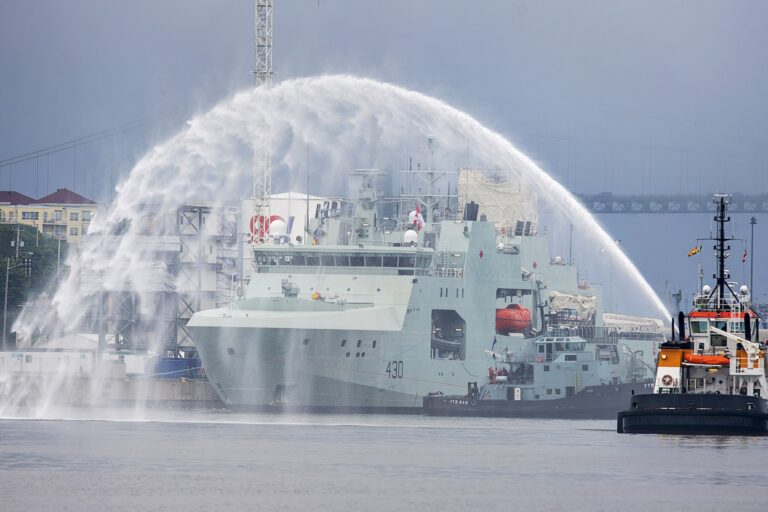
There are already numerous examples of government-backed integration between Canadian and Finnish companies. In defence, for instance, Canada and Finland are partners with the United States, in an arrangement struck under then-president Joe Biden to build new icebreakers.
The Canadian end is underwritten by a big federal purchase; Canadian shipbuilder Davie bought a major Helsinki shipyard, where it began work on the first of the new icebreakers for the Canadian coast guard before transferring production to Davie’s Quebec yard.
Canada needed icebreakers, Joly said, but they’re just a first step toward selling ships to other countries with Arctic interests, such as the United Kingdom, France and Japan.
Meanwhile, Finnish steel company Outokumpu is buying molybdenum from a mine in Greenland operated by Canada’s Greenland Resources, a project backed by Natural Resources Canada.
The Canadian government has backed Nokia’s Canadian operation with $80 million over the past few years, despite criticism from tech leaders, such as Shopify’s Tobi Lütke, that such backing comes at the expense of Canadian firms.
Nokia Canada’s history is nuanced, though. The west-Ottawa complex once belonged to Newbridge Networks, a homegrown Ottawa company founded by tech baron Terry Matthews, before France’s Alcatel bought it. Then Nokia bought Alcatel.
Jeffrey Maddox, Nokia Canada’s president, told The Logic that its Canadian-European pedigree makes Nokia’s technology attractive to Canadian governments in a market where the main competition is Chinese. As with the Finnish-Canadian icebreakers, there’s an export opportunity—and given the federal investments in Nokia, the government has “skin in the game,” he said.
Nokia Canada has just entered an agreement with Export Development Canada to explore exports of technology for major AI-oriented data centres, Maddox said. “The level of collaboration with the government has absolutely accelerated.”