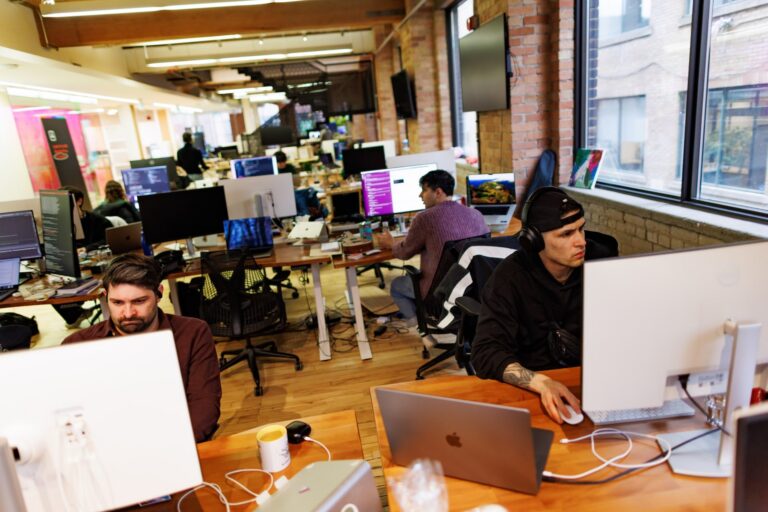
When the COVID-19 pandemic forced the temporary closure of the Okanagan coLab co-working space in Kelowna, B.C., its 150-strong membership dropped by just five per cent.
The drop was minor, because the space suddenly became “a life raft” for the community that used it to stay connected, and to learn together how to traverse uncharted waters, said Shane Austin, who runs the coLab. As a result, the 10-year-old space had to very quickly figure out how to “create digital experiences that are like co-working spaces, that can help nurture creativity and belonging.”
Talking Point
Beyond the big names, a large swath of co-working spaces are themselves small businesses. They say their industry is struggling to meet their overhead in the short term, with revenue from membership and events dwindling and little rent relief coming from landlords or governments. Despite this, they remain positive that they could play an important role in a post-pandemic future where companies will look to rebuild their cultures even as they downsize their real estate footprints.
In the first month of the shutdown, coLab began trying “numerous things, and whichever works will be our new business model,” Austin said. The space set up a virtual-only membership, offering access to all its new online channels, including newsletters and a virtual ecosystem of investors, which even attracted some new members.
“If we had frozen our business, I don’t know how long I’d last, [because] our runway is month to month,” Austin said. “We needed to learn how to become more than a co-working space—how to become a connector in the community.”
Co-working spaces emerged in the early 2000s in response to a growing freelance workforce. Now, with workers facing an even less certain future in a world where the coronavirus is leading to questions about the future of traditional and non-traditional offices alike, the spaces are trying to redefine themselves. Their proprietors believe their future could be brighter than ever; they see themselves helping companies and workers in a post-COVID-19 future where companies look for ways to rebuild office culture while reducing their real estate footprints. First, though, they have to survive the pandemic.
The highest-profile player in shared workspaces has been WeWork, which famously melted down last year amid questions about its leadership and business model. Already reeling, the pandemic has hit it hard; the company has asked landlords for a break on rent, and reportedly plans more job cuts, this time likely numbering more than 1,000. But WeWork’s struggles don’t represent the state of the entire industry. Breather, a New York- and Montreal-based company that provides flexible, private office space, was making job cuts of its own last year. It’s now seeing a 35 per cent uptick in demand for its space as employers look for temporary offices. “No one wants to sign a direct lease right now, because of the uncertainty,” Breather CEO Bryan Murphy said earlier this month. New York-based WeWork rival Industrious, meanwhile, is reportedly preparing for an IPO next year.
But beyond the big players, a large swath of co-working spaces are themselves small businesses. The Logic spoke to six owners of independent co-working-spaces who reported that they’re struggling with short-term overhead costs at a time when the future of their business model is uncertain. All said they are still awaiting rent relief as they search for alternative revenue sources.
Charlotte Kirby, founder and owner of The Village Hive, a co-working space in Markham, Ont. that serves 100 members, hasn’t shut her space down entirely, believing that people “still need face-to-face interaction.” While events have been entirely cancelled, therapists who work out of her space are still using their private offices to help clients.
“I don’t want to close my doors to the space I’ve been running for years,” Kirby said. “But I think if anything, once we get through this, we could see the continued growth of co-working as people realize they don’t need to pay for brick-and-mortar setups. That they can get their employees to work from home and maybe part time at co-working spaces. The hard part is just going to be getting through the next few months of paying our bills.”
Kirby said she doesn’t qualify for any government subsidy or grants at this time. Her landlord has applied for rent relief. (“Fingers crossed,” she said.) While she waits, she’s also creating a virtual community through daily Zoom coffee chats and “weekly worksprints” with members. She’s working on a reopening plan, as well as plans for a new space in the North York district of Toronto.
Groundswell Coworking, a space in downtown Simcoe, Ont. that opened in March 2019, is taking a similar approach. When COVID-19 forced it to close, owner Jess Bommarito shifted her focus to offering virtual support, starting with a free series called “Thriving Online Mini Masterminds” to help business owners find ways to keep operating. “Because we were able to pivot so quickly, we didn’t experience a decrease in revenue,” Bommarito said.
“More people than ever before in the history of the world are working from home, and they don’t know how to do that. This is something that co-working operators know really well and can help with,” she said. “All the people without jobs who will now turn to freelancing and self-employment—I want to be there to help them.”
Carly Nemtean, co-founder and CEO of The Collective, a Toronto-based space for architects and designers, is trying to support her members who are working remotely by moving the space’s monthly design showcase to Instagram Live.
Nemtean said the space’s landlord gave her a 50 per cent deferral on rent for April and May. However, she said it’s seen a 65 per cent drop in residency, and that half of its vendors have not been able to make their rent. Her landlord has not opted into the federal relief program as of yet, but Nemtean is hopeful business will pick up once things reopen.
“Co-working is actually an opportunity for companies to grow into, but also in a recession, I think it’ll be a great opportunity, because companies who are larger will downsize,” she said. “So, to be honest, I think co-working will actually survive.”
Not every workspace, however, has been able to pivot their operations in the short term in a way that keeps co-working culture alive at a time of social isolation. Rachel Kelly, founder of Make Lemonade, a Toronto space for women, said the pandemic has forced her to reconsider her business model, which depends largely on recurring membership revenue, rental spaces and day passes.
While Make Lemonade is also offering virtual co-working to its 100 members, it’s not enough to support the business in the long run, Kelly said. “This has really forced me to look at our business model and introduce different streams of revenue so that being physically open isn’t the only dependent way for us to make money,” she said.
Amanda Munday, founder of The Workaround, a 13,000-square-foot parent-friendly workspace in Toronto’s East End, agreed, noting it’s not possible for her space to move to virtual support “because it’s not our primary business model.”
The Workaround made the bulk of its revenue for its child-care program, all of which “evaporated” once the social-distancing measures started. While Munday has qualified for the Canada Emergency Business Account, which offers a $40,000 interest-free loan, she said it hasn’t been enough to cover rent for April, May and June and keep operations frozen for an undefined time period.
“I haven’t paid rent, and I can’t pay rent,” she said. She’s using the limited funds she has available instead to prepare her space for reopening, buying wipes, cleaning supplies and plexiglass, while also finding barriers between a reduced number of seating spaces.
From a member survey and social media, she’s encouraged that there’s an appetite to return to a space like hers. “What we do very well is create a container in which people gather and learn from each other,” she said. “And so when you remove the actual container, it is so suffocating.”
At the Okanagan coLab, meanwhile, Austin is considering a long-term program that provides skills training and co-op programs to newcomers and students, and a “co-learning” platform for members that allows for peer-to-peer mentoring. He is also “experimenting” with coLab participating in joint ventures with members that will see the space become a shareholder or take on equity to share any revenue made.
With influential tech giants like Twitter, Facebook and Shopify eyeing a future with fewer large, centralized offices, Austin sees co-working spaces like his being “a big part” of the conversation. “Co-working spaces can become the new shape of work,” he said.”