Skip to content

Canada's Business and Tech Newsroom

  • Professional Subscription
  • Partnerships & Advertising
  • Licensing & Syndication
Log In Subscribe
Welcome,
  • My Account
  • Log Out
  • Business
  • Tech
  • National
  • The Big Read
  • Briefings
  • Commentary
Search
Log In Subscribe
Welcome,
  • My Account
  • Log Out
News

Canadian investors trail global peers on sustainability stewardship, according to data from UN affiliate

Data from close to 100 Canadian investors and money managers shows many firms committed to responsible investing aren’t doing enough to press publicly listed portfolio companies to improve their practices around environment, social and governance (ESG) issues. 

A report from the Canadian chapter of the UN Principles for Responsible Investment (PRI) presented to signatories in a webinar and viewed by The Logic shows that Canadian asset owners and managers score well below their U.K. peers and slightly below the global average when it comes to consulting public companies they manage in both their active and passive portfolios. 

News

Canadian investors trail global peers on sustainability stewardship, according to data from UN affiliate

By Catherine McIntyre
A flare stack from the Imperial Oil refinery in Edmonton in December 2018. Photo: The Canadian Press/Jason Franson
Apr 15, 2021
A A
A Small A Medium A Large
Share

Gift

Share

Data from close to 100 Canadian investors and money managers shows many firms committed to responsible investing aren’t doing enough to press publicly listed portfolio companies to improve their practices around environment, social and governance (ESG) issues. 

A report from the Canadian chapter of the UN Principles for Responsible Investment (PRI) presented to signatories in a webinar and viewed by The Logic shows that Canadian asset owners and managers score well below their U.K. peers and slightly below the global average when it comes to consulting public companies they manage in both their active and passive portfolios. 

Talking Point

A UN partner organization that tracks companies’ environmental, social and governance records found that Canadian asset owners and managers score far worse than their U.K. peers and slightly below the global average when it comes to pressing publicly listed portfolio companies to improve their sustainability practices beyond proxy voting. Investors often cite such engagement as an alternative to divestment to entice investees to change behaviours around climate change or board governance, for example. But “while most signatories engage in [proxy] voting, the active ownership often stops there,” reads a report from the UN Principles for Responsible Investment.

The results are based on annual transparency reports PRI signatories are required to submit to the body. PRI is a global network of more than 3,000 signatories who commit to making business decisions through an ESG lens, and to tracking and disclosing their progress on the issues. The organization has 189 Canadian signatories, including most of Canada’s largest banks and pension funds. Firms are asked to disclose details about how they track ESG factors in all of their asset classes and what steps they’re taking to improve their sustainability. Questions address what they’re doing to reduce their carbon footprints, whether and how they’re monitoring investees’ ESG progress and if they’re discussing the issues with people responsible for creating ESG policies and standards.

“While most signatories engage in [proxy] voting, the active ownership often stops there,” reads the report. 

Beyond voting, stewardship can include meeting with a firm’s executives to try and influence change, issuing open letters signed by co-investors, suing a firm over its practices and nominating board members who champion sustainability.

PRI breaks down companies’ stewardship (or engagement) performance in three categories: how a signatory directly engages portfolio companies; how an outsourced service provider—like ISS or Glass Lewis—engages companies on a signatory’s behalf; and how a signatory collaborates with other asset owners and managers to influence ESG improvements. PRI then scores signatories’ answers in each category on a scale from zero to three. 

According to the data from 2020, nearly 35 per cent of Canadian signatories scored zero out of three on all questions of how they engage firms through outsourced service providers; over 20 per cent scored zero on how their individual firms engage directly with portfolio companies; and almost 25 per cent scored zero on collaborating with other firms to press for change in portfolio companies. 

In the U.K., less than 10 per cent of signatories scored zero on collaborative and individual engagement, and 20 per cent scored zero on engagement with service providers. 

Canadian firms, however, scored well above the global average and their U.K. peers on using their voting powers to influence change at portfolio firms. Less than five per cent of signatories scored zero on questions of voting, compared to 10 per cent in the U.K. and 15 per cent globally that scored zero. 

Scores of asset owners and managers now tout ESG principles in their investing criteria. Global ESG assets are expected to exceed US$53 trillion by 2025, up from an estimated US$37.8 trillion this year, representing about a third of all assets under management. The mainstreaming of ESG follows pressure from consumers and regulators demanding more socially and environmentally responsible business practices. However, the industry is rife with accusations of greenwashing—concerns that companies take credit for responsible investing without doing the heavy lifting to clean up their portfolios.  

Investors often cite engagement with companies as an alternative to divestment to entice them to change behaviours around climate change or board governance, for example. Lindsey Walton, PRI’s head of Canada, agreed that asset owners should use divestment only as a last resort, but that other stewardship practices have to improve if they want to influence companies to make meaningful changes on social and environmental issues. “You have to make sure you’ve done absolutely everything in your power before you say, ‘This isn’t working, we’re going to have to divest,’” said Walton. “When you just divest from a company, the emissions don’t go away; they’re just not in your portfolio. It’s much more powerful if you go through a series of escalation steps.”

Gift the full article

Voting in favour of shareholder proposals or against chairs that are reluctant to improve ESG is just one aspect of that stewardship, said Walton. Those votes also tend to be non-binding, making them more symbolic than mechanisms for affecting change. “You need different levers on your escalation plan if an investee isn’t doing what you want them to do, she said. 

Ryan Riordan, director of research at the Institute for Sustainable Finance at Queen’s University, said he isn’t surprised that Canada lags the U.K., or even the global average, on its engagement practices. “The average Canadian asset owner or asset manager is smaller than the average U.K. or global one,” said Riordan. “I’m also not surprised, given our extractive economy. A country like the U.K. started to decarbonize in the ‘90s, so it makes sense that their asset managers are also much more aware of that sort of thing.” 

Still, he said the results strike him as a problem. “It highlights that Canada needs to push for more decarbonization at a firm level and an investor level. We’re wrestling with the transition to a green economy more [than some peers] because so much of our economy is tied up in extraction,” said Riordan, adding that shareholder activism could be an effective tool in that transition. “Investors need to decide what they want and what’s doable and coordinate their activism to get it done.”


#ESG #investing #UN PRI

Sponsored Content

The road to risk-smart regulation

By Deborah Aarts

Why cybersecurity needs to match pace with AI

By Jessica Aftimus Rosa

How to shift your workforce from AI experimentation to adoption

By Jessica Aftimus Rosa
Paid promotional content

Loading...

Thanks for sharing!

You have shared 5 articles this month and reached the maximum amount of shares available.

Close
This account has reached its share limit.

If you would like to purchase a sharing license please contact The Logic support at [email protected].

Close
Want to share this article?

Upgrade to all-access now

Close
Gift the full article!

You have gifted 0 article(s) this month and have 5 remaining.

Copy link and gift
Copy Link
Email to a friend
Send Email
Gift on Social Media

Recipients will be able to read the full text of the article after submitting their email address. They will not have access to other articles or subscriber benefits.

Photo: The Canadian Press/Jason Franson

Most Popular This Week

A side shot of Annie Andrews passing a cluster of supporters with a hand outstretched and a joyful look on her face.
News

What the Democrats’ midterm sweep means for Canadian business

By Joanna Smith
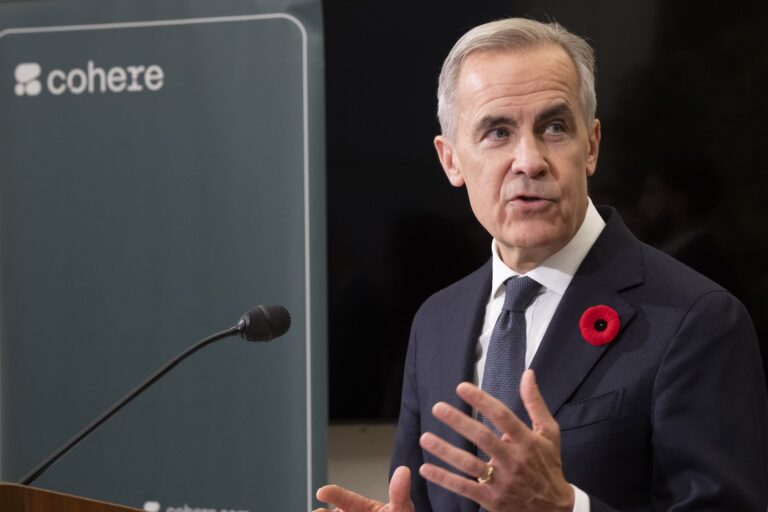
An image of Prime Minister Mark Carney, standing in front of a microphone and speaking. He is wearing a blue suit and tie, while looking away from the camera. He is standing in front of a dark background. The Cohere logo is visible in the background.
News

Conservatives challenge Ottawa to justify its $1.6B Cohere investment

By Catherine McIntyre
U.S. President Donald Trump and Canadian Prime Minister Mark Carney in suits, sitting and talking in the Oval Office with gold decor.
News

Canadians have given up on the old America. They feel fine about it

By David Reevely
A logo that reads AI in blue lettering against a light yellow background.
News

BDC launches programs to test Canadian AI tools in small businesses

By Catherine McIntyre

In-depth, agenda-setting reporting

Great journalism delivered straight to your inbox.

A close-up of computer equipment with the Tenstorrent logo on the casing.
Exclusive

Tenstorrent is lobbying Ottawa for data-centre funding and sovereign AI contracts

By Catherine McIntyre

Briefing

Ex-Cohere engineers and Blue J executive raise US$6M to launch new firm

By Anita Balakrishnan   |   Nov 10, 2026 | 3:27 PM ET

CN confirms work with Strathcona on northern B.C. crude-by-rail project

By Meghan Potkins   |   Nov 10, 2026 | 3:10 PM ET

Canada and Cohere sign AI safety pledge with Anthropic, OpenAI and other industry giants

By Catherine McIntyre   |   Nov 10, 2026 | 3:03 PM ET

Best business newsletter in Canada

Get up to speed in minutes with insights and analysis on the most important stories of the day, every weekday.

Exclusive events

See the bigger picture with reporters and industry experts in subscriber-exclusive events.

Membership in The Logic Council

Membership provides access to our popular Slack channel, participation in subscriber surveys and invitations to exclusive events with our journalists and special guests.

Recent Popular Stories

News

Wealthsimple launches AI assistant as Canada’s big banks block third-party agents

By Chaimae Chouiekh   |   Nov 5, 2026
News

Former Ciena employee claims she was fired for reporting sexual assault by executive

By Catherine McIntyre   |   Nov 3, 2026
An exterior of a five-storey office building with two Canadian flags out front. Above the entrance is a four-storey window with Ciena's logotype written sideways.
Commentary

Carmichael: Carney and Champagne’s budget sends the bond market a message

By Kevin Carmichael   |   Nov 5, 2026
An image of Mark Carney against a light and dark background.
News

Ottawa extends open banking principles to other sectors—but continues to delay original framework

By Claire Brownell   |   Nov 5, 2026
News

Canada is buying military gear for a world where ‘pretty much everything’ changed

By David Reevely   |   Nov 2, 2026
Three people, wearing business clothing and red poppy pins, sit on chairs on a stage. The person in the middle is speaking. A blue background is visible behind them.
News

Conservatives challenge Ottawa to justify its $1.6B Cohere investment

By Catherine McIntyre   |   Nov 2, 2026
An image of Prime Minister Mark Carney, standing in front of a microphone and speaking. He is wearing a blue suit and tie, while looking away from the camera. He is standing in front of a dark background. The Cohere logo is visible in the background.

Canada's most influential executives and policymakers are reading The Logic

  • CPP Investments
  • Sun Life Financial
  • C100
  • Amazon
  • Telus
  • Mastercard
  • bdc
  • Shopify
  • Rogers
  • RBC
  • General Motors
  • MaRS
  • Government of Canada
  • Uber
  • Loblaw Companies Limited
logic-logo

Canada's Business and Tech Newsroom

100% human-crafted journalism

Newsroom

  • News Tips
  • AI Policy
  • Editorial Disclosures
  • Story Pitches

Company

  • About Us
  • Terms of Service
  • Privacy Statement
  • Corporate Information

Contact

  • Contact Us
  • Advertise
  • FAQs
  • Work at The Logic

© 2026 The Logic Inc. All Rights Reserved.

Trusted by leaders

Error

Account creation failed.

Please email us at [email protected].

Create Account

[wppb-register form_name=”cozmo-registration-form-for-modal”]

I do have an account
Login
or

[wppb-login]

I don’t have an account