American telcos Verizon and AT&T were on the verge of firing up antennas to offer 5G wireless service this week, but held off on activating transmitters near airports when airlines said the signals from the antennas could disrupt their planes’ instruments.
Skip to content

News
Canada’s lower 5G frequencies lower worries around airports
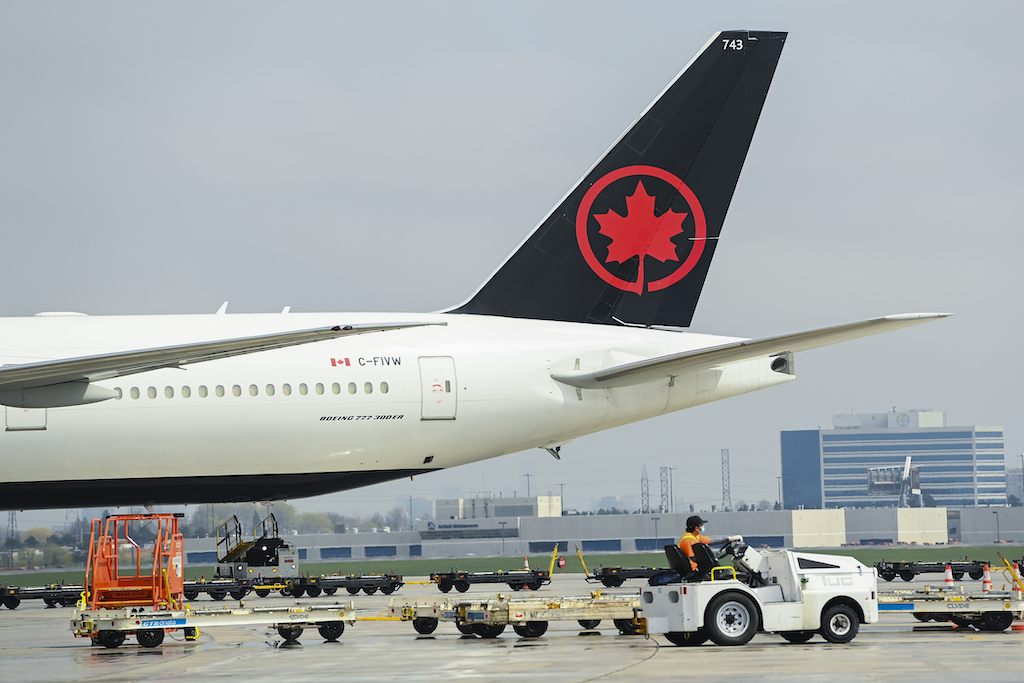
Air Canada planes sit on the tarmac at Pearson International Airport in Toronto in April 2021. Photo: Nathan Denette/The Canadian Press
American telcos Verizon and AT&T were on the verge of firing up antennas to offer 5G wireless service this week, but held off on activating transmitters near airports when airlines said the signals from the antennas could disrupt their planes’ instruments.
The U.S. Federal Aviation Administration (FAA) warned that “because the proposed 5G deployment involves a new combination of power levels, frequencies, proximity to flight operations, and other factors, the FAA will need to impose restrictions on flight operations using certain types of radar altimeter equipment close to antennas in 5G networks.”
Why is the U.S. going nuts about it?
In the U.S., 5G service uses slices of radio spectrum as high as 3980 MHz. Plane altimeters use a band between 4200 MHz and 4400 MHz to bounce signals off the ground to check their heights. The fear is that those signals are close enough to interfere and potentially imperil landings, especially in bad weather.
The Federal Communications Commission’s Brendan Carr (a Republican appointee) condemned “a failure of competent leadership” and said the FCC is the proper authority, it carefully studied the issue, and the 5G broadcasts would be safe.
Industry observers are dismayed.
The FAA is now testing a variety of altimeters to make sure they’re safe from interference.
Why isn’t Canada’s air industry going nuts?
Canada’s existing 5G services operate at lower frequencies than in the United States—the closest are centred on 3500 MHz instead of 3800 MHz. Also, in a move that startled telcos last fall, the federal government told them to turn down the power on 5G antennas near airports and point all of them down, away from air traffic.
“I don’t think the FCC has passed any mitigation measures,” said David Farnes, general manager of the Radio Advisory Board of Canada, a specialized federal body that helps the government with technical radio-spectrum issues.
The order to angle 5G antennas toward the ground means even aircraft making odd landings—medevac helicopters, for instance—would be protected, Farnes told The Logic.
…Should we be going nuts?
Canada’s next spectrum auction is for the 3800-MHz band and the government is currently consulting on the terms. Farnes pointed out the first question in the Innovation Department’s survey asks about measures to keep those signals from interfering with aviation. Both that department and Transport Canada are in a working group monitoring and assessing the problem, he added, and are cooperating.



Loading...
Thanks for sharing!
You have shared 5 articles this month and reached the maximum amount of shares available.
CloseThis account has reached its share limit.
If you would like to purchase a sharing license please contact The Logic support at [email protected].
CloseGift the full article!
You have gifted 0 article(s) this month and have 5 remaining.
Recipients will be able to read the full text of the article after submitting their email address. They will not have access to other articles or subscriber benefits.
Photo: Nathan Denette/The Canadian Press
Most Popular This Week




In-depth, agenda-setting reporting
Great journalism delivered straight to your inbox.
The Big Read
Alberta’s referendum is just the start of the turmoil
Briefing
EverWind plans $10B data centre and wind development in Nova Scotia
Canada ready to force Stelco to sell its Canadian operations, Joly says
Feds plan a 60 MW defence-oriented data centre for Ottawa
Best business newsletter in Canada
Get up to speed in minutes with insights and analysis on the most important stories of the day, every weekday.
Exclusive events
See the bigger picture with reporters and industry experts in subscriber-exclusive events.
Membership in The Logic Council
Membership provides access to our popular Slack channel, participation in subscriber surveys and invitations to exclusive events with our journalists and special guests.






