Canada’s headline inflation unexpectedly slowed to 2.8 per cent in February from 2.9 per cent the previous month, Statistics Canada said Tuesday. That bolsters Bank of Canada governor Tiff Macklem’s case that price pressures will gradually recede this year, creating the conditions for interest-rate cuts.
“This report is clearly encouraging from the Bank of Canada’s perspective,” CIBC economist Katherine Judge said in a note.
Good surprise: Bay Street analysts had expected that inflation re-accelerated to 3.1 per cent. Instead, year-over-year changes in the consumer price index have now come in below three per cent for two consecutive months for the first time since early 2021. Inflation appears to be back in the Bank of Canada’s comfort zone of one per cent to three per cent. Its target is actually the midpoint of that range—so there still is some distance to travel, but inflation hasn’t looked this tame in a long time.
Price wars: Competition and political pressure might be helping. Statistics Canada observed significant price drops for cellular services and internet access from a year earlier, as the big telecom firms offered discounts and more data for the same price consumers were paying a year ago. The grocers, which have been hauled before parliamentary committees to explain their pricing decisions, also showed well in the latest inflation readings. Food purchased in stores increased 2.4 per cent year over year, the first time food inflation has been slower than overall inflation since October 2021.
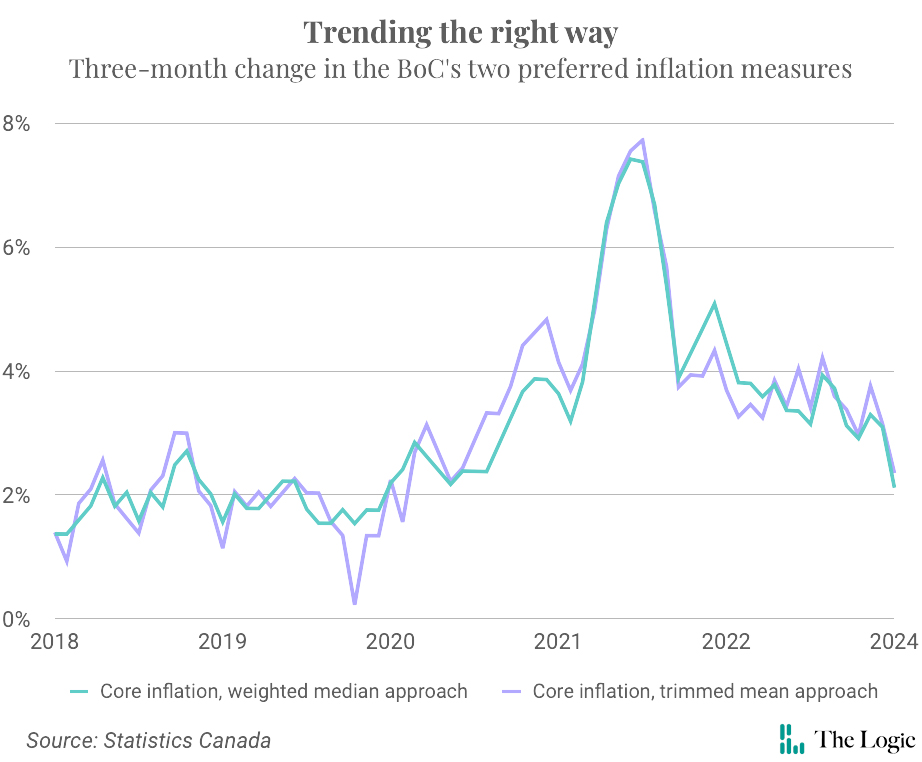
Core strength: The Bank of Canada uses various measures that adjust for volatile prices to get a sense of the underlying trend. And to grasp what’s happening in real time, it’s been calculating the three-month change in those “core” indexes to produce an annualized rate that’s uninfluenced by what was happening a year ago. The three-month rates of its two preferred core measures decelerated to around two per cent in February, the slowest since the start of 2021. “The slower inflation momentum suggests that the underlying inflation dynamic has slowed to a pace consistent with the BoC’s target,” Charles St-Arnaud, chief economist at Alberta Central, said in a note.
Bottom line: The loonie fell as traders positioned for earlier rate cuts in Canada. Judge, St-Arnaud and Desjardins’ Randall Bartlett were among the economists who said the path is clear to start cutting rates in June.
The latest inflation reading wasn’t perfect. Statistics Canada’s measure of shelter costs actually accelerated and the level of grocery prices was 21.6 per cent higher than February 2021. Those highly visible items will continue to influence consumer confidence and sow doubt that inflation is coming down. Expectations matter to the central bank, but evidence of weaker economic growth probably tips the scales in favour of rate cuts sooner rather than later.