TORONTO — Some of Canada’s largest pension fund managers are putting less money into emerging markets like China and Latin America, with geopolitical uncertainty seemingly spooking investors into making less risky bets.
Skip to content


News
Canada’s big pension funds are pulling back from emerging markets
Deglobalization and tariff threats from the U.S. are spooking investors and sending many of Canada’s Maple 8 scuttling to less risky markets
Toll booths along the Yamuna Expressway in Agra, Uttar Pradesh, India. Canadian pension funds have invested heavily in major infrastructure projects in Asia. Photo: Creative Touch Imaging Ltd./NurPhoto via Getty Images
TORONTO — Some of Canada’s largest pension fund managers are putting less money into emerging markets like China and Latin America, with geopolitical uncertainty seemingly spooking investors into making less risky bets.
Canada Pension Plan Investment Board (CPP Investments), the country’s largest retirement fund manager, is leading the move away from emerging markets. The fund’s investments in developing regions represented 20 per cent of its portfolio at the end of its last fiscal year, which ended March 31, 2024, down from 22 per cent a year earlier, the lowest it’s been since 2019. “As part of our review of the Strategic Portfolios over the past year, we revisited our appetite for Emerging Markets and adjusted our long-term geographic allocations to reflect updated views,” the firm said in its annual report.
Talking Points
- Some of Canada’s largest pension funds are scaling back investments in emerging markets in Asia and Latin America after years of growing portfolios
- Geopolitical and economic uncertainty created by U.S. President Donald Trump are a major factor driving the reversal
“There definitely is a trend where institutional investors are, in this environment, more focused on developed markets,” said John Cho, head of KPMG Canada’s private capital team, and whose job involves advising pensions on deals. “You take more risk when you go afar into different regions.”
The shift is a stark reversal for CPP Investments, which manages nearly $700 billion in pension assets on behalf of about 22 million Canadians. The firm had been steadily increasing the portion of its investments in emerging markets for at least the past decade. In 2018, the firm anticipated that a third of its portfolio would be invested in emerging markets by 2025, but its holdings in developing regions peaked in 2023 at 22 per cent.
It’s not just CPP Investments that’s backing off in emerging markets. British Columbia Investment Management Corporation (BCI) cut its investments in emerging markets and the Asia Pacific region from 15.7 per cent of its portfolio in its fiscal 2023 to 13.8 per cent in 2024. Ontario Teachers’ Pension Plan shrunk its share of assets in Asia Pacific (which includes some developed economies) and Latin America relative to its overall portfolio from fiscal 2022 to 2023, according to its most recent annual report. And Alberta Investment Management Corporation (AIMCo) reduced its holdings in Asia and “the rest of the world” over the same reporting period.
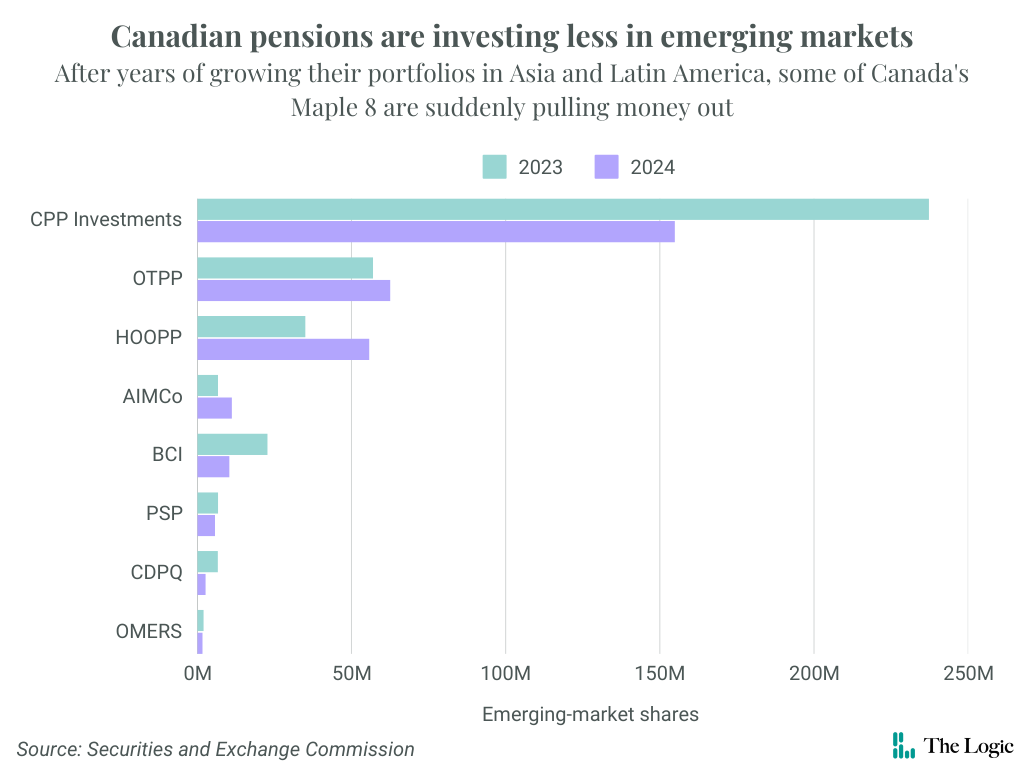
Five of Canada’s eight largest pension funds, known as the Maple 8—including Caisse de dépôt et placement du Québec, Ontario Municipal Employees Retirement System and Public Sector Pension Investment Board—also held fewer U.S.-listed shares in emerging-market stocks at the end of 2024 than they did a year earlier, an analysis of U.S. Securities and Exchange Commission filings shows.
AIMCo, meanwhile, confirmed this month that it’s shutting its Singapore office, despite only opening it in 2023 as part of an Asia Pacific expansion plan. AIMCo said the move was being made to reduce costs, with an office in New York City also being shut down.
Fund managers like CPP and other Canadian firms began ramping up investments in emerging-market assets a little over a decade ago. They were lured in by the high potential for returns in places like China, India and parts of Latin America. In China in particular, rapid economic growth and a burgeoning middle class created big investment opportunities in manufacturing, infrastructure and technology—and for much lower prices than in North America or Europe.
Related Articles


Cho said there are several factors influencing the recent trend away from emerging markets. Slower economic growth is weighing on investments in China, with foreign direct investment down 99 per cent over three years, according to Chinese government data. In India, high prices for assets in sectors like infrastructure and real estate may deter Canadian investors from buying. Lower-than-expected growth in parts of Latin America and the Caribbean means fewer opportunities in that region, too.
Then there’s U.S. President Donald Trump, whose protectionist policies and threats of sweeping tariffs are cramping international trade. “It’s just a more difficult environment to invest into emerging markets,” Cho said, “and you wonder will you get excess investment returns for the heightened risk?”
The pull away from emerging markets coincides with some investors shifting more money into the U.S. CPP Investments, for instance, had about 42 per cent of its portfolio invested in the U.S. by the end of its fiscal 2024, up from 36 per cent the year before. OMERS has 53 per cent of its assets in the U.S., according to its 2024 annual report, compared to 48 per cent in 2023. BCI’s U.S. exposure increased from 41 per cent to 43.4 per cent over the same period.
Cho said that this trend could continue as Trump’s tariff threats lure companies to bring manufacturing to the U.S. and subsequently create more U.S. investment opportunities.
The picture may be more complicated for Canadian assets, he said. On one hand, a weak Canadian dollar could create good buying opportunities for investors. But it’s too soon to know, said Cho, to what degree a faltering loonie could counteract the economic pain tariffs are poised to inflict.
Edwin Cass, chief investment officer at CPP Investments, recently told trade publication Top 1000 Funds that, despite the firm’s move away from emerging markets, there are still good investments to make. Cass pointed to infrastructure like toll roads in Mexico, Chile, Indonesia and India as strong-performing assets, and said he’s optimistic about renewable energy investments abroad as more countries transition to lower-carbon economies.



Loading...
Thanks for sharing!
You have shared 5 articles this month and reached the maximum amount of shares available.
CloseThis account has reached its share limit.
If you would like to purchase a sharing license please contact The Logic support at [email protected].
CloseGift the full article!
You have gifted 0 article(s) this month and have 5 remaining.
Recipients will be able to read the full text of the article after submitting their email address. They will not have access to other articles or subscriber benefits.
Photo: Creative Touch Imaging Ltd./NurPhoto via Getty Images
Most Popular This Week




In-depth, agenda-setting reporting
Great journalism delivered straight to your inbox.
News
A tech firm born from post-Brexit trade chaos sets its sights on Canada
Briefing
Dozens of Canadian researchers join chorus of scientists calling for a global AI oversight
TC Energy strikes deal with Indigenous groups for ownership stake in Coastal GasLink pipeline
Canada’s Tailscale taps Google Moonshot alum to lead sovereign AI push
Best business newsletter in Canada
Get up to speed in minutes with insights and analysis on the most important stories of the day, every weekday.
Exclusive events
See the bigger picture with reporters and industry experts in subscriber-exclusive events.
Membership in The Logic Council
Membership provides access to our popular Slack channel, participation in subscriber surveys and invitations to exclusive events with our journalists and special guests.