Listen Now
0:00
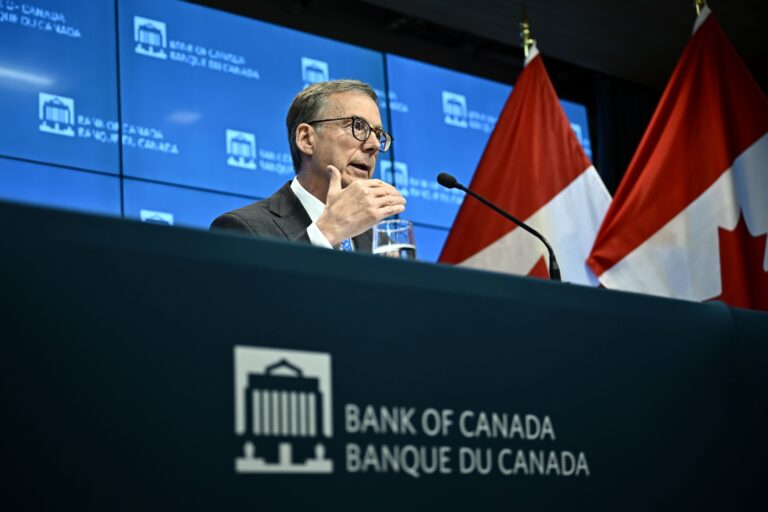
The Bank of Canada left the benchmark interest rate unchanged at 2.25 per cent. Governor Tiff Macklem said he is facing a “dilemma” because inflation is heating up even as the economy cools. Leaving policy unchanged balances the risks, “for now,” he said.
“Recession” watch: Macklem avoided the debate over whether Canada is in a recession by sticking to the facts. In his statement on the decision, the governor acknowledged that Statistics Canada’s tally of economic output in the first quarter was weaker than the central bank had forecast. He isolated an “unexpected pullback” in government spending as the primary reason for the miss. He described business investment as weak and resisted getting too excited about a surge in employment last month, noting that hiring numbers have been volatile. “When you look through the bumpiness, employment in Canada is little changed since the start of the year,” Macklem said.
Related Articles


The Bank of Canada will update its forecasts next month. Macklem foreshadowed what to expect, saying that recent data suggests economic growth has resumed thanks to increased consumer spending and “more stability in housing activity.” Nevertheless, Macklem said he expects the economy will remain in “excess supply,” central bank speak for an economy that is growing too slowly to stoke inflation.
“Recession is not the word I would use,” Macklem said at a press conference. “The economy is weak. It hasn’t grown really in the last year.”
Inflation watch: Unfortunately, inflation is rising despite weak demand. Macklem said the effects of the Iran war will cause year-over-year changes in the consumer price index to hover close to three per cent in the “coming months.” That’s the top of the Bank of Canada’s comfort zone. Macklem said he and his deputies decided that they will “look through” the war’s near-term effects, as there is little evidence that higher energy costs are causing other prices to rise. The consumer price index encompasses hundreds of goods and services and the number of those components growing faster than three per cent is at the historical average. “We will be watching closely for evidence of broadening price pressures,” Macklem said.
Tiff be nimble: Macklem said monetary policy “may need to be nimble.” That’s because the growth numbers argue for an interest rate cut, while the inflation data suggest interest rates are too low. The governor offered a helpful sketch on how to follow along. If the U.S. imposes “significant” new tariffs, the central bank probably would have to cut rates. If the conflict in the Middle East persists, and higher energy prices lead to broader inflation, the Bank of Canada might have to resort to “consecutive increases” to keep inflation from taking root.
It’s also possible that no clear path emerges. In that case, expect the central bank to err on the side of containing price pressures. “If energy prices stay high, we will not let their effects become broad-based persistent inflation.”
Editor’s note: This story has been updated with a quote from Tiff Macklem.