BlueDot, the digital health firm credited with first spotting the COVID-19 outbreak at the turn of the year, is helping Toronto’s public health agency measure people’s movement using anonymized smartphone location data as part of the city’s efforts to curb the spread of the virus.
Skip to content

News
AI firm BlueDot helping Toronto Public Health measure residents’ movement in bid to track COVID-19 risks
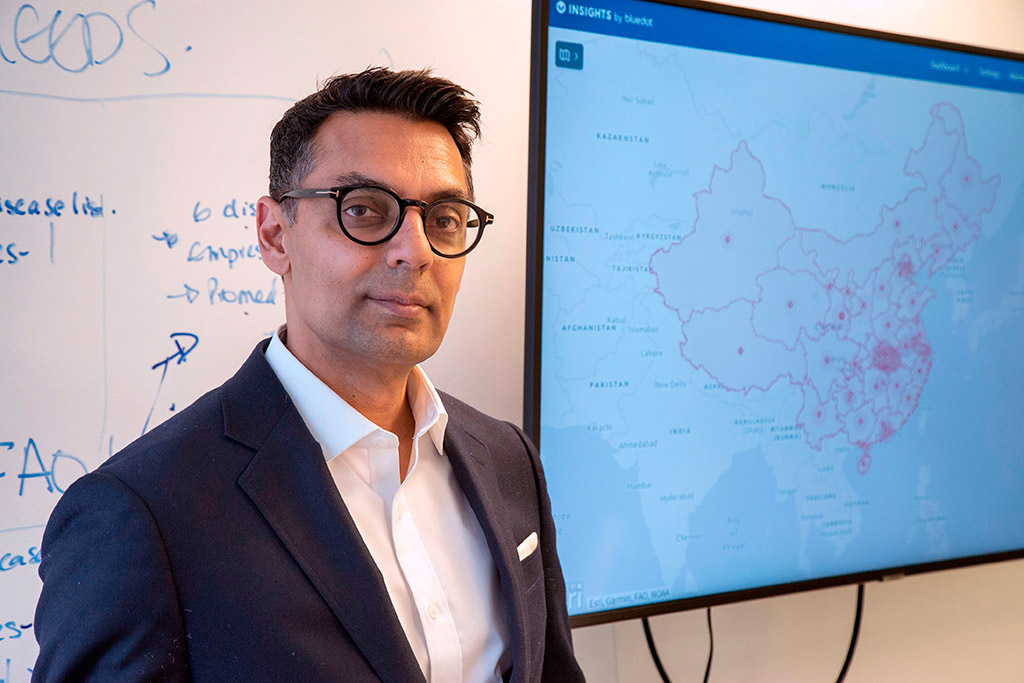
Dr. Kamran Khan, CEO of BlueDot, at the company’s Toronto office in February 2020. Photo: Jorge Uzon/AFP via Getty Images
BlueDot, the digital health firm credited with first spotting the COVID-19 outbreak at the turn of the year, is helping Toronto’s public health agency measure people’s movement using anonymized smartphone location data as part of the city’s efforts to curb the spread of the virus.
BlueDot’s mobility indices—summaries showing patterns of movement between and within different parts of the city—are based on “near-real-time mobile device location data” collected from smartphone apps, Dr. Michael Finkelstein, acting director of communicable-disease control at Toronto Public Health (TPH), told The Logic.
Talking Point
Toronto Public Health is using anonymized data on mobile-device locations provided by local digital health firm BlueDot in its efforts to monitor the risk of COVID-19 exposure for different parts of the city and vulnerable communities.
BlueDot CEO Dr. Kamran Khan said the company’s third-party data providers “strictly comply” with privacy laws and regulations. The firm’s mobility indices don’t include personal information about device users such as names or phone numbers, he said, and the company aggregates what it gets “to the level of populations.” BlueDot doesn’t know from which apps the data is drawn. Khan didn’t directly answer The Logic’s questions about whether the company buys the data from brokers or from app developers themselves.
Finkelstein said TPH receives the information on “an aggregated geographic level,” such as by neighbourhood or census tracts, the 2,500- to 8,000-person areas used to conduct the national population count.
The agency uses the data as part of studies to figure out “which activities from cases placed [people] at increased risk of infection,” according to a report that medical officer of health Dr. Eileen de Villa prepared for the city’s Board of Health earlier this month. It cites as an example the possibility of using the information to gauge the “the distance travelled to or from a gathering that may be considered high risk for exposure to COVID-19,” allowing the agency to understand who may have been most impacted, and how to reach them. CP24 first reported details of that document on October 14.
BlueDot’s mobility indices provide “the intelligence needed to prevent outbreaks from accelerating and overwhelming the healthcare system by using finite human resources in the most efficient manner possible,” Khan said. The company typically delivers the metrics to TPH weekly, and there’s a three-day lag in the data.
The city’s contract with BlueDot started on September 29, and runs for two years, Finkelstein said. TPH declined to disclose the value of the agreement, citing commercial confidentiality.
Toronto city councillor Kristyn Wong-Tam, who sits on the Board of Health, said she supports the TPH initiative. “The intention is to try to use one additional dataset to understand how the coronavirus [is] being transmitted, and where,” she said, noting that the mobility information will be overlaid with other sources, such as areas where residents are working. “We’re learning that some people cannot stay at home because they [are] essential workers, many of [whom] are racialized women, low-income and living in the northwest quadrant of the city.” According to de Villa’s report, mobility data shows residents of that area have continued to travel at similar rates throughout the pandemic, even as those in more affluent neighbourhoods have stayed home.
BlueDot government clients use its data and insight tools to monitor disease outbreaks and make risk assessments. In March, the firm started including cellphone geolocation data it obtains from third-party providers. Chicago has used BlueDot’s tools to monitor whether the city’s population was staying home in the pandemic’s first months, and make decisions about lifting lockdowns.
That same month, Toronto Mayor John Tory said the city had obtained data from wireless carriers to generate a heat map that would show where residents were congregating despite social-distancing orders; he later walked back the claim. At the time, City of Toronto chief communications officer Brad Ross issued a statement that the city “is not in possession of such data, nor will it acquire such data.”
Asked last week whether the city has changed its position on the use of mobility data in light of the measures described in de Villa’s report, Ross referred The Logic to TPH, which he said “operates independently of the City of Toronto.” TPH told The Logic it is a division of the city.
Technology experts have pointed out the shortcomings of cellphone data-based tracking, noting that the anonymization of data is reversible with additional information or if it isn’t aggregated; for example, individual residents could be identified based on their home address, where they consistently spend time. Civil rights groups have also called for restrictions to prevent public health authorities from sharing the information with other government agencies, particularly law enforcement.
Ontario privacy commissioner Patricia Kosseim said neither the agency nor the City has consulted her office about using cellphone data in antiviral efforts. “Although the use and disclosure of properly de-identified health information falls outside the scope of privacy legislation, custodians such as Toronto Public Health must take reasonable steps to ensure that even information which appears at first blush to be de-identified cannot be used, alone or in combination with other information, to identify an individual,” she said.
Toronto isn’t BlueDot’s only Canadian government client. It started working with Ontario’s health ministry at the end of March. Federally, the Public Health Agency of Canada (PHAC) and Health Canada have contracts worth $3.58 million with the company for licences for its software tools as well as ongoing consulting. The agency uses the firm’s models and data tables to help assess the risk of COVID-19 entering the country under different travel scenarios, and to evaluate community spread. The defence department also signed a $497,200 contract in late March with BlueDot for the use of its database.
Khan declined to say whether his firm’s revenues have grown during the pandemic, or whether it’s sought to raise fresh capital since its US$7-million Series A round in August 2019, led by The Co-operators and BDC Capital’s Women in Technology Venture Fund. But headcount has nearly doubled this year. “COVID-19 has understandably increased demand and interest in the services that BlueDot offers, both for the current pandemic as well for the inevitable next outbreak,” he said.



Loading...
Thanks for sharing!
You have shared 5 articles this month and reached the maximum amount of shares available.
CloseThis account has reached its share limit.
If you would like to purchase a sharing license please contact The Logic support at [email protected].
CloseGift the full article!
You have gifted 0 article(s) this month and have 5 remaining.
Recipients will be able to read the full text of the article after submitting their email address. They will not have access to other articles or subscriber benefits.
Photo: Jorge Uzon/AFP via Getty Images
Most Popular This Week




In-depth, agenda-setting reporting
Great journalism delivered straight to your inbox.
News
National Bank CEO warns AI alone won’t give banks a lasting edge
Briefing
Canada and Ontario commit over $5B to support tariff-hit steel sector
Hackers will see cars as major targets in next 3 years, 83% of car-tech workers say
EA shutting down Edmonton studio BioWare
Best business newsletter in Canada
Get up to speed in minutes with insights and analysis on the most important stories of the day, every weekday.
Exclusive events
See the bigger picture with reporters and industry experts in subscriber-exclusive events.
Membership in The Logic Council
Membership provides access to our popular Slack channel, participation in subscriber surveys and invitations to exclusive events with our journalists and special guests.





