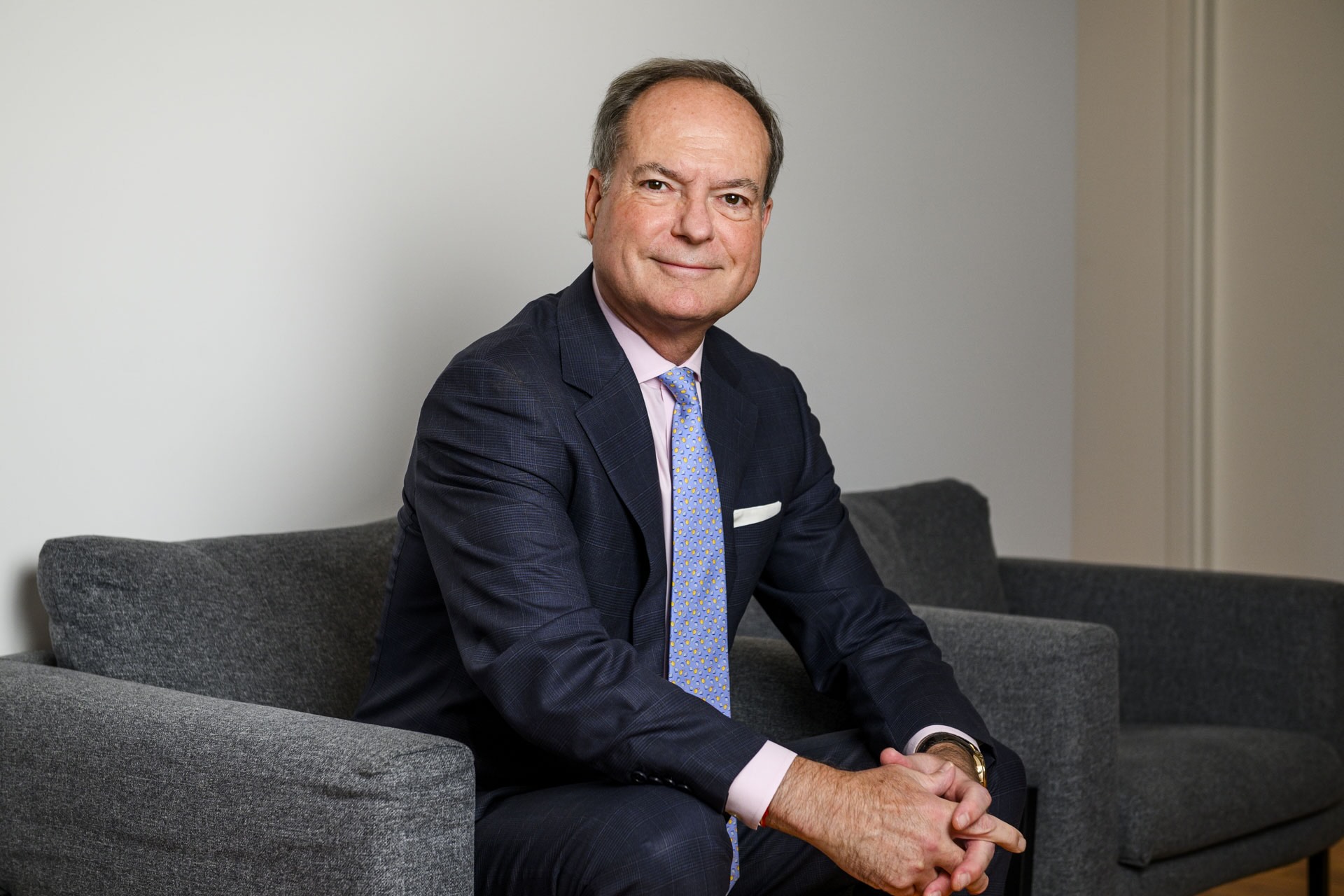
There’s still some Bay Street in Ontario Finance Minister Peter Bethlenfalvy, whose quarter-century in finance included stops at TD Securities, credit-rating agency DBRS, Manulife Financial and CST Consultants, where he managed a $4-billion investment portfolio.
Skip to content
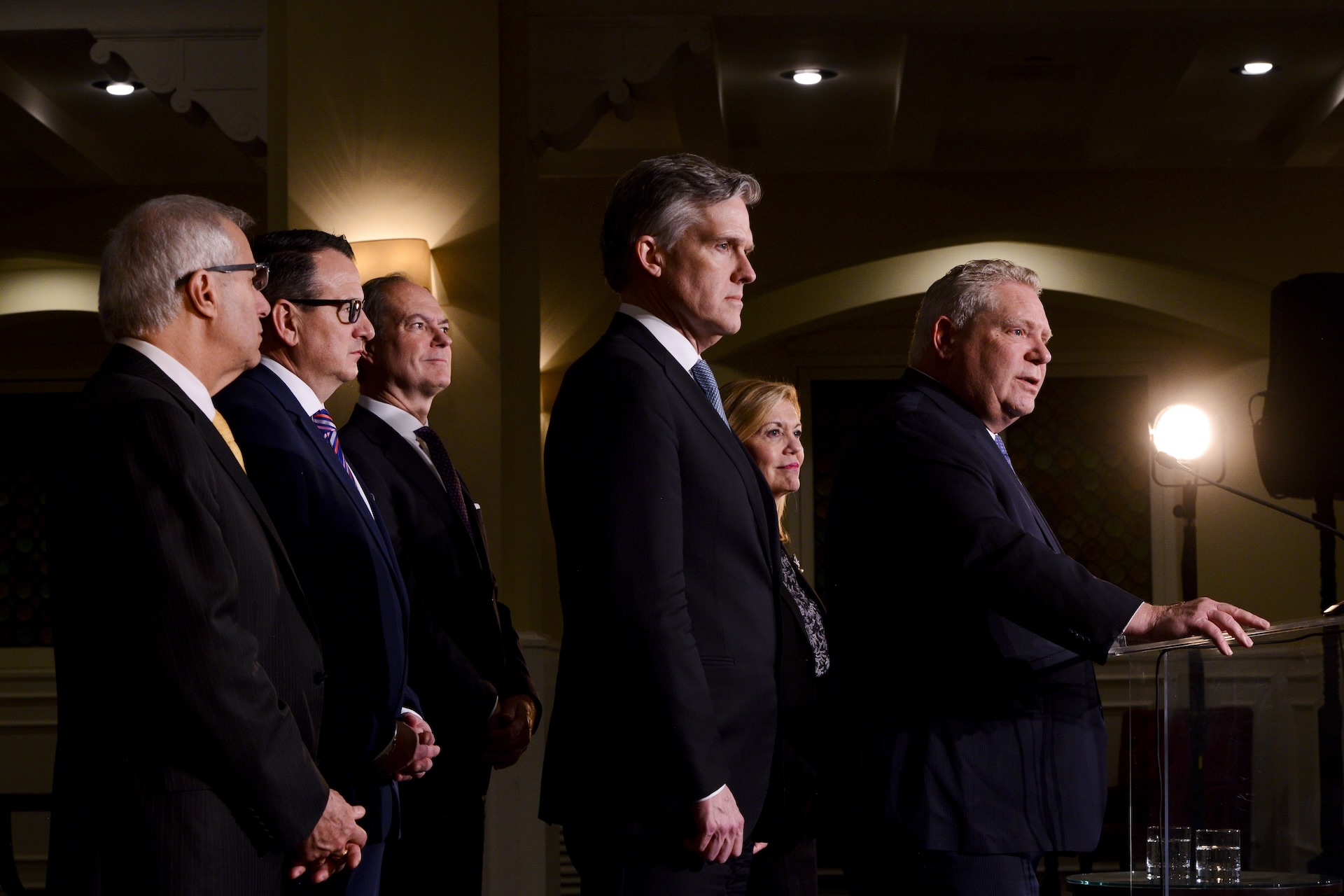 Ontario Premier Doug Ford is one of the few political leaders who has emerged from the cost-of-living crisis without having to worry constantly about his job. Photo: The Canadian Press/Sean Kilpatrick

Commentary
Carmichael: With $200 ‘tax rebate,’ Ontario presses its fiscal advantage
Handing out $3B in windfall payments might be bad economic policy, but how do you measure the value of political stability?
Ontario Minister of Finance Peter Bethlenfalvy poses before an editorial board meeting at The Logic's Toronto newsroom on Nov. 18, 2024. Photo: Christopher Katsarov Luna for The Logic
There’s still some Bay Street in Ontario Finance Minister Peter Bethlenfalvy, whose quarter-century in finance included stops at TD Securities, credit-rating agency DBRS, Manulife Financial and CST Consultants, where he managed a $4-billion investment portfolio.
“I go out every 90 days and face the media on my financial results,” Bethlenfalvy said at a meeting with a group of editors and reporters from The Logic on Monday. “I come from the private sector. In what world wouldn’t you tell your shareholders and your stakeholders how you’re doing with their money,” he added. “It allows us to get our message out, but it also gives people a chance to criticize our plan, and I think that’s healthy.”
So let’s criticize. As the Bennett Jones team of policy advisers observed earlier this year, it’s “unfortunate” that so little attention is paid to the economic performance and policy choices of provincial, territorial and local governments because they are responsible for most public expenditures and investment. A dialogue dominated by Pierre Poilievre and Justin Trudeau is too narrow, especially since political calculations threaten to freeze federal policy making for the next year, if not longer. It could be up to the bigger provinces, cities and First Nations to move the needle in the short term.
First, the good from Ontario’s fall economic statement. Bethlenfalvy has put the province in a position to weather whatever might come from Donald Trump’s return to the White House.
Related Articles


Ontario has generated significantly more revenue than expected this year. Bethlenfalvy and Premier Doug Ford opted to spend much of that windfall on a one-time tax rebate (more on that later), but while narrowing the deficit and bolstering the province’s contingency reserves. The budget is effectively balanced, even as Ontario is in the middle of the biggest infrastructure investment plan in the province’s history.
“Shrinking deficits imply long-term bond borrowings will be used primarily to refinance maturing debt and make investments in capital assets,” analysts at Laurentian Bank Securities said in their review of Ontario’s revised fiscal plans, speculating that the province’s debt could be on the verge of an upgrade from rating agencies. “It is a sound advantage very few provinces benefit from.”
If there was ever a time to apply Nassim Nicholas Taleb’s concept of antifragility, it’s now.
Maybe Trump’s return to power brings a period of plenty. Maybe Canada avoids Trump’s tariffs and survives the renegotiation of the North American trade agreement in 2026 unscathed. Maybe the change of leadership in Washington leads to an armistice between Russia and Ukraine and some kind of peace between China and Taiwan.
Even if such a scenario plays out, the existential threat posed by climate change will remain. Governments in Canada must also confront the growing burden of an aging population, the productivity slump and the opportunity costs associated with technological disruption. It’s impossible to predict how all this will go. The winners will have left themselves with optionality.
The cost-of-living crisis has harmed the public’s faith in institutions. The prime minister and the governing Liberal party are deeply unpopular. When political parties are fighting for survival, they do desperate things. A confident government that decided it needed revenue to confront all those challenges listed above might have taken the International Monetary Fund’s advice and raised the GST, a highly efficient tax that does little to alter behaviour. Instead, Trudeau raised capital gains taxes, creating more friction for investment at a time when business investment was already chronically weak.
“I don’t like it,” Bethlenfalvy said of the federal government’s decision to raise capital gains taxes. “I don’t think you can tax your way to prosperity, and that’s why we’re helping Ontarians … in the form of this taxpayer rebate.”
That brings us to the bad in Bethlenfalvy’s fiscal plan—or if not bad, the less than ideal. His update increased the revenue projection for the fiscal year ending March 31, 2025 by almost $7 billion. Some of that gain is from piggybacking on the higher capital gains inclusion rate, which Bank of Nova Scotia economist Laura Gu estimates could boost Ontario’s tax revenue by some $3 billion over three years.
If provinces see higher capital gains taxes as an investment killer, there is nothing stopping them offsetting federal tax rates with provincial measures. They might even take advantage and set themselves apart by cutting taxes on productive investment. Ontario did something else. Bethlenfalvy opted to use $3 billion to give every Ontarian a tax rebate of $200. The finance minister shared polling data that suggest the measure is extremely popular. “That’s tapping into some need out there,” he said. “That just speaks to providing timely relief at a time that they really need it.”
At The Logic Summit last month, Bank of Canada governor Tiff Macklem said policymakers should confront the productivity crisis by making sure every decision improves the country’s ability to generate wealth. If Ontario had such a filter, a policy of helicopter money wouldn’t have made the cut. The better long-term play would have been spending even more on aging infrastructure, or accelerating debt repayment in case interest rates spike again. “Economic conditions suggest a hold-the-line plan would have passed muster,” Gu wrote.
Most assessments of Bethlenfalvy’s update noted that his Progressive Conservative party appears to be keen for an election next year. That brought an air of cynicism to the critiques. The reserves that Bethlenfalvy has set aside could finance “other potential targeted electoral measures,” the Laurentian Bank note said.
Economists and commentators struggle with the messiness of power. They dismiss suboptimal policy decisions, and then lament the state of democracy. Bethlenfalvy’s helicopter drop might be bad economic policy, but how do you measure the value of political stability? Ford is one of the few political leaders who has emerged from the cost-of-living crisis without having to worry constantly about his job.
“Just look around the world, that’s the number one issue,” Bethlenfalvy said. “Incumbent governments, if you’re not dealing with the cost-of-living crisis and affordability, you do so at your own peril.”
Few regimes are in greater peril than Trudeau’s minority government in Ottawa. He and Finance Minister Chrystia Freeland stole Ford and Bethlenfalvy’s playbook on Thursday and announced that almost 19 million Canadians will be getting a $250 tax-free rebate in the new year. They paired that gift with a pledge to temporarily lift the federal sales tax on a bevvy of items associated with the holidays, such as booze, restaurant meals and Christmas trees.
There’s a difference between the two plans, though. The Ontario government decided to blow money out the door from a position of fiscal strength, while Freeland has struggled to stay within her self-imposed deficit and debt guardrails. Ford and Bethlenfalvy look canny. Without spending cuts to offset their copycat helicopter drop, Trudeau and Freeland risk looking desperate.
Kevin Carmichael is The Logic’s economics columnist and editor-at-large. He has spent more than two decades covering economics, business and finance for outlets including Bloomberg News, The Globe and Mail and the Financial Post, where he also served as editor-in-chief.



Loading...
Thanks for sharing!
You have shared 5 articles this month and reached the maximum amount of shares available.
CloseThis account has reached its share limit.
If you would like to purchase a sharing license please contact The Logic support at [email protected].
CloseGift the full article!
You have gifted 0 article(s) this month and have 5 remaining.
Recipients will be able to read the full text of the article after submitting their email address. They will not have access to other articles or subscriber benefits.
Photo: Christopher Katsarov Luna for The Logic
Ontario Premier Doug Ford is one of the few political leaders who has emerged from the cost-of-living crisis without having to worry constantly about his job.
Most Popular This Week



In-depth, agenda-setting reporting
Great journalism delivered straight to your inbox.
News
ApplyBoard was the worst-performing Canadian startup in Fidelity’s portfolio in 2026
Briefing
Defence Investment Agency to be a Crown corporation so it can get deeper into Canada’s military industry
Mark Carney says he’ll work with Quebec separatist premier-to-be on housing, infrastructure, big projects
Mistral claims its new AI model closes the gap with leading Chinese developers
Best business newsletter in Canada
Get up to speed in minutes with insights and analysis on the most important stories of the day, every weekday.
Exclusive events
See the bigger picture with reporters and industry experts in subscriber-exclusive events.
Membership in The Logic Council
Membership provides access to our popular Slack channel, participation in subscriber surveys and invitations to exclusive events with our journalists and special guests.