Opposition leader Pierre Poilievre sniffed at this week’s emergency meeting of first ministers, organized at the behest of premiers who were rattled by Donald Trump’s tariff threat.
Skip to content

Commentary
Carmichael: Parliamentary shenanigans matter to the economy
Look no further than the plight of Canadian fintechs
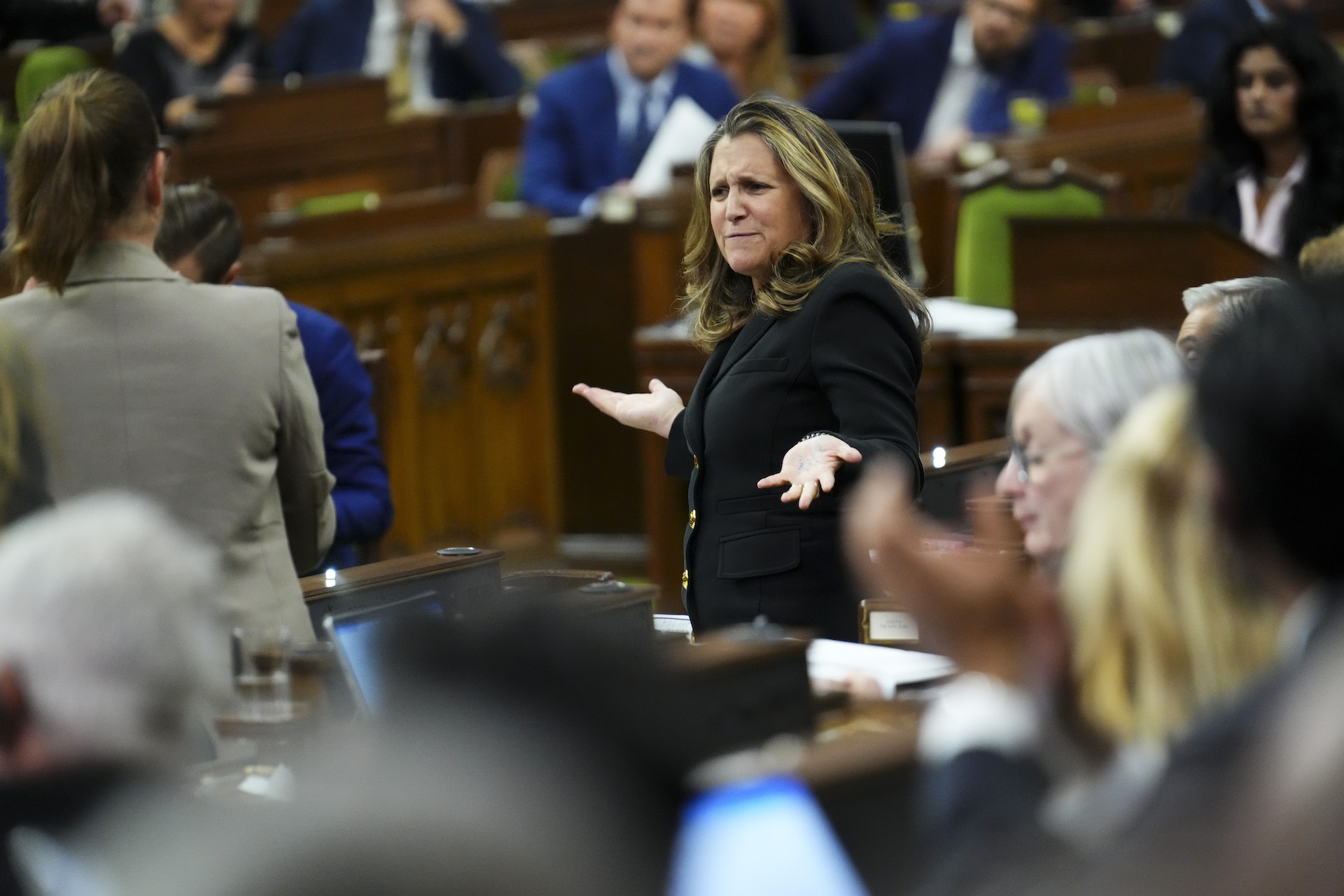
Finance Minister Chrystia Freeland responds to a question in the House of Commons in October 2024. Photo: The Canadian Press/Sean Kilpatrick
Opposition leader Pierre Poilievre sniffed at this week’s emergency meeting of first ministers, organized at the behest of premiers who were rattled by Donald Trump’s tariff threat.
“Justin Trudeau’s plan to save the economy? A zoom call!” Poilievre wrote on X, and then invited his followers to sign a “Canada First” petition by supplying their names, postal codes, email addresses and mobile phone numbers to the Conservative Party of Canada.
Poilievre’s plan to save the economy? He sent a letter to the Speaker requesting an emergency debate in the House of Commons, a body that has refused to consider actual legislation since the end of September. Poilievre’s request was granted thanks to the backing of the New Democratic Party. Here’s a link to Hansard. Decide for yourself if members of Parliament moved the needle on anything.
Charitably, the Conservatives are blocking legislative debate over a point of principle: the House called on the government to hand over to the RCMP documents related to the Sustainable Development Technology Canada scandal, and the government refused. The Mounties said they don’t want the documents. The Conservatives have kept up their filibuster anyway, with the support of the rest of the opposition.
Related Articles


Political stability used to be a Canadian advantage. The U.S. and the European Union are more attractive markets, but investing there came with the uncertainty of bureaucratic gridlock in Brussels and periodic government shutdowns and legislative brinksmanship in Washington.
In Canada, politics could get acrimonious, but the government tended to function. Political risk wasn’t something executives and investors had to think about. They do now. The unseriousness of Canada’s political class is hurting the economy, even as its leaders profess that they are here to save it from whatever Donald Trump might bring.
Here’s an example of how chronic political gamesmanship makes a mess of things in the real world. The Logic reported earlier this month that Calgary-based Neo Financial’s $362-million funding round was led by an undisclosed Chinese investor. The Globe and Mail reported this week that the mystery investor was Tencent, one of China’s most important technology companies.
Neo disclosed that a group of A-listers that included Shopify founder Tobi Lütke, Slack founder Stewart Butterfield and Canada’s Thomson family were among the investors in the Series D round, but cloaked the identity of the biggest source of funds. If the initial mystery raised cautionary flags, the news that the investor is a Chinese company subject to government pressure raises red ones. The Financial Times reported earlier this year that the Chinese government had begun buying stakes in its biggest tech companies, including Tencent.
Prime Minister Justin Trudeau’s government might have been reluctant initially to join the U.S.’s great power struggle with China, but now it’s all in. It quickly matched prohibitive U.S. tariffs on Chinese electric vehicles. Solaris, a miner, said this week that it has left Canada after a lengthy security review forced it earlier this year to scrap a $130-million investment from a Chinese company. Newly appointed CEO Matthew Rowlinson will work from Switzerland.
So far, Canada’s China-blocking has focused on electric vehicles and the minerals needed to power them, but authorities want to put a fence around data, too.
Jack Ma, the billionaire founder of Alibaba, a rival of Tencent for Chinese tech supremacy, disappeared from public view for several years after he was critical of regulators in 2020. It sent a signal to the rest of the world that the Chinese government intended to keep its tech champions on a tight leash.
Canada has joined its democratic allies in banning Huawei telecommunications gear out of fear the Chinese government could use it for spying. Earlier this month, Industry Minister François-Philippe Champagne ordered Bytedance’s Canadian arm, TikTok Technology Canada, to shut down, citing national security concerns.
Given the political context, why would any Canadian company tempt fate by taking money from one of the firms the U.S. thinks threatens its tech supremacy? Maybe because Neo ran out of time waiting for Ottawa to decide how it will regulate financial services online.
Finance Minister Chrystia Freeland is sitting on legislation that would enact an open-banking regime that would allow customers to safely share their financial data with registered service providers. The Conservatives support open banking and have called on the government to enact legislation. Their two-month filibuster is preventing Freeland from doing so.
Parliamentary shenanigans matter. Fintechs such as Neo need clarity to decide on strategy. A clear set of rules and a timeline for implementation also would lower the risk premium demanded from investors who are courted to bet on companies that promise they can steal clients from the big banks. A company as big as Tencent can take a flyer on a Canadian fintech on the off chance it can secure a toehold in a rich western economy. But most investors, and especially domestic ones, will need clarity on the regulatory environment.
“It’s really hard for me to say, ‘OK, we’re going to put a few million dollars into this experimental stuff this year,’ because we know it’s going to come in three years’ time,” Andrew Moor, chief executive of Equitable Bank, said in an interview earlier this year.
Ottawa has been studying open banking since 2018. Back then, Canada was in the vanguard, home to an impressive group of financial upstarts. Those firms would have benefited from regulation that leveled the playing field with legacy banks, but they’ve been forced to make their way on uneven terrain. “We’re way behind many countries in this world,” Matthew Boswell, the head of the Competition Bureau, said during testimony at the House industry committee on Nov. 25. “Way behind.”
Freeland’s dithering on open banking is responsible for much of that delay. Now, it’s the opposition. The NDP used its votes in the Commons to end the Conservative filibuster to pass the government’s temporary GST relief and $250 rebate for most working Canadians. Then it went back to supporting deadlock.
Something you hear a lot on Parliament Hill is that Canada is broken. Maybe not yet, but the political class is doing its best to make that rhetoric a reality.
Kevin Carmichael is The Logic’s economics columnist and editor-at-large. He has spent more than two decades covering economics, business and finance for outlets including Bloomberg News, The Globe and Mail and the Financial Post, where he also served as editor-in-chief.



Loading...
Thanks for sharing!
You have shared 5 articles this month and reached the maximum amount of shares available.
CloseThis account has reached its share limit.
If you would like to purchase a sharing license please contact The Logic support at [email protected].
CloseGift the full article!
You have gifted 0 article(s) this month and have 5 remaining.
Recipients will be able to read the full text of the article after submitting their email address. They will not have access to other articles or subscriber benefits.
Photo: The Canadian Press/Sean Kilpatrick
Most Popular This Week


In-depth, agenda-setting reporting
Great journalism delivered straight to your inbox.
News
ApplyBoard was the worst-performing Canadian startup in Fidelity’s portfolio in 2026
Briefing
Defence Investment Agency to be a Crown corporation so it can get deeper into Canada’s military industry
Mark Carney says he’ll work with Quebec separatist premier-to-be on housing, infrastructure, big projects
Mistral claims its new AI model closes the gap with leading Chinese developers
Best business newsletter in Canada
Get up to speed in minutes with insights and analysis on the most important stories of the day, every weekday.
Exclusive events
See the bigger picture with reporters and industry experts in subscriber-exclusive events.
Membership in The Logic Council
Membership provides access to our popular Slack channel, participation in subscriber surveys and invitations to exclusive events with our journalists and special guests.