Hypothesis: the housing crisis is a result of the productivity crisis. If we had taken the latter seriously, we might have been able to avoid the former. We didn’t, so governments have resorted to trying to spend their way out of the problem. However, new research by the Canada Mortgage and Housing Corporation suggests money won’t be enough.
Skip to content
 Mathieu Laberge, CMHC’s senior vice-president of housing economics and insights. Photo: Canada Mortgage and Housing Corporation/Handout

Commentary
Carmichael: Are Canada’s builders up to the task of solving the housing crisis?
Throwing money at the problem won’t fix it if our construction companies are too small and too low tech, research finds
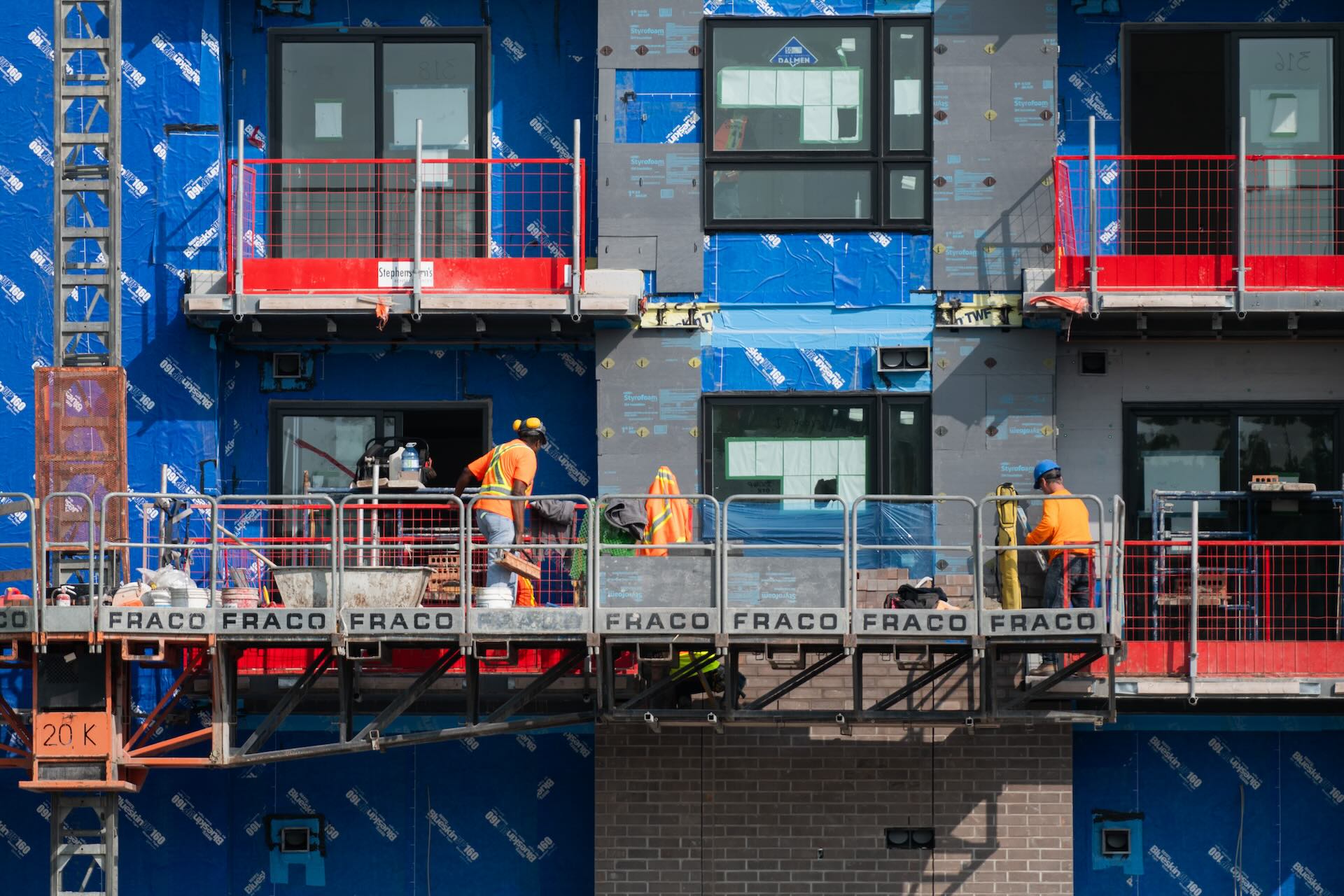
Construction workers at an affordable housing project in Ottawa in September 2023. Photo: The Canadian Press/Spencer Colby
Hypothesis: the housing crisis is a result of the productivity crisis. If we had taken the latter seriously, we might have been able to avoid the former. We didn’t, so governments have resorted to trying to spend their way out of the problem. However, new research by the Canada Mortgage and Housing Corporation suggests money won’t be enough.
The public investment planned for real estate is mind-boggling. Finance Minister Chrystia Freeland promised measures worth $8.5 billion in her latest budget. Ontario put up $1.8 billion for water systems and other basic infrastructure needed to make homes liveable. British Columbia extended tax exemptions on home transfer costs for first-time homebuyers and newly constructed properties. And so on.
All that money will bend the supply curve through mass alone. But Canada’s supply crunch isn’t about a lack of funds—this country has no issue committing a disproportionate amount of its wealth to housing. The bigger issue is the makeup of the construction industry: Canada’s builders might be too small and too low tech to scale fast enough to move the needle.
There are exceptions, but more often than not, the construction industry’s output per hour of work lags that of the broader economy. In the fourth quarter, when Canada finally ended a miserable period of negative productivity growth, construction dropped 1.1 per cent from the previous quarter.
Related Articles


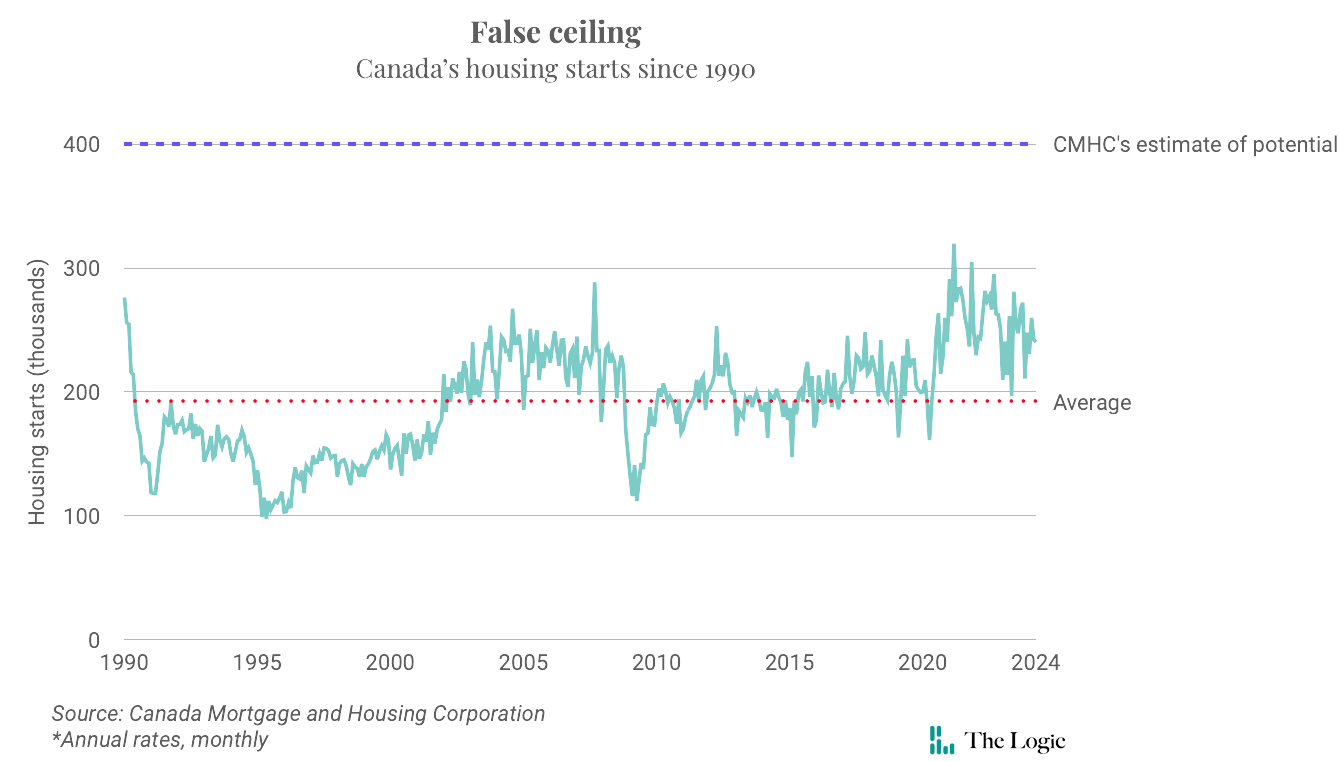
Mathieu Laberge, CMHC’s senior vice-president of housing economics and insights, has added some depth to those numbers. Laberge’s latest work on the housing crisis offers an estimate of how many houses Canada can reasonably build in a year. He puts the number at about 400,000 units per year, based on the historical relationship between construction workers and housing starts. In case that was too crude a measure, he also looked at starts in Vancouver, Edmonton and Calgary, which consistently build the most homes per person. Those calculations also suggested Canada has the “potential” to build around 400,000 homes per year.
Last year, however, builders started work on about 240,000 units—even though they employed a record 650,000 people.
It’s hard to imagine a better backdrop for the construction industry over the past decade. Low interest rates and population growth combined to fuel demand, and a technology boom offered a unique opportunity to invest. But somehow, builders are less productive today than they were 20 years ago.
“It doesn’t come out as much in the news, but industry has a role to play,” Laberge said in an interview. “Why don’t all the resources we put in the sector bring more outcomes?”
Laberge’s estimate of Canada’s homebuilding potential is a challenge to at least two pearls of received wisdom. Housing starts have hit an annual rate of more than 300,000 units only twice since 1990, and the monthly average over that period is about 192,000, feeding an argument that the current trend of around 240,000 is about all that we can reasonably expect. Laberge’s analysis suggests otherwise.
The other assumption Laberge’s work tests is that the supply crunch is primarily the fault of municipal gatekeepers and ill-considered provincial and federal housing policy. That’s certainly part of it; Laberge pegs a proliferation of fees and codes as one reason builders are less productive than they were in the past.
But the other reason, as far as Laberge can tell, is the makeup of the construction industry itself. There are too many small, regional builders who are either content to work within their geographies or lack the means to scale. That can only put upward pressure on prices, while creating backlogs because demand exceeds the builders’ capacity to keep up.
Laberge observed that industry data show that Canada has only one residential builder that employs more than 500 people. Roughly 25,000 micro-firms employ one to four people, while about 11,000 smaller residential builders employ between five and 100 people. “Consolidation may help generate economies of scale, making the math work better to build affordable housing and enabling some production savings to be passed on to Canadians,” he wrote.
Canada tends to romanticize smaller companies as the backbone of the economy, but that preference is one of the root causes of our twin housing and productivity crises. The Canadian Home Builders’ Association acknowledged as much in its pre-budget submission to the federal government; the lobby said a shift to factory-made modular homes would boost productivity, but insisted that a series of policy changes would be necessary to overcome structural factors such as a preference for “site-built” projects, where developers tend to “share” sub-contractors, moving them from “site to site like an assembly line.”
In an interview, Kevin Lee, the head of the homebuilders’ association, said regulation and financial conditions are the biggest impediments to ramping up supply. He said consolidation “may or may not be necessary” to boost productivity, as the assembly-line approach of specialized subcontractors can be pretty efficient and smaller companies are better able to navigate the boom-bust nature of the housing market.
Still, Lee said industry is “always ready to step forward and do more as long as the environment is receptive to that happening.” It’s hard to argue the environment hasn’t improved. The housing crisis will persist until a critical mass of builders recognize that, and decide to maximize their potential.
Kevin Carmichael is The Logic’s economics columnist and editor-at-large. He has spent more than two decades covering economics, business and finance for outlets including Bloomberg News, The Globe and Mail and the Financial Post, where he also served as editor-in-chief.



Loading...
Thanks for sharing!
You have shared 5 articles this month and reached the maximum amount of shares available.
CloseThis account has reached its share limit.
If you would like to purchase a sharing license please contact The Logic support at [email protected].
CloseGift the full article!
You have gifted 0 article(s) this month and have 5 remaining.
Recipients will be able to read the full text of the article after submitting their email address. They will not have access to other articles or subscriber benefits.
Photo: The Canadian Press/Spencer Colby
Mathieu Laberge, CMHC’s senior vice-president of housing economics and insights.
Most Popular This Week




In-depth, agenda-setting reporting
Great journalism delivered straight to your inbox.
News
Canada Goose shrugs off Trump’s 50% tariff threat
Briefing
TC Energy says North American natural gas demand is growing much faster than previously expected
Mississauga imposes data centre pause, as Toronto councillors scrutinize local projects
A third of Canadian workers are using generative AI, but not for everything
Best business newsletter in Canada
Get up to speed in minutes with insights and analysis on the most important stories of the day, every weekday.
Exclusive events
See the bigger picture with reporters and industry experts in subscriber-exclusive events.
Membership in The Logic Council
Membership provides access to our popular Slack channel, participation in subscriber surveys and invitations to exclusive events with our journalists and special guests.