OTTAWA — Many Canadian businesses were already scrambling to gather documentation that will let them use the North American trade deal to avoid 25 per cent universal tariffs brought in by U.S. President Donald Trump. Now, a new rule that would offer others a discount on those tariffs is adding more paperwork to the pile.
Skip to content


News
Why Canadian companies are scrambling to adjust to Trump’s new rules on country of origin
New 20 per cent rule for U.S. content ‘changes the math’ for Canadian exporters already rushing to complete paperwork for North American trade deal
Some Canadian exporters could benefit from a new U.S. rule that reduces tariffs on goods composed of at least 20 per cent American content. Photo: AFP via Getty/Geoff Robins
OTTAWA — Many Canadian businesses were already scrambling to gather documentation that will let them use the North American trade deal to avoid 25 per cent universal tariffs brought in by U.S. President Donald Trump. Now, a new rule that would offer others a discount on those tariffs is adding more paperwork to the pile.
Talking Points
- A new rule could reduce tariff rate for goods with U.S. content making up at least 20 per cent of value, including those traded outside USMCA
- Getting paperwork wrong during the trade war would be a “serious business failure,” says a KPMG partner
A discount on tariffs
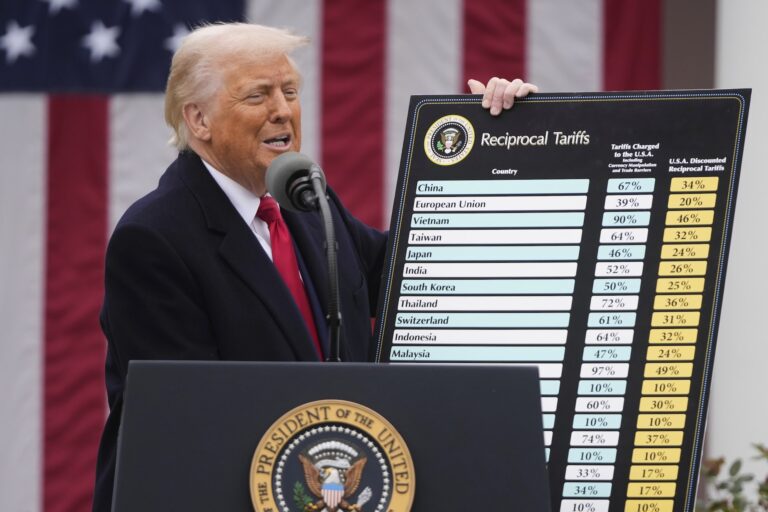
The president signed an executive order on April 2 that outlines so-called reciprocal tariffs levied on much of the world. Beginning at a baseline rate of 10 per cent, the tariffs climb higher for dozens of countries based on the size of their trade deficits with the U.S.
But the executive order also allowed some wiggle room: if 20 per cent or more of a good is made up of content that originated in the U.S., only the non-American part will be subject to tariffs.
If a good is valued at $100 and $20 of that comes from U.S. content, then the duty—whatever the rate may be—would be charged on the other $80. If another item worth $100 contains U.S. content worth up to $19.99—or none at all—then the tariff would apply to the full value of the good. The executive order says U.S. Customs and Border Protection has the power to collect documentation for anything declared as U.S. content so it can enforce this rule.
What it means for Canada
Related Articles

The newly announced rule could have big implications for Canadian exports to the U.S. that do not go through the United States-Mexico-Canada Agreement (USMCA). To understand why, you have to rewind to March 4, when Trump imposed 25 per cent tariffs on nearly all goods from Canada and Mexico over concerns that fentanyl was flowing into the U.S. across both borders. Two days later, Trump granted a major carve-out for any goods traded through USMCA.
Canada was left off the list of countries facing reciprocal tariffs, but trade exports say the newly announced 20 per cent rule would apply to Canadian goods that do not go through USMCA. It remains unclear whether that means now, when the fentanyl-related tariffs are still in place, or later, when the White House said the rate for most goods would drop from 25 to to 12 per cent.
Either way, it could affect a surprisingly large amount of exports.
By the numbers
About 38 per cent of Canada’s total exports to the U.S. went across the border through USMCA last year. Since World Trade Organization rules allowed most Canadian exports to enter the U.S. with low or non-existent duties, many businesses did not until now consider it worth the effort to document what was needed to prove it. RBC Economics estimated that if those steps were taken, all but six per cent of those 2024 Canadian exports could have gone through USMCA and would therefore remain duty-free even under the Trump tariff regime.
Changing the rules
The rules setting out which goods can move through USMCA are all about the country of origin. It is easy enough to determine the origin of a vegetable grown in a Canadian farm field. Eligibility criteria for manufactured goods, which contain a variety of parts, generally depends on whether the amount of content originating from either the U.S., Canada or Mexico meets a certain threshold—with all sorts of complicated formulas depending on the kind of goods.
The process for determining and documenting originating status is so complicated under USMCA, especially for sectors with complex, global supply chains, that many businesses did not bother. Still, the rules were at least agreed to and understood by the three countries that signed the trade deal. The executive order says little about how U.S. customs officers will now determine U.S. content, beyond noting they will have the power to enforce what is a unilateral move by the U.S. to change the rules of the game.
A ‘blunt but usable workaround’
Many Canadian businesses have been rushing to obtain the documents needed to prove their goods have enough North American content so they can trade through USMCA, but it is not a sure bet. “Eligibility does not mean a firm will (or even can) confidently certify compliance. Many sectors face complex, costly, or high-risk barriers to claiming USMCA origin,” Toronto-based trade lawyer Barry Appleton wrote in an email to The Logic.
Pharmaceuticals, for example, often have active ingredients from many different sources. It can also be tough to trace the origin of the imported content of consumer electronics. If the cost and risk of those issues still outweigh the benefits of seeking USMCA compliance, then Appleton said the 20 per cent rule offers firms a “blunt but usable workaround.”
What this means for businesses
“It changes the math,” said Joy Nott, a partner at KPMG who focuses on trade and customs practice. That includes the formulas that Canadian exporters would use to determine rules of origin under USMCA, but also their calculations about the value of accurate paperwork. She said she is dealing with many clients who are now realizing their past documentation might no longer pass the bar—and the penalty could be a 25 per cent duty bill.
The higher stakes also means company executives are getting involved in a way that she did not see when USMCA changed some of the administrative processes in 2020. “Getting it wrong now is not considered an administrative nuisance,” she said. “Getting it wrong now is considered a serious business failure that can’t or should not happen.”
Matthew Kronby, a trade lawyer at Osler, Hoskin & Harcourt in Toronto, expects it will also be a challenge for the U.S. border agency, which will have to set and administer “different rates of duties for dozens and dozens of different countries”—and then consider partial tariff rates through the 20 per cent rule. “It’s not clear to me, or to most observers, how they will manage this administratively.”
Canada’s vulnerability
Appleton said relying on long-established trade practices between Canada and the U.S. has left the Canadian side vulnerable to Trump’s whims. “The USMCA was meant to bring predictability,” Appleton, co-director and senior fellow of the Center for International Law at New York Law School, wrote in a briefing note last week. “But without vigilance, predictability becomes presumption—and presumption is not protection. Canada now faces the real consequences of what happens when duty-free becomes duty-vulnerable.”



Loading...
Thanks for sharing!
You have shared 5 articles this month and reached the maximum amount of shares available.
CloseThis account has reached its share limit.
If you would like to purchase a sharing license please contact The Logic support at [email protected].
CloseGift the full article!
You have gifted 0 article(s) this month and have 5 remaining.
Recipients will be able to read the full text of the article after submitting their email address. They will not have access to other articles or subscriber benefits.
Photo: AFP via Getty/Geoff Robins
Most Popular This Week


In-depth, agenda-setting reporting
Great journalism delivered straight to your inbox.
News
ApplyBoard was the worst-performing Canadian startup in Fidelity’s portfolio in 2026
Briefing
Defence Investment Agency to be a Crown corporation so it can get deeper into Canada’s military industry
Mark Carney says he’ll work with Quebec separatist premier-to-be on housing, infrastructure, big projects
Mistral claims its new AI model closes the gap with leading Chinese developers
Best business newsletter in Canada
Get up to speed in minutes with insights and analysis on the most important stories of the day, every weekday.
Exclusive events
See the bigger picture with reporters and industry experts in subscriber-exclusive events.
Membership in The Logic Council
Membership provides access to our popular Slack channel, participation in subscriber surveys and invitations to exclusive events with our journalists and special guests.