OTTAWA — Canada is better at protecting the steel it produces for the United States from unfair trade practices than its own domestic market, says the national industry association—an approach that, perversely, could undermine efforts to avoid steep tariffs from the Trump administration.
Skip to content

 Prime Minister Justin Trudeau, centre, tours the ArcelorMittal Dofasco steel mill in Hamilton in 2022. Photo: The Canadian Press/Nathan Denette
News
Canada does a better job protecting American steel than its own, says industry
Canadian producers call for U.S.-style tariffs on cheap steel melted and poured in China
Canada's steel industry says U.S. mills like this one in Granite City, Ill., have benefitted more from Canadian trade policy than domestic producers. Photo: AP Photo/Jeff Roberson
OTTAWA — Canada is better at protecting the steel it produces for the United States from unfair trade practices than its own domestic market, says the national industry association—an approach that, perversely, could undermine efforts to avoid steep tariffs from the Trump administration.
“There are measures that the U.S. has taken that we have not taken to protect our market,” said Catherine Cobden, president and CEO of the Canadian Steel Producers Association (CSPA).
Talking Points
- U.S. data shows more than 95 per cent of steel imported from Canada was melted and poured within the North American free-trade zone
- The Canadian Steel Producers Association says about 40 per cent of steel in the domestic market is from foreign sources, including 600,000 tonnes a year from China
- The U.S. steel industry complains that global steel oversupply—caused largely by cheap Chinese exports—is undermining its business
Canada imposed 25 per cent tariffs on Chinese steel and aluminum products last October, matching a move by the Biden administration. The steel industry in this country had supported Ottawa’s move, arguing it was needed to protect access to the U.S. export market, which was worth almost $10.9 billion in 2024. Canada imported $7.2 billion in U.S. steel last year.
Yet the association says cheaper steel continues to flow into Canada in an unfinished state, which is not subject to the higher tariffs. That makes it harder for Canada’s steel industry to compete for domestic sales, while prompting complaints from the U.S. that Canada has benefited from a glut China created in the global market.
Since 2020, the U.S. has tracked steel imports by not just the country of origin but also the country of melt and pour—that is, where the raw steel is first made in a furnace, in a liquid state, and then poured into a solid shape for the first time, including semi-finished products like slabs. It does so in part to figure out whether countries Washington has targeted with tariffs, such as China, are getting steel into the U.S. through other countries.
The idea that China and other countries are circumventing U.S. tariffs this way is one of U.S. President Donald Trump’s stated justifications for imposing 25 per cent tariffs on all imports of aluminum and steel, removing an exemption Canada has had since 2019.
Related Articles

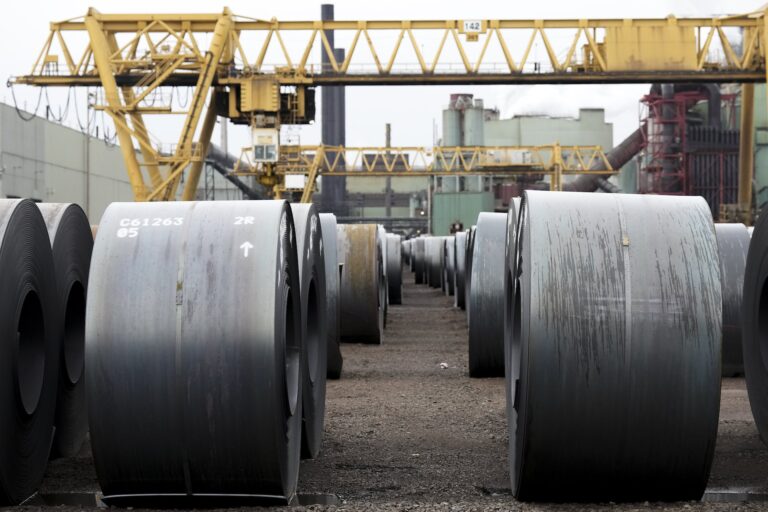
The U.S. data shows very little Chinese steel makes its way into the country from Canada. In 2024, the U.S. imported just over six million tonnes of finished steel products from this country. Some 95.3 per cent of it was melted and poured in the member countries of the United States-Mexico-Canada Agreement on trade (USMCA).
Those yearly numbers have been steady since 2020. Over that same span, the U.S. imported just 52,667 tonnes of steel from Canada that was originally melted and poured in China and 34,104 tonnes from Canada that had been melted and poured in Russia.
This “demonstrates irrefutably that we are not a back door to China, from Canada into [the] United States,” Cobden said. “We are actually a strong partner that’s practising USMCA trade.”
The numbers for Canada’s domestic market tell a different story. Citing data from Statistics Canada and other sources, the industry organization says 40 per cent of steel in Canada was melted and poured offshore. (Canada only made it mandatory to report the country of melt and pour last November.) China now accounts for at least 50 per cent of imports of 82 specific steel products, up from 26 in 2020. Over that same time period, Chinese imports doubled to more than 600,000 tonnes.
“We’re doing a better job helping the U.S. protect their market than what we’re doing in Canada domestically, which is a problem,” Cobden said. “We need to do the same. We need to improve, dramatically and urgently, the Canadian marketplace.”
Even though the U.S. data shows little Chinese steel is entering through Canada, the U.S. argues the presence of Chinese steel in Canada is still an issue. That is because it stems from the same root cause: overcapacity. The Organization for Economic Co-operation and Development said the global steel overcapacity would reach 573 million tonnes last year. China is a major factor. Its annual steel production, which now tops one billion tonnes, far exceeds domestic demand.
“Chinese steel exports to third countries can displace sales of locally produced steel in those markets and lead to increased exports of third-country steel production to the U.S. market,” the American Iron and Steel Institute wrote in a January paper. The institute recommended the USMCA, which is up for review next year, be updated to include more incentives to use North American steel, but did not blame Canada for the displacement issue.
The White House did. The Feb. 10 executive order said “imports of steel articles from Canada and Mexico have increased significantly to levels that once again threaten to impair U.S. national security.” It added: “These surges have occurred while authorities in those countries have supported otherwise uncompetitive producers with subsidies and other interventions that have exacerbated the global excess capacity crisis.”
Julian Karaguesian, an economics lecturer at McGill University who previously worked as a finance counsellor at the Canadian Embassy in Washington, D.C., said the U.S. argument could make sense from a political point of view, but not an economic one. “Canada is an independent country,” he said. “We either have a free trade agreement or we don’t.”
The CSPA wants Ottawa to get its own house in order, including by buying Canadian steel for domestic infrastructure projects. It also wants the federal government to extend tariffs to steel that is melted and poured in China. “That would broaden protections in the Canadian market from unfair trade from Chinese overcapacity and signal to the U.S. administration that Canada is deeply serious about addressing Chinese steel throughout North America,” Cobden said in a written statement. Global Affairs Canada did not provide a comment in time for publication.
Jamie Tronnes, executive director at the Washington-based Center for North American Prosperity and Security, said stricter controls could help, but it will be hard to win over a president determined to bring steelmaking home. Both Trump and Peter Navarro, his senior counselor for trade and manufacturing, want to build a stronger defence industrial base within U.S. borders. “In their minds, you cannot be a strong country if you do not have steel and aluminum,” Tronnes said.
Building a new steel mill can take a long time, she noted, so both producers and buyers of steel might absorb the short-term cost of tariffs instead of upending supply chains—especially if they think the tariffs will not outlast Trump’s administration. Tronnes said Canada could benefit by doubling down on open trade policy, because businesses could see it as an incentive to remain. “It really is key to get those strong free trade agreements in place with as many partners as possible outside of the United States,” she said.
Keanin Loomis, president and CEO of the Canadian Institute of Steel Construction said using Canadian steel in government-funded infrastructure projects would help support the industry through the looming trade war. “Here is something we can very consequentially and easily do as a country: be really mindful of how we procure domestically,” he said.



Loading...
Thanks for sharing!
You have shared 5 articles this month and reached the maximum amount of shares available.
CloseThis account has reached its share limit.
If you would like to purchase a sharing license please contact The Logic support at [email protected].
CloseGift the full article!
You have gifted 0 article(s) this month and have 5 remaining.
Recipients will be able to read the full text of the article after submitting their email address. They will not have access to other articles or subscriber benefits.
Photo: AP Photo/Jeff Roberson
Prime Minister Justin Trudeau, centre, tours the ArcelorMittal Dofasco steel mill in Hamilton in 2022.
Most Popular This Week



In-depth, agenda-setting reporting
Great journalism delivered straight to your inbox.
News
Carney hails LNG expansion as proof Canada can move faster on projects
Briefing
BMO, CIBC join cross-border blockchain experiment Project Agorá
Trade remains greatest ‘downside risk’ to Canada’s economic growth: Deloitte
AMD to acquire Radical Ventures-backed World Labs in US$8.2B deal
Best business newsletter in Canada
Get up to speed in minutes with insights and analysis on the most important stories of the day, every weekday.
Exclusive events
See the bigger picture with reporters and industry experts in subscriber-exclusive events.
Membership in The Logic Council
Membership provides access to our popular Slack channel, participation in subscriber surveys and invitations to exclusive events with our journalists and special guests.