TORONTO—The federal government will make $26 billion in tax credits available to companies for research and development over the next six years as part of major reforms to Ottawa’s flagship R&D incentive program, Finance Minister Chrystia Freeland announced Friday afternoon.
Skip to content


News
Ottawa revamps flagship R&D incentive program with bigger tax breaks and new rules for public companies
Revisions will allow more companies to receive larger returns for research and development
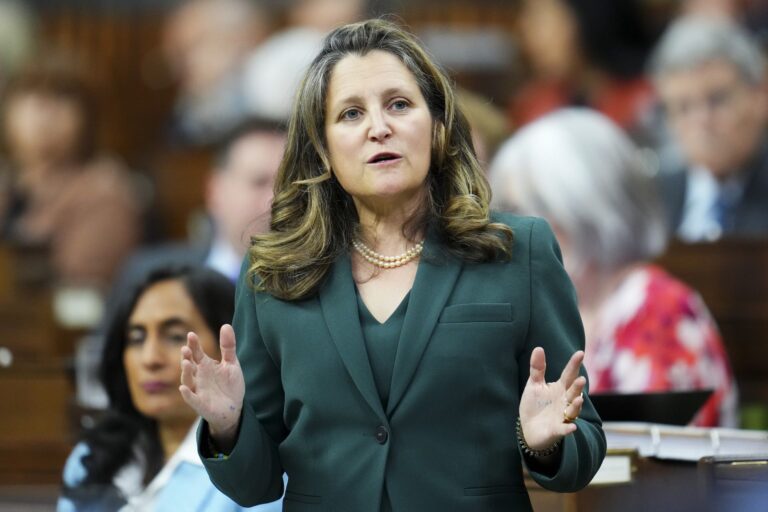
Finance Minister Chrystia Freeland at a news conference in Ottawa, in June 2024. Photo: The Canadian Press/Adrian Wyld
TORONTO—The federal government will make $26 billion in tax credits available to companies for research and development over the next six years as part of major reforms to Ottawa’s flagship R&D incentive program, Finance Minister Chrystia Freeland announced Friday afternoon.
The long-awaited reforms to the Scientific Research and Experimental Development program (SR&ED) include expanded eligibility criteria that will allow publicly-traded companies to claim 35 per cent of their R&D expenditures, up from the 15 per cent non-refundable credit they were previously entitled to.
Talking Points
- The long-awaited reforms to the Scientific Research and Experimental Development program include expanded eligibility criteria that will let publicly-traded companies claim 35 per cent of their R&D expenditures, up from the previous 15 per cent non-refundable credit
- Both public and private companies will be able to apply the refundable credit to more of their expenses, with the annual limit rising from $3 million to $4.5 million
Freeland made the announcement at the Toronto Stock Exchange.
Both public and private companies will be able to apply the refundable credit to more of their expenses, with the limit rising from $3 million to $4.5 million. And the government is allowing more firms to continue claiming the highest tax refund as they grow, by increasing the amount of taxable capital a company can have while still claiming the full refund.
The government is also bringing back a rule scrapped in 2014 that lets companies claim capital expenditures for their R&D. Since then, tax refunds were only available for spending on R&D itself and not for the cost of things like equipment needed for that work.
The changes will be part of the Liberals’ fall economic statement, to be released on Monday.
Andrew White, the CEO of biofuel company Char Technologies, said his firm had to sacrifice SR&ED credits when it went public on the TSX Venture Exchange in 2016—a challenge for a company that at the time generated little revenue. “It makes the decision to be able to leverage the Venture Exchange for access to capital easier when you don’t have to trade off some of these other incentives,” he said of the reforms.
Ottawa currently returns about $4 billion annually in R&D tax credits through the program. While the Liberal government originally said it would not spend more on SR&ED reforms, Friday’s announcement earmarks an additional $1.9 billion for the program over six years.
Related Articles

“A lot of Canada’s R&D relies on SR&ED today,” Freeland said, adding that the changes will make it “an even better source of support, particularly for innovative Canadian startups.”
Canadian tech founders have long complained that the SR&ED incentive is too difficult to access, with onerous paperwork that leads many to outsource the filing to consultants. Scale-ups have also said the type of work for which they can claim credit under the program is too limited.
Innovation leaders have also expressed concern about the kinds of companies receiving SR&ED paybacks. According to analysis by The Logic, big businesses—many of them foreign-owned—receive a disproportionate share of the program’s dollar value. On the other end of the scale, critics have argued, SR&ED props up “zombie” firms, companies that would otherwise fail due to a lack of revenue but stay in operation thanks to the program’s payouts.
The proposed changes have been a long time coming. The Liberals first promised to review the program in the April 2022 budget, finally launching consultations on changes this January.
Friday’s announcement did not include new restrictions on subsidiaries of foreign firms claiming the incentive, and will make it more valuable to larger firms by raising the taxable capital a company can have while claiming SR&ED. Nor did it provide updates on a related proposal to establish a patent box system, which would let companies pay a lower tax rate on profits generated by intellectual property they hold in Canada. Tech founders and groups have called for such a program to encourage Canadian firms to commercialize their workers’ ideas within the country.
“We had hoped to see the federal government take meaningful steps to stop subsidizing the R&D of foreign multinationals that contribute much less to the Canadian economy than homegrown companies,” said Council of Canadian Innovators president Benjamin Bergen in a statement, “and we had hoped that the government would bring more transparency to SR&ED.”
He added, “While this announcement is welcome, and it moves to address some of the specific issues that we have been talking about in recent years, it must be the beginning, not the end, of SR&ED reform.”



Loading...
Thanks for sharing!
You have shared 5 articles this month and reached the maximum amount of shares available.
CloseThis account has reached its share limit.
If you would like to purchase a sharing license please contact The Logic support at [email protected].
CloseGift the full article!
You have gifted 0 article(s) this month and have 5 remaining.
Recipients will be able to read the full text of the article after submitting their email address. They will not have access to other articles or subscriber benefits.
Photo: The Canadian Press/Adrian Wyld
Most Popular This Week



In-depth, agenda-setting reporting
Great journalism delivered straight to your inbox.
News
Canada’s landmark ESG case heads to a final decision
Briefing
Matthew Proud-led SPAC threatens to pull out of merger with UniUni
Ottawa awards Mitacs $162M to create AI-focused work placements
Ontario puts $30M into Vector Institute for AI adoption
Best business newsletter in Canada
Get up to speed in minutes with insights and analysis on the most important stories of the day, every weekday.
Exclusive events
See the bigger picture with reporters and industry experts in subscriber-exclusive events.
Membership in The Logic Council
Membership provides access to our popular Slack channel, participation in subscriber surveys and invitations to exclusive events with our journalists and special guests.