After nearly two years of relying on government grants, Tenomix co-founder and CEO Saumik Biswas decided in January 2023 that he needed venture capital to take the company to its next stage of growth. The timing wasn’t ideal. Rising interest rates and inflation had popped the VC bubble inflated during the pandemic. Many investors were waiting out the challenging market before betting on new startups. But determined to raise money, Biswas began pitching to investors.
Skip to content


 Saumik Biswas, CEO of Tenomix. Photo: Tenomix/Handout

Special Report
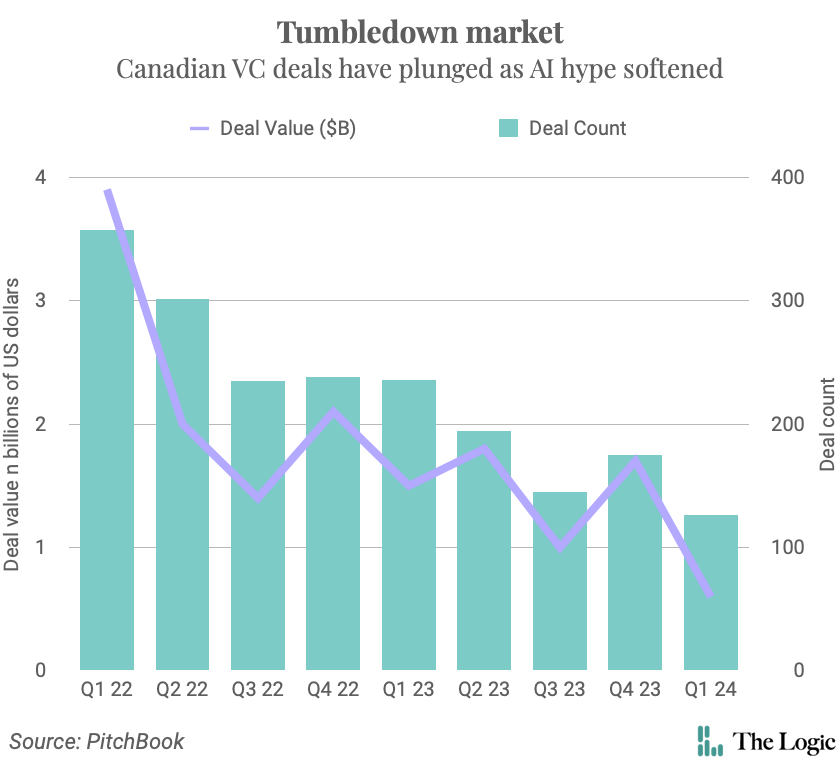
VC deal making plummets as AI hype softens
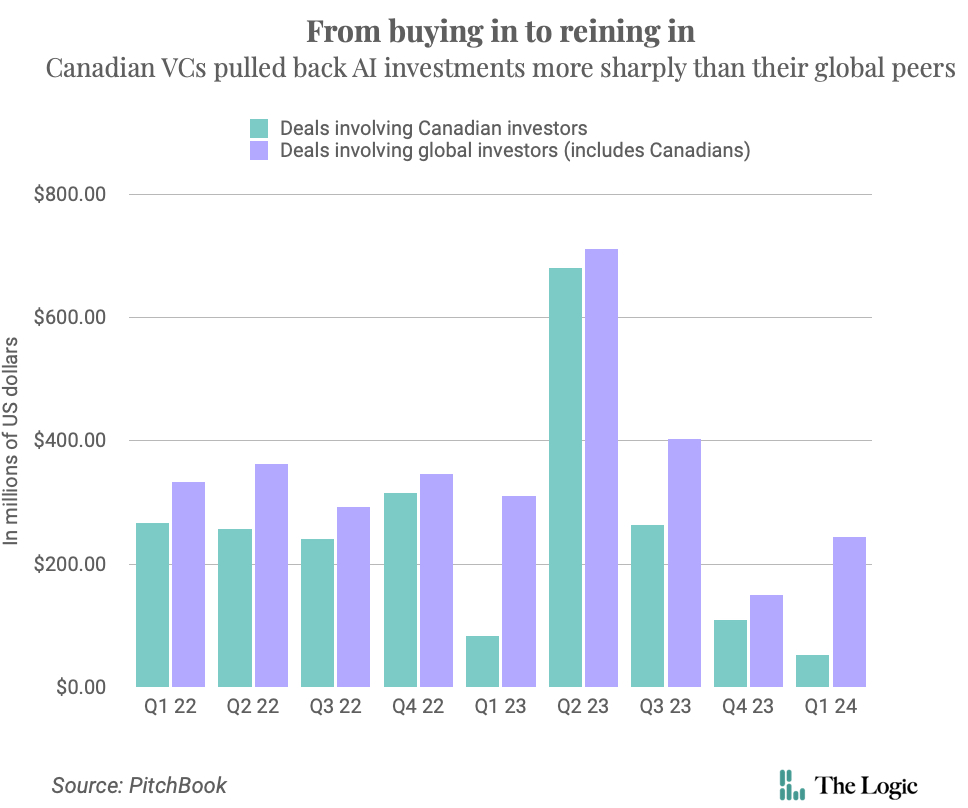
Canadian VCs have reined in AI investing far more than their global peers, data shows
Toronto's downtown Financial District, in September 2013. Photo: The Canadian Press/Nathan Denett
After nearly two years of relying on government grants, Tenomix co-founder and CEO Saumik Biswas decided in January 2023 that he needed venture capital to take the company to its next stage of growth. The timing wasn’t ideal. Rising interest rates and inflation had popped the VC bubble inflated during the pandemic. Many investors were waiting out the challenging market before betting on new startups. But determined to raise money, Biswas began pitching to investors.
“It was definitely not easy,” he said, after finally closing the seed round in February, more than a year after starting to fundraise. Biswas described the feat as almost a full-time job for him and his co-founder Eveline Pasman. That was on top of running Tenomix, a London, Ont.-based startup that’s building technology to automate part of the diagnostic process for colon cancer. The pair reached out to 205 investors over that period and logged 590 hours of meetings before closing the round.
Talking Points
- It’s been a challenging year so far for Canadian startups trying to raise money. Venture capital investing declined to about US$600 million in the first quarter, down from US$1.7 billion in the fourth quarter of 2023, according to the latest PitchBook data
- Tempered enthusiasm for AI and cleantech deals contributed to the drop
Biswas’ struggle to raise money in this market is reflected in data from PitchBook showing VC deal activity continued to decline in Canada over the past quarter. Data shared with The Logic shows startups and scale-ups raised about US$600 million across 126 deals in the first three months of the year. That’s down from US$1.7 billion the previous quarter and US$1.5 billion during the same period a year earlier.
Venture capital funding slowed substantially for much of the last two years in the wake of feverish investing activity in 2020 and 2021. Interest in generative AI helped boost deal making last year, particularly in Q2 when Canadian companies in the sector raised more than US$710 million, according to PitchBook’s most recent data on the sector.
But the initial hype around large language models—triggered by the launch of ChatGPT—has started to temper, VCs told The Logic. Investors are becoming more scrupulous about their artificial intelligence bets, which is translating to fewer dollars in the whole ecosystem. AI companies in Canada raised about US$245 million this year’s first quarter, PitchBook data shows.
Thomas Park, lead partner of BDC Capital’s Deep Tech Fund, said with many of the startups that pivoted to AI amid the hype early last year, “we’re not seeing much traction” with customers.
Part of the challenge for AI startups, said Park, is showing that their technology can’t easily be replicated with open-source data. “You need a unique data set or some really specific expertise in the industry.”
Related Articles


Park added that companies looking to implement AI in their business operations may get what they need from more established firms like Cohere or Anthropic, weakening demand for startups’ AI services.
Still, the data shows that AI represented a sizable share of overall funding in Q1 2024, and while investment activity is still below 2022 levels, AI companies raised more money in Q1 than in the last three months of 2023.
Canadian VCs have reined in AI investing far more than their global peers, according to PitchBook. They participated in 13 deals worth just US$52 million in Q1, down from about 26 deals worth US$110 million in Q4 2023. Their activity peaked in the second quarter of last year with 39 deals in which companies raised US$680 million.
Patrick Lor, Calgary-based managing partner at Panache Ventures, said his firm is still considering AI investments, but their approach to the sector has changed. “There’s definitely interest. I just think companies need to explain how it all comes together,” he said. “As you can imagine, everybody is adding ‘AI’ to their pitch decks.” Those getting meetings with investors, said Lor, are able to show how they built their products and what about them is proprietary.
Slower AI deal making isn’t solely responsible for last quarter’s tepid VC market. Funding for cleantech and climate tech—another bright spot on last year’s otherwise dismal investment landscape—has waned. Investors contributed just US$26.2 million to climate tech and cleantech startups in Q1, according to PitchBook, down from about US$360 million the previous quarter.
Startups in the sector have been coping with a funding freeze from Sustainable Development Technology Canada (SDTC), one of their major sources of early-stage capital. The federal government barred the arm’s-length granting agency from distributing funding last October amid conflict of interest concerns. Tom Rand, managing partner at climate-tech fund ArcTern Ventures, said that while SDTC’s freeze may impede raising for early-stage firms, the drop in cleantech investing is tied to the same market conditions weighing on startups across sectors.
Deal sizes overall have also become smaller, as investors focus on earlier-stage companies, said Park. Investment rounds in the US$1-million to US$10-million range—which are generally considered seed investments—accounted for about 37 per cent of deals in the first quarter of 2024, up from about 22 per cent a year earlier, according to PitchBook.
Park said the biggest drop in activity is at the stage immediately following that early round. “A lot of the companies that got seed funding in the last two to three years are not doing well. They’re not hitting their metrics,” he said. “In a lot of ways, the Series A pipeline isn’t very good.”
Many startups that raised money during the pandemic have since faced a challenging economy, with high interest rates weighing heavily on their businesses, said Park. Some have had to focus on cutting costs rather than hitting growth targets in revenue and sales. Startups outside AI may be facing more competition from Big Tech firms that are now offering more software solutions in-house, he added; for BDC Capital, that’s meant shifting investments to earlier-stage companies. Firms that do manage to meet their targets, however, are still attracting plenty of competition from investors to fund their next round, he said.
As investors keep holding out for exceptional deals, startups that were waiting for VC activity to pick up may finally be willing to negotiate their valuations, said Lor. Until recently, he said, “companies were still holding tough,” as they stretched investment money they brought in during the pandemic to avoid raising on terms that lowered their value.
Having recently been in a similar position, Biswas, the Tenomix CEO, urged fellow founders to practise patience. Establishing connections with investors well before your company needs cash is key, he said. “The pathway may take longer than expected,” he said. “Make sure you have enough runway … in case there’s any delays in the funding round—because anything can come up.”
Methodology
The numbers in this article are based on data provided by PitchBook, a research and analytics platform. PitchBook gathers information on the public and private markets from publicly available sources, including news reports, regulatory filings and press releases. Its research team conducts manual reviews to vet the data.
While the quarterly VC data is current as of publication, PitchBook may update it retroactively as more information on past deals becomes public later.



Loading...
Thanks for sharing!
You have shared 5 articles this month and reached the maximum amount of shares available.
CloseThis account has reached its share limit.
If you would like to purchase a sharing license please contact The Logic support at [email protected].
CloseGift the full article!
You have gifted 0 article(s) this month and have 5 remaining.
Recipients will be able to read the full text of the article after submitting their email address. They will not have access to other articles or subscriber benefits.
Photo: The Canadian Press/Nathan Denett
Saumik Biswas, CEO of Tenomix.
Most Popular This Week



In-depth, agenda-setting reporting
Great journalism delivered straight to your inbox.
News
Takeovers are shifting control of Canadian firms abroad, survey shows
Briefing
OMERS posts 4.8% first-half return, plans to increase Canada exposure
Brookfield joins investors group backing Nvidia’s US$500B AI financing push
Polar raises US$215M for second Canadian risk-transfer fund
Best business newsletter in Canada
Get up to speed in minutes with insights and analysis on the most important stories of the day, every weekday.
Exclusive events
See the bigger picture with reporters and industry experts in subscriber-exclusive events.
Membership in The Logic Council
Membership provides access to our popular Slack channel, participation in subscriber surveys and invitations to exclusive events with our journalists and special guests.