About one in five respondents to The Logic’s latest survey said they have fallen for digital scams, most commonly from bogus callers claiming to represent the Canada Revenue Agency or other government institutions.
Skip to content
 A number of Logic survey respondents commented that they believe the rise in digital scams is due to increased use of AI, and easier access to personal information. Photo: Chris Delmas/AFP via Getty Images

Subscriber Survey
How Logic readers are dealing with the rise in digital fraud
‘I’ve been extremely diligent, but they’re getting increasingly sophisticated’
A number of Logic survey respondents commented that they believe the rise in digital scams is due to increased use of AI, and easier access to personal information. Photo: Chris Delmas/AFP via Getty Images
About one in five respondents to The Logic’s latest survey said they have fallen for digital scams, most commonly from bogus callers claiming to represent the Canada Revenue Agency or other government institutions.
Financial losses to fraud in the country totalled some $569 million in 2023, according to the Canadian Anti-Fraud Centre. That’s up from $531 million in 2022.
Examples of scams that The Logic subscribers said they have fallen victim to included everything from clicking on malicious links to responding to a fake CRA email with a social insurance number. One person said they sent two e-transfer payments after a contractor’s email account was hacked.
“I was very, very close to forking over a large sum of money for fake T Swift tickets,” another subscriber wrote.
Related Articles


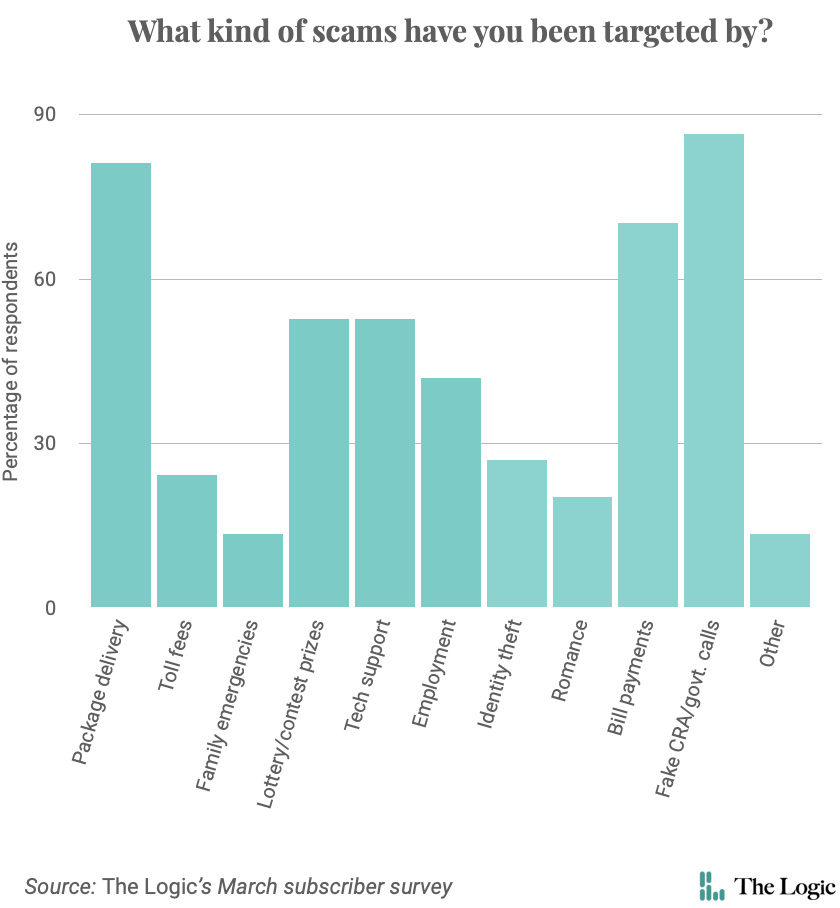
Other top scams that respondents to The Logic’s survey said they have been targeted by include package delivery schemes (81 per cent) and fake requests for bill payments (70 per cent).
“The fake delivery scams in particular seem to be increasing in frequency,” one subscriber said. “I get at least one per day now, sometimes two. Now all I do is block them immediately without even looking further into what they may be.”
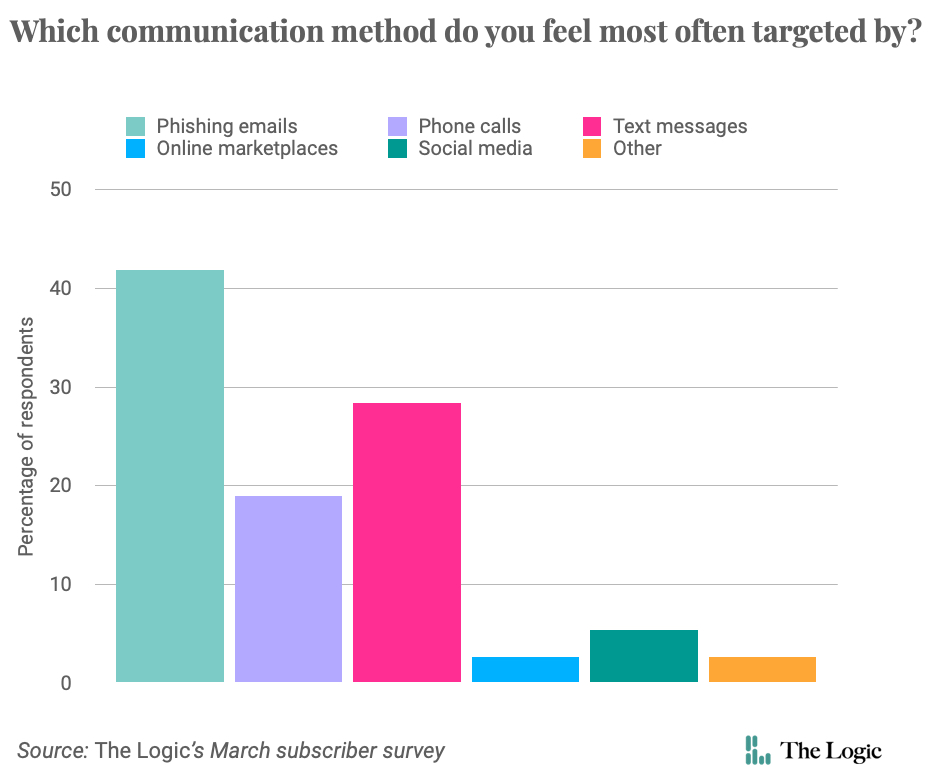
When asked which communication method they felt most often targeted by, most respondents said phishing emails (42 per cent), then texts (28 per cent), with phone calls coming in third (19 per cent). Several subscribers said they no longer answer phone calls if they don’t recognize the callers.
“I’ve actually missed legitimate communication due to suspicion,” one commented.
One subscriber noted that phishing emails seem less obviously bogus than fraud attempts via social media, phone calls or texts. Another said they’ve noticed upticks in phishing emails when they sign up for new email lists or around the same time they hear about other data breaches.
An upswing in fraudsters’ use of artificial intelligence and the increased digitization of personal information may also be to blame, a number of respondents said.
“AI and other tools make it easier to scale, iterate and customize. Companies and governments have allowed and not remediated the fact that the vast majority of everyone’s [personal identifiable information] is accessible to scammers,” one subscriber wrote.
“I think that AI is likely helping to craft more realistic looking messaging,” said another. “Before, the language used was often a dead giveaway, but the language is getting better and better.”
Others said the fast-paced innovation of AI makes them worry they could fall victim to a scam even if they haven’t in the past.
“I’ve been extremely diligent, but they’re getting increasingly sophisticated,” a respondent wrote.
Many subscribers also commented that Canada could improve regulations and impose greater consequences on perpetrators of online scams.
About 30 per cent said the government bears the most responsibility for stopping digital fraud. Most respondents (44 per cent) said it’s primarily up to individuals to protect themselves.
Some subscribers wrote that though government, businesses and financial institutions should provide education and set appropriate policies, individuals must ultimately be skeptical and diligent to protect their finances.
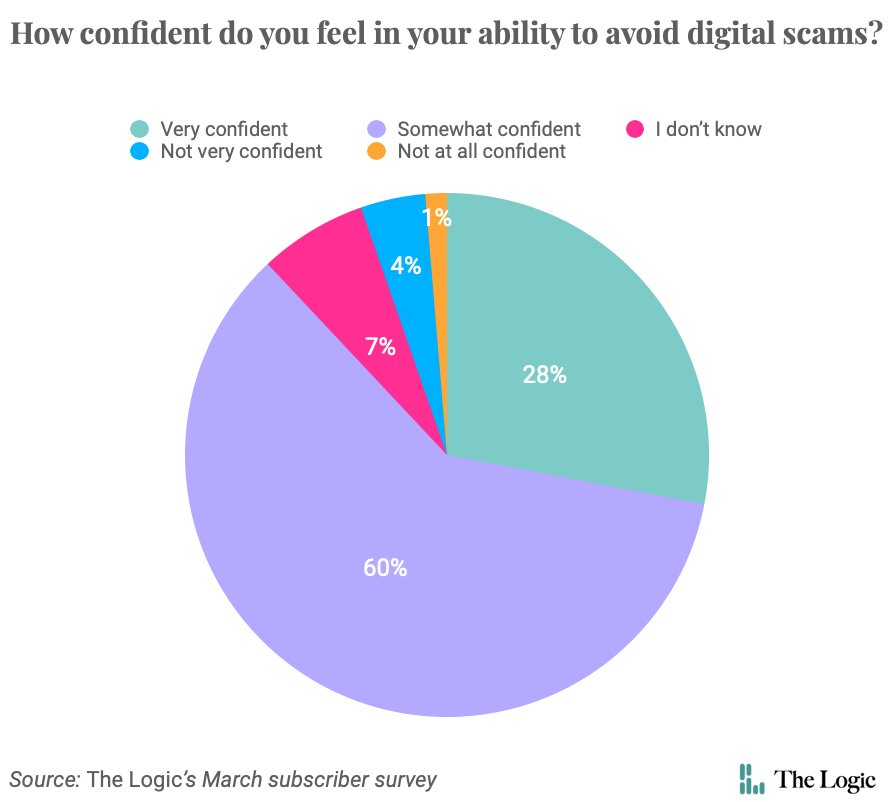
And most respondents said they’re either somewhat (60 per cent) or very confident (28 per cent) in their abilities to identify potential frauds now.
“I am the rock that employment scammers break upon. I welcome the challenge,” one respondent said.
“Everyone knows the legit channels they use. If it’s not something that I set up and use frequently, it’s a scam—plain and simple,” said another.
Editor’s note: Data from the Canadian Anti-Fraud Centre has been updated with figures released after this story was sent to production.
Methodology
The Logic emailed subscribers a private link to an online survey on March 25 and the survey closed March 27. Respondents’ identities were kept anonymous. Subscribers were first asked, “Have you ever fallen for a digital scam?” and could answer: “Yes” or “No.” They were then asked, “Which communication method do you feel most often targeted for fraudulent schemes?” and could select: “Phishing emails,” “Phone calls,” “Text messages,” “Online marketplaces,” “Social media” or “Other.” Next, they were asked, “What kind of scams have you been targeted for, if at all?” and could choose: “Package delivery scams,” “Toll fee scams,” “Fake family emergencies,” “Lottery or contest prize scams,” “Tech support scams,” “Employment scams,” “Identity theft,” “Romance scams,” “Fake bill payments,” “Fake calls from the CRA or other government institutions” or “Other.” They were also asked, “Who bears the most responsibility in digital fraud prevention?” and could select: “Individuals,” “Government,” “Financial institutions” or “Businesses.” Next, respondents were asked, “How confident do you feel in your ability to avoid potential digital scams?” and could select: “Very confident,” “Somewhat confident,” “I don’t know,” “Not very confident” or “Not at all confident.” After each question, respondents could add written comments if they chose. Finally, respondents were asked, “Why do you think digital scams are on the rise?” and could leave a written comment.
Loading...
Thanks for sharing!
You have shared 5 articles this month and reached the maximum amount of shares available.
CloseThis account has reached its share limit.
If you would like to purchase a sharing license please contact The Logic support at [email protected].
CloseGift the full article!
You have gifted 0 article(s) this month and have 5 remaining.
Recipients will be able to read the full text of the article after submitting their email address. They will not have access to other articles or subscriber benefits.
Photo: Chris Delmas/AFP via Getty Images
Most Popular This Week




In-depth, agenda-setting reporting
Great journalism delivered straight to your inbox.
News
Canada gets low returns from events like the World Cup. Ottawa wants to know why
Briefing
Nokia to spin out space communications business through Canadian SPAC deal
Ontario police aren’t reporting spyware use, senior privacy official warns
Magna founder Stronach found guilty of indecent and sexual assault
Best business newsletter in Canada
Get up to speed in minutes with insights and analysis on the most important stories of the day, every weekday.
Exclusive events
See the bigger picture with reporters and industry experts in subscriber-exclusive events.
Membership in The Logic Council
Membership provides access to our popular Slack channel, participation in subscriber surveys and invitations to exclusive events with our journalists and special guests.