Canada’s claim to AI fame comes from a core group of computer scientists whose work over the years helped establish the field today. But a new analysis suggests the country may be starting to slip in the research race. Here’s what you need to know:
Skip to content
 Canada may be losing some of AI’s leading researchers, a new analysis by think tank MacroPolo found. Photo: Roger Lemoyne for The Logic

News
Canada may be losing ground in AI research race, analysis suggests
More top researchers in the field leaving Canada, think tank study shows
Canada may be losing some of AI’s leading researchers, a new analysis by think tank MacroPolo found. Photo: Roger Lemoyne for The Logic
Canada’s claim to AI fame comes from a core group of computer scientists whose work over the years helped establish the field today. But a new analysis suggests the country may be starting to slip in the research race. Here’s what you need to know:
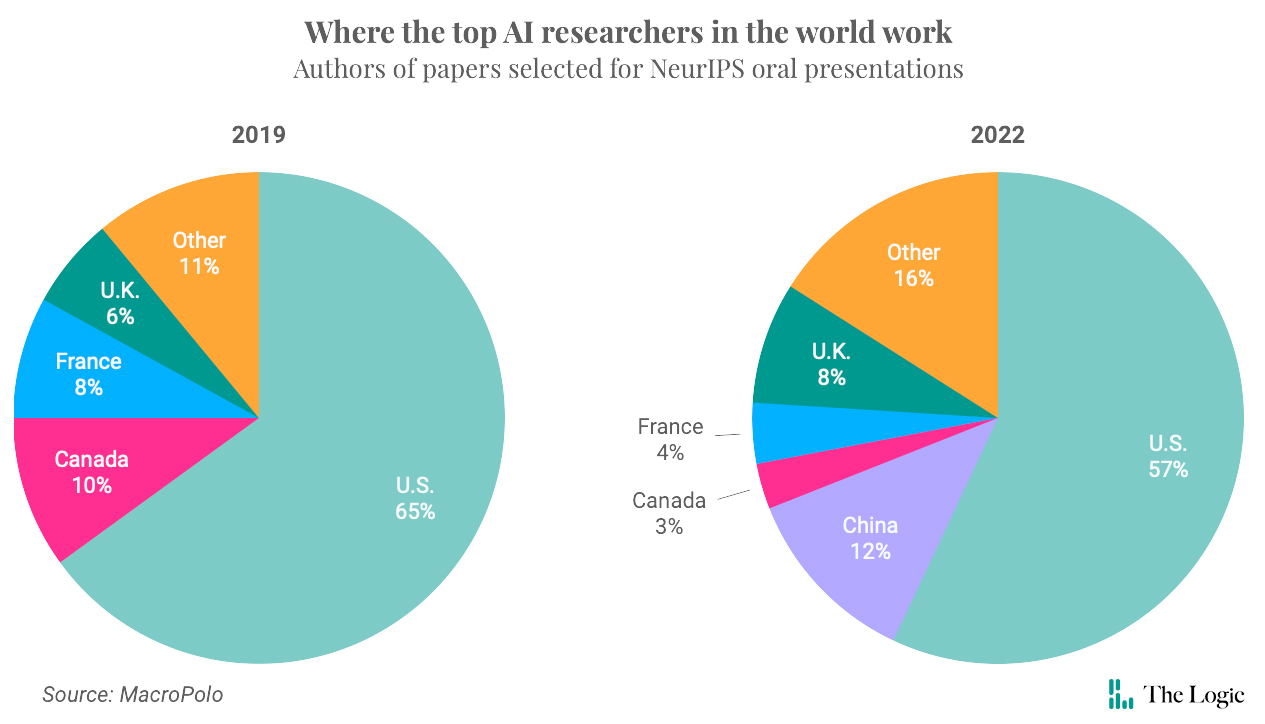
Taking it from the top: In 2019, 10 per cent of the “most elite” two per cent or so of AI researchers were based in Canada, according to calculations by MacroPolo, a branch of the Chicago-based Paulson Institute think tank. In 2022, it was three per cent. The U.S. was by far the biggest site of top-tier talent in the field, with 65 per cent and 57 per cent, respectively, in those years.
MacroPolo’s analysis is based on the number of authors of papers presented at NeurIPS, a long-running artificial intelligence and machine learning conference where some of the field’s most influential discoveries made their debuts. The think tank’s “most elite” category consists of researchers whose work was selected for oral presentations.
Flow-through talent: MacroPolo’s figures suggest Canada remains a net importer of top AI researchers—two per cent of the people it identified completed their undergraduate degrees in this country, compared to the three per cent who wrote their prestigious papers here.
But the think tank’s analysis also indicates the country is losing some of AI’s leading minds. It estimates 37.5 per cent of the top researchers who did their graduate studies were still in Canada as of 2022, compared to 43.8 per cent who worked in the U.S. Its 2019 data showed that half had stayed in Canada and a quarter had moved to the U.S.
Related Articles


Firms and institutions across the border have long drawn on Canada’s AI ecosystem to recruit talent. In early 2017, fears of brain drain in the field led tech and academic leaders to lobby policymakers for funding to train and retain AI researchers. Ottawa responded with the Pan-Canadian AI Strategy (PCAIS), a now $568.8-million effort to help universities hire and keep accomplished professors and commercialize more of their innovations. They’ve in turn trained thousands of students. Still, the massive AI interest sparked by generative systems has renewed brain drain concerns.
Dig deeper: The MacroPolo data is really a story about China, said Elissa Strome, executive director for the PCAIS at CIFAR, the Toronto-based research organization. The share of elite AI talent based in the country jumped from a negligible amount in 2019 to 12 per cent in 2022. (Changes in Chinese researchers’ participation in NeurIPS may account for some of the shift.)
Stromme said the MacroPolo results may paint a partial picture. Still, “there is an important message for Canada here: we can’t let up in our efforts to both recruit and retain talent,” she said. “Global competition is fierce.”
Correction: An earlier version of this story’s chart had incorrect data for AI researchers in the Canada and Other categories. It has been updated with the correct figures.



Loading...
Thanks for sharing!
You have shared 5 articles this month and reached the maximum amount of shares available.
CloseThis account has reached its share limit.
If you would like to purchase a sharing license please contact The Logic support at [email protected].
CloseGift the full article!
You have gifted 0 article(s) this month and have 5 remaining.
Recipients will be able to read the full text of the article after submitting their email address. They will not have access to other articles or subscriber benefits.
Photo: Roger Lemoyne for The Logic
Most Popular This Week




In-depth, agenda-setting reporting
Great journalism delivered straight to your inbox.
Commentary
Carmichael: Canadian ignorance about India is a strategic weakness
Briefing
Aritzia shares pop after earnings rise 204%
First Nation in Alberta goes to court over fast-tracked oil pipeline
Chinese EV maker Geely Auto Group to launch in Canadian market in 2027
Best business newsletter in Canada
Get up to speed in minutes with insights and analysis on the most important stories of the day, every weekday.
Exclusive events
See the bigger picture with reporters and industry experts in subscriber-exclusive events.
Membership in The Logic Council
Membership provides access to our popular Slack channel, participation in subscriber surveys and invitations to exclusive events with our journalists and special guests.





