The country’s preeminent research and development funding program continues to benefit big companies disproportionately, new data shows, though the gap between big and small firms has narrowed in recent years.
Skip to content



The Big Read
Flagship R&D tax credit still rewards large firms disproportionately, though new data shows gap is narrowing
Federal government reviewing SR&ED program long criticized by Canadian entrepreneurs
Photo: Illustration by John Hemminger
The country’s preeminent research and development funding program continues to benefit big companies disproportionately, new data shows, though the gap between big and small firms has narrowed in recent years.
The Scientific Research & Experimental Development credit—commonly known as SR&ED, and pronounced “shred”—sees the federal government forgo between $3 billion and $4 billion in tax revenue in a typical year to help companies cover their research expenses. The program is meant to incentivize firms—from local startups to foreign conglomerates—to innovate and build new products in Canada.
Talking Points
- Large companies still claim a disproportionate share of the tax credits offered under SR&ED, the federal government’s flagship research and development incentive program
- However, new data shows the value of credits claimed by large firms is declining
- Canadian entrepreneurs have long criticized the program for supporting large foreign companies at the expense of domestic firms
SR&ED has long been a target for criticism from some of Canada’s leading entrepreneurs, who argue it supports big foreign companies at the expense of those headquartered domestically. The federal government has recently begun a review of the program, which has existed in one form or another since the Second World War and which was last overhauled in 2012.
Through SR&ED, companies can claim a refundable tax credit on expenses like researchers’ wages and materials used in research and development. Private Canadian companies can generally claim a 35 per cent refundable tax credit on up to $3 million of these expenses, while public and foreign companies can collect a 15 per cent non-refundable credit on R&D expenses for work done in Canada. There’s no cap on the amount of spending against which they can claim.
Though SR&ED is a multibillion-dollar program, Ottawa discloses little information about the program’s recipients or its economic impacts.
The Logic’s 2018 analysis of data from 2013 to 2017 showed that the lion’s share of money from the incentive program went to large companies, many of which were headquartered outside Canada. That reporting followed an internal government report, a copy of which The Logic obtained, in which entrepreneurs and business leaders criticized SR&ED for being onerous to apply for and for its poorly defined objectives, which they said made it ripe for exploitation.
Related Articles

New data from the Canada Revenue Agency reveals a shift in the types of companies that benefit most from the program, though the biggest companies still have a relative edge.
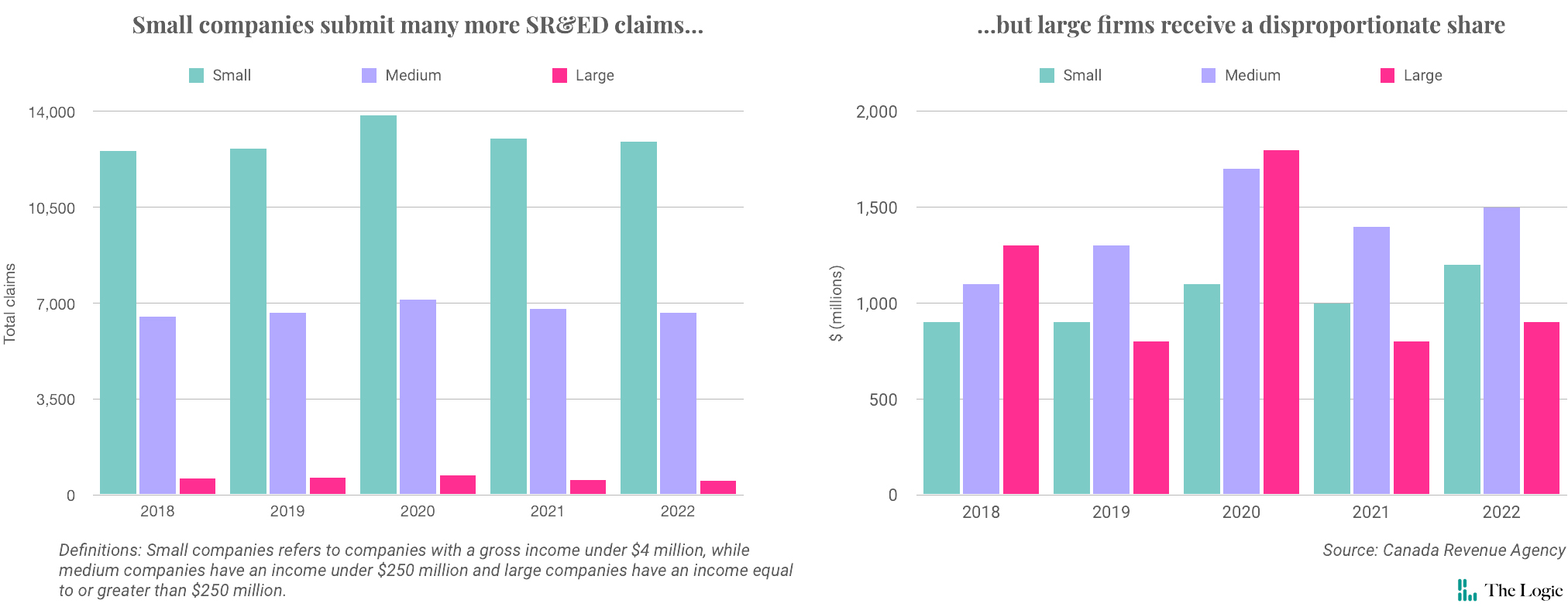
Large companies—those earning gross income of at least $250 million—received an average total of about $1.1 billion in SR&ED credits each year from 2018 to 2022, the CRA data shows. That’s down from an average total of $1.6 billion in each of the previous five years. In 2021 and 2022, the last two years in which data is available, large companies received an average total of less than $1 billion annually in SR&ED credits.
Small and medium-sized businesses collected an average total of $2.4 billion from SR&ED each of the last five years—slightly more than in the previous five years, when they collected an average $2.2 billion each year.
However, far more small companies than large ones apply for SR&ED—nearly 13,000 small companies collected credits in 2022 compared to just over 500 large ones—meaning large companies claim a disproportionate share of the program’s dollar value.
David Douglas, a principal at Ryan, LLC, where he helps companies claim SR&ED and other government incentives, said the numbers reflect what he’s seen in his own business, particularly since the COVID-19 pandemic.
CRA’s data shows a spike in R&D credits paid to large companies in 2020–21, when they collected $1.8 billion. That was in part because CRA was pushing through a backlog of credits, said Douglas, but also because of corporate windfalls like Ottawa’s emergency wage subsidy program. That government support, coupled with historically low interest rates and a robust investment landscape, enticed many large companies to spend big on research and development, said Douglas.
The following two years, however, SR&ED claims among large firms dropped by more than half, as rising interest rates and an end to pandemic relief programs prompted companies to reel in spending.
The recent shift in SR&ED dollars away from large companies is an incidental reaction to market and other government initiatives, and has nothing to do with changes to the tax incentive itself, Douglas said.
“[It’s] not for a lack of dollars being spent. It’s the efficiency within which they’re being used.”
Companies that rely on the credits, and the lobbyists who represent them, say SR&ED needs to be overhauled to ensure that, by design, it benefits Canadian companies that are helping grow the economy.
Overall R&D spending by Canadian firms is relatively low compared to its G7 peers, which is “turning us into laggards” in innovation, said Council of Canadian Innovators president Ben Bergen. “That’s not for a lack of dollars being spent,” he said. “It’s the efficiency within which they’re being used.”
A commonly cited concern with so much of the credits going to large companies is that many of them tend to be foreign owned. “We know that of the big business population, there’s a substantial amount of spending [on] foreign R&D,” said Robin Shaban, co-founder of the Canadian Anti-Monopoly Project, a think tank that advocates for antitrust policies.
The most recent data from the Research Infosource ranking of companies based on R&D spending shows the top 100 companies spent roughly between $13 billion and $16 billion a year on research and development from 2020 to 2022 in Canada, of which foreign firms accounted for between 19 per cent and 22 per cent on average.
Most of those companies would be eligible for SR&ED, said Douglas. Huawei Canada, for instance—which spent about $320 million on R&D in 2020, the last year it logged such spending in the country—disclosed in a 2019 report that it had collected $103 million from the incentive program to that point.
“Is this R&D actually translating into intellectual property or other commercializable products or services that are contributing to Canadian wealth?” said Shaban. “Or is this a tax credit that’s being used to fund or support intellectual property development outside of Canada?”
CRA spokesperson Aaron Martin told The Logic the agency does not track whether SR&ED recipients are based in Canada or elsewhere. “Having a business be headquartered in Canada is not one of the eligibility requirements of the SR&ED tax incentive program,” Martin said in an email.
Ottawa is now exploring questions about SR&ED’s economic impact in Canada in its long-awaited program review. In January, the government began consultations on “cost-neutral ways to modernize” the program. “The purpose of the consultation is to hear directly from Canadian businesses, including smaller businesses and innovators, about how to better target SR&ED to ensure Canada is a leader in R&D, innovation, and commercialization,” Department of Finance spokesperson Caroline Thériault told The Logic by email.
The Finance Department is specifically soliciting input on how the program can help retain IP in Canada, “particularly to support innovative Canadian businesses to remain Canadian owned and operated,” reads its call for comments, which is open until April 15.
Kyle Briggs, CEO and co-founder of biotech firm Northern Nanopore—which was acquired by U.K.-based Oxford Nanopore Technologies in November—said SR&ED doesn’t currently incentivize economic outputs like generating IP and keeping it in Canada. “These subsidiaries of multinationals, there should be a careful look at that eligibility there to make sure that IP is developed in such a way that it’s actually benefiting the country that’s subsidizing it.”
Bergen said the SR&ED review should focus broadly on updating the program from a jobs strategy to an innovation economy strategy. “If you’re supporting large foreign multinationals which use it for R&D within the country,” he said, “what you’re essentially doing is creating jobs for some large companies but the actual ideas that they’re generating, and the money they can seek from them as rents, leave the country and go to other jurisdictions.”
Douglas, meanwhile, said disincentivizing large foreign companies is “ironic,” given the program has been a tool to bring jobs and foreign investment to the country. “But for the credit, would that R&D happen in Canada?” he said. “I’m not sure.”
Correction: The 35 per cent SR&ED tax credit for private companies is refundable on up to $3 million. The 15 per cent credit for public and foreign companies is non-refundable. This story has been updated.



Loading...
Thanks for sharing!
You have shared 5 articles this month and reached the maximum amount of shares available.
CloseThis account has reached its share limit.
If you would like to purchase a sharing license please contact The Logic support at [email protected].
CloseGift the full article!
You have gifted 0 article(s) this month and have 5 remaining.
Recipients will be able to read the full text of the article after submitting their email address. They will not have access to other articles or subscriber benefits.
Photo: Illustration by John Hemminger
Most Popular This Week




In-depth, agenda-setting reporting
Great journalism delivered straight to your inbox.
The Big Read
Beacon is building an AI empire by fixing Main Street’s software
Briefing
Inovia raises US$200M for new VC fund as it eyes AI’s impact
43% of eligible Albertans voted ahead of Monday’s referendum
AI chip company Tenstorrent raises US$1.5B, valuing it at US$6.2B
Best business newsletter in Canada
Get up to speed in minutes with insights and analysis on the most important stories of the day, every weekday.
Exclusive events
See the bigger picture with reporters and industry experts in subscriber-exclusive events.
Membership in The Logic Council
Membership provides access to our popular Slack channel, participation in subscriber surveys and invitations to exclusive events with our journalists and special guests.







